
All About Tuxedo Cats: The Coat, the Myths, and the Famous Ones
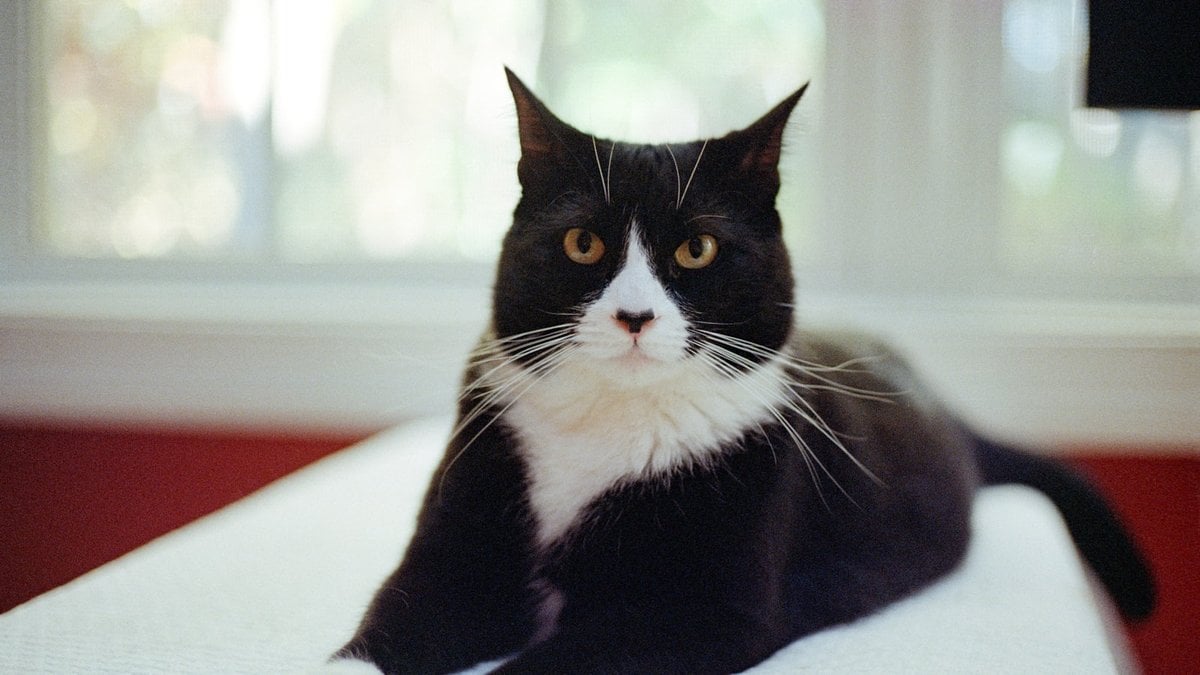
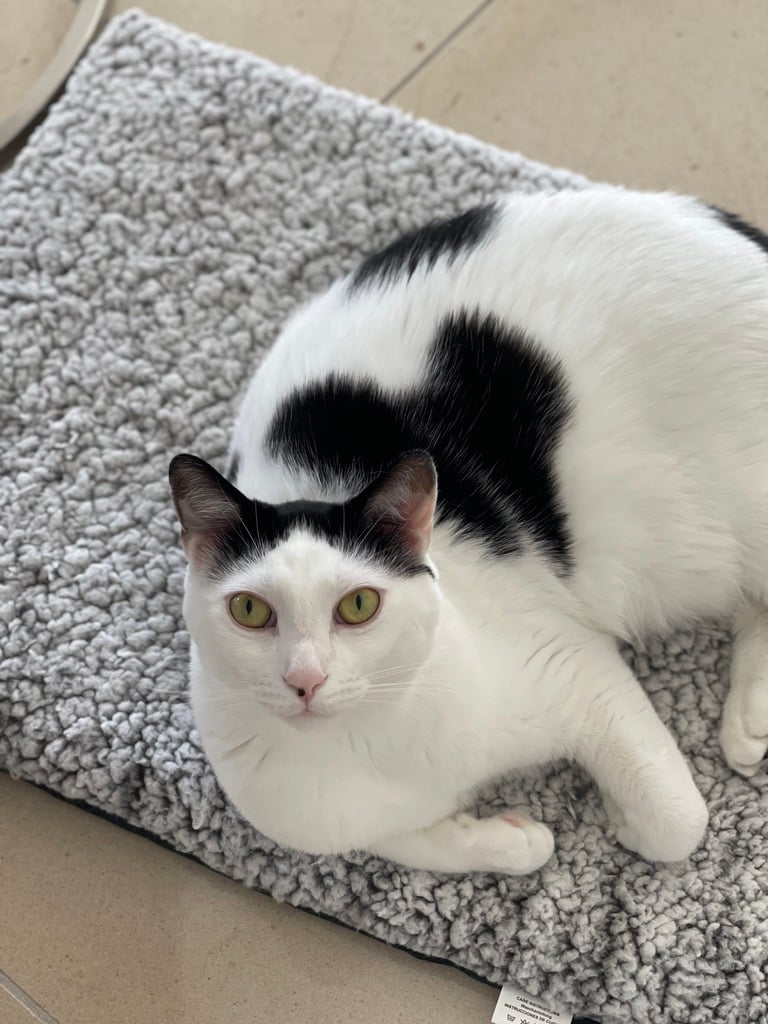
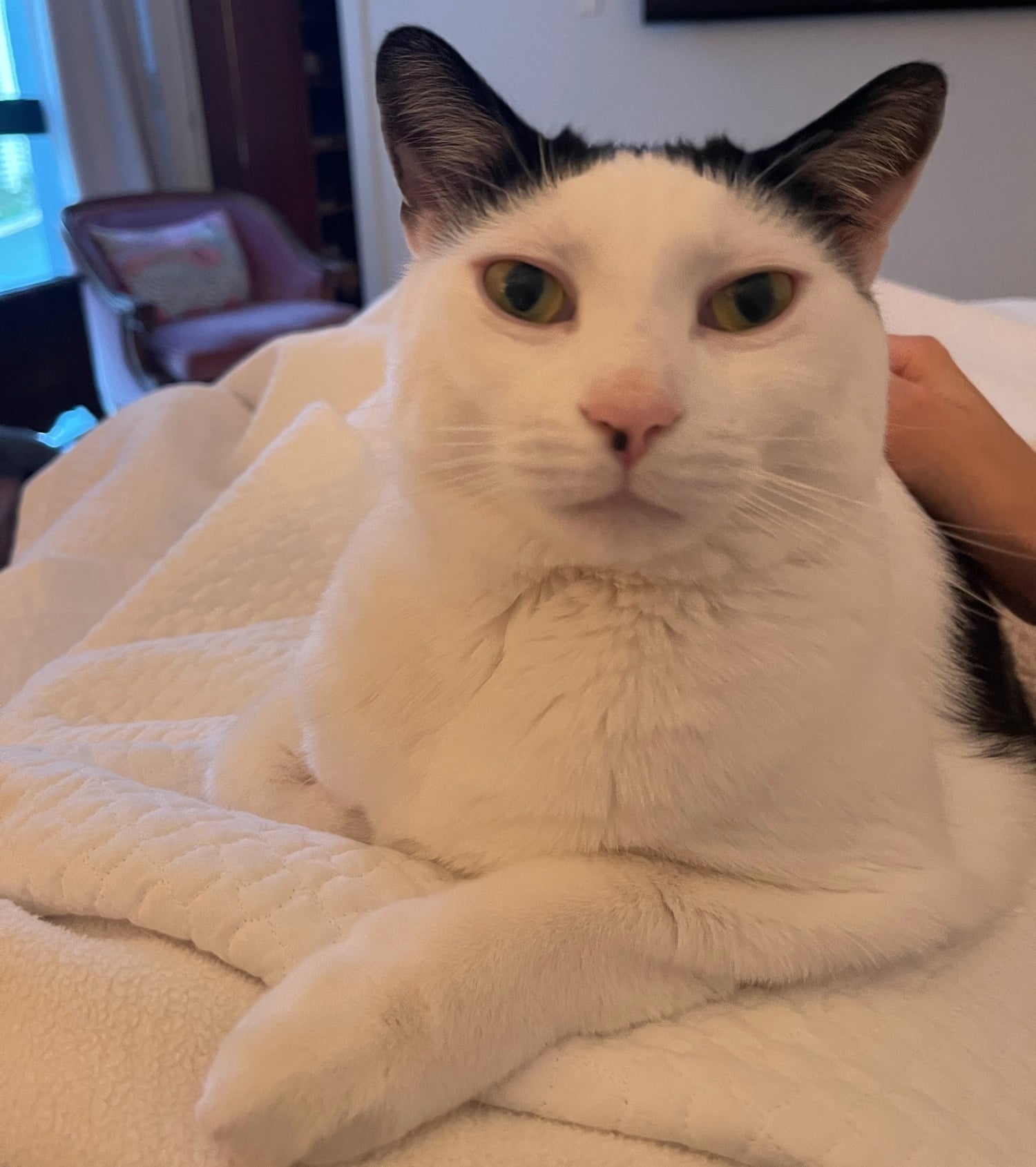
One of our two cats, Louis, is black and white, and for years I called him a tuxedo without thinking twice about it. Then I actually looked into it, and it turns out he isn’t really a tuxedo at all. He’s mostly white with black patches, black over the ears and around the eyes, split by a white blaze down the middle of his face, and a couple of big spots down his back, which puts him further up the white-spotting scale (which means he’s just got a lot more white than a real tuxedo does). But he’s exactly what got me curious, because most of what I’ve seen written talks a lot about personalities and history, and it seemed, well, not true. So I wanted to investigate.
First, the thing everyone gets slightly wrong: it’s not a breed
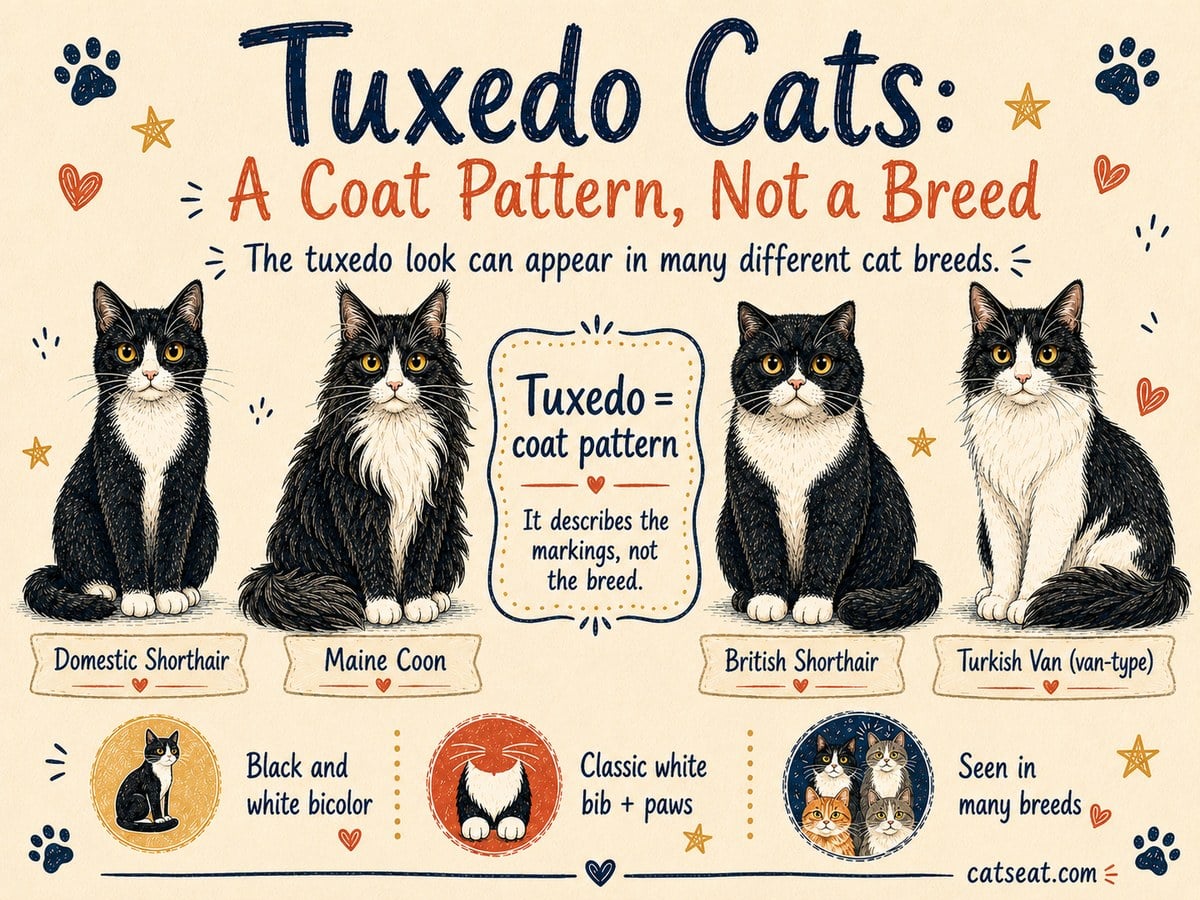
There is no such thing as a tuxedo breed. “Tuxedo” describes a coat pattern, a black-and-white bicolor with the white landing on the chest, belly, paws, and often the chin, so the cat looks like it’s wearing formalwear. That pattern can show up in all kinds of cats: your average domestic shorthair from a shelter, sure, but also Maine Coons, British Shorthairs, American Shorthairs, Turkish Vans, and plenty of others. When someone says they have a tuxedo cat, they’re telling you what their cat is wearing, not what breed it is.
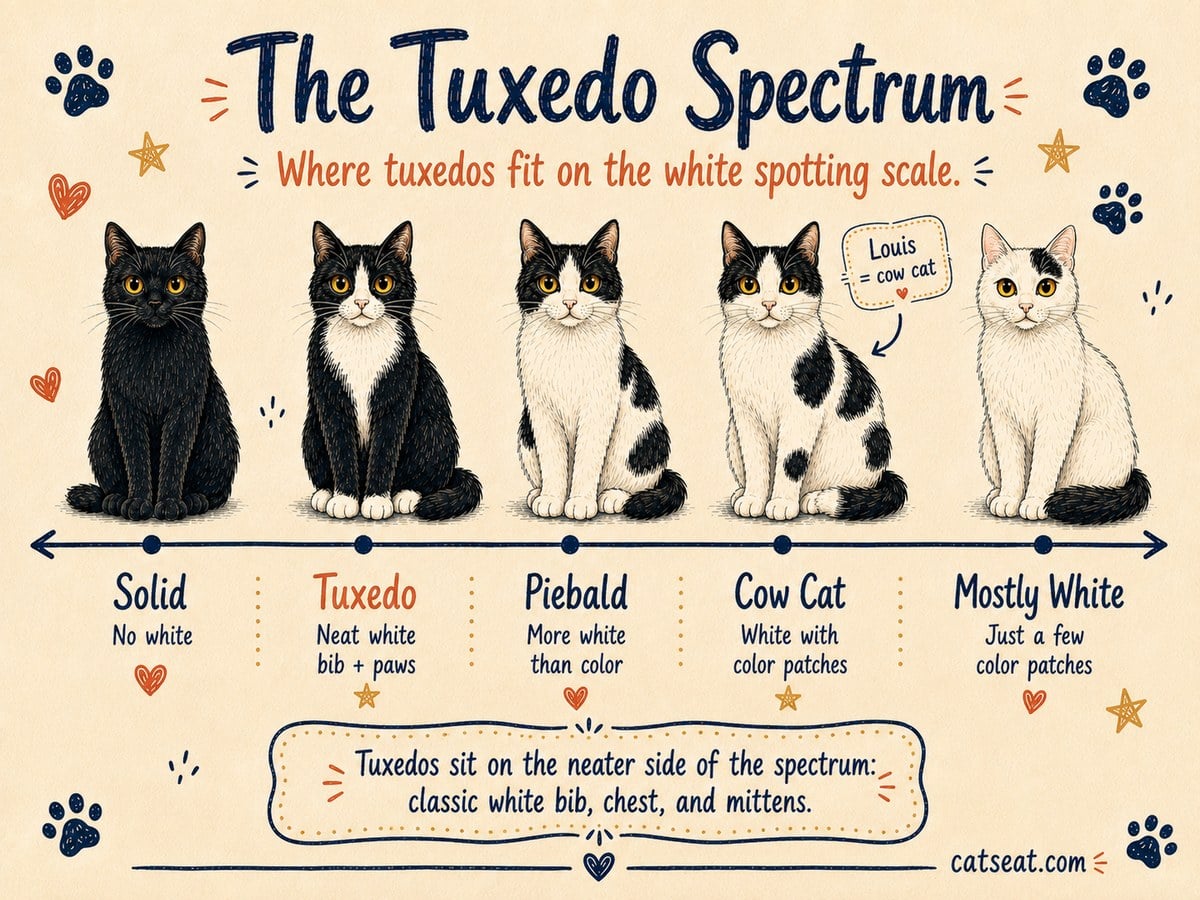
The “tuxedo” is really just a low-key version of what geneticists call white spotting, a small amount of white on an otherwise solid-colored cat. Add more white and you slide up a scale toward the “cow cat” look, then toward a mostly-white cat with a few colored patches. The classic tuxedo sits near the tidy end of that range: mostly colored, with a crisp white bib and mittens.
Why the white is where it is
OK, we’re about to get technical! This is the part I find great, and it comes from a 2016 study out of the Universities of Edinburgh and Bath, published in Nature Communications. For a long time, scientists assumed pigment cells in a developing kitten migrated in some organized, directed way to color the whole animal. This study found the opposite. The pigment cells actually spread by moving more or less at random while the embryo grows, multiplying and drifting as they go.
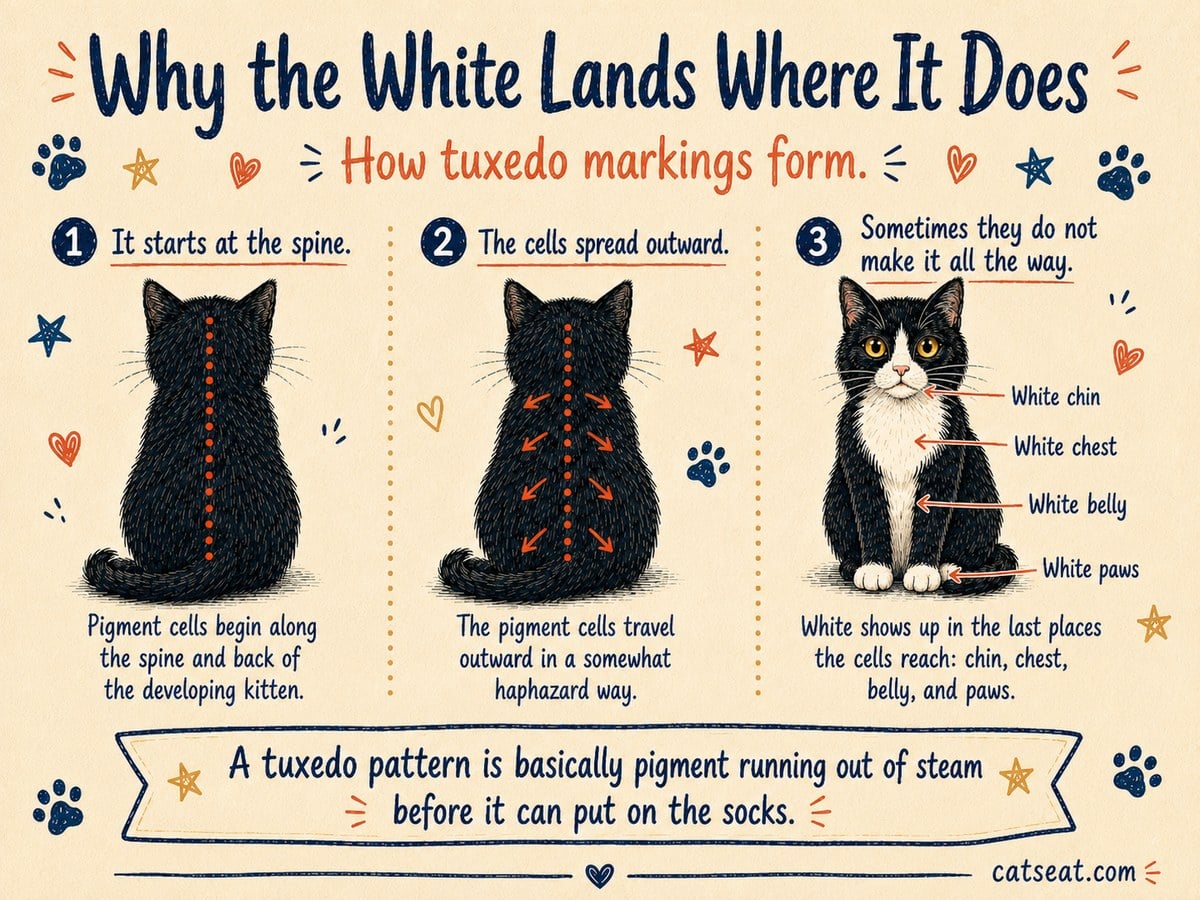
Here’s why that produces a tuxedo. Those pigment cells start out near the back and spine, and the very last places they reach, if they reach them at all, are the chest, belly, paws, and chin. When a common mutation slows the cells down so there aren’t quite enough of them to cover the whole cat, the spots they never quite reach are exactly those extremities. The result is color on the back and head, white where the cells ran out. That’s your tuxedo: not a design, just pigment cells running out of gas right before they got to the socks.
the genetics, and why male tuxedos are not rare
White spotting traces to the KIT gene, and unlike the orange coloring that makes calicos almost always female, KIT sits on a regular chromosome, not a sex chromosome. This also settles a common mixup: tuxedo cats are split roughly fifty-fifty male and female, which makes a male tuxedo just as common as a female. (Compare that to a male calico, which turns up about once in 3,000 cats because calico color is sex-linked.) So if anyone tells you a male tuxedo is rare or special, they’ve confused two totally different pieces of cat genetics.
About that famous “tuxedo personality”
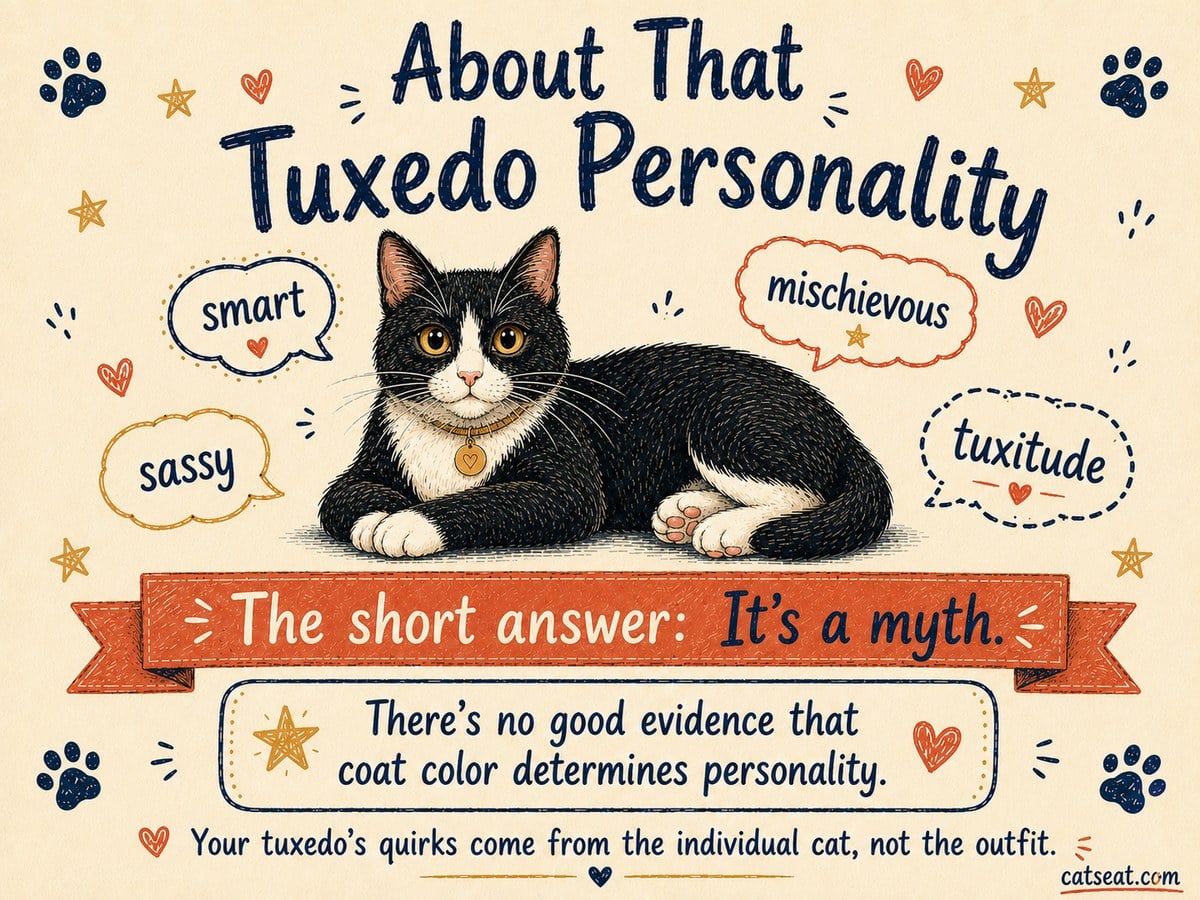
If you have a tuxedo cat with an outlandish personality, I have good and bad news for you. The bad news? Telling your friends your tuxedo cat is THAT way because it’s a tuxedo is, well, probably wrong. The good news? They have that amazing personality because that’s just how THEY are!
There’s no scientific evidence that coat color or pattern predicts personality in cats, and none at all for a distinct tuxedo temperament. The studies that do exist on color and behavior are narrower than people think. A 2015 UC Davis survey found that owners reported slightly more attitude from tortoiseshell and calico cats during things like vet handling, which is where the whole “tortitude” idea comes from, but the effect was small, based on owner impressions, and swamped by plain individual variation. And a separate study out of UC Berkeley found something telling: people assign personality traits to cats based on coat color, whether or not the cats actually differ. So a good chunk of “tuxedo personality” may be us seeing what the tuxedo led us to expect.
My own black-and-white cat is certainly a character, but then again, I have an orange-and-white who is just as full of herself in her own right. Tuxedo fans aren’t wrong about the personality they see; they’re just responding to the cat, not the suit. As the internet has it:
While we’re clearing things up: two more myths
You’ll see it claimed that tuxedo kittens open their eyes a day earlier than other kittens. There’s no basis for this. All kittens, regardless of color, open their eyes somewhere around seven to ten days old, and since tuxedo isn’t a breed, there’s no mechanism by which a coat pattern would change developmental timing. It’s a cute stat that someone made up and everyone reposted.
And the various claims that tuxedo cats were sacred in ancient Egypt, or made up most of the cats in Egyptian tomb paintings, I went looking for a real source on those and found only pet blogs citing each other. As far as I can tell, the tuxedo is the one coat that never actually picked up an ancient legend. Which is fine. It’s been busy building a modern résumé instead.
Ironically, the cats in Egyptian art are overwhelmingly tabbies, sandy and striped like their wild ancestor the African wildcat, which is what you see in the famous scenes: the cat sitting under a chair, or the one hunting birds in the marshes. The range of coats we see today came much later. Researchers who traced cat coat genetics found that even the swirled ‘classic’ tabby marking didn’t become common until around the medieval period, thousands of years after the pharaohs. So there almost certainly weren’t any tuxedos padding around the tombs to revere in the first place.
The famous tuxedos who deserve a place in history (well, aside from your tuxedo, of course!)
If tuxedos don’t quiet have the ancient mythology we thought, they more than make up for it as documented public servants. The list of tuxedo cats in politics include:
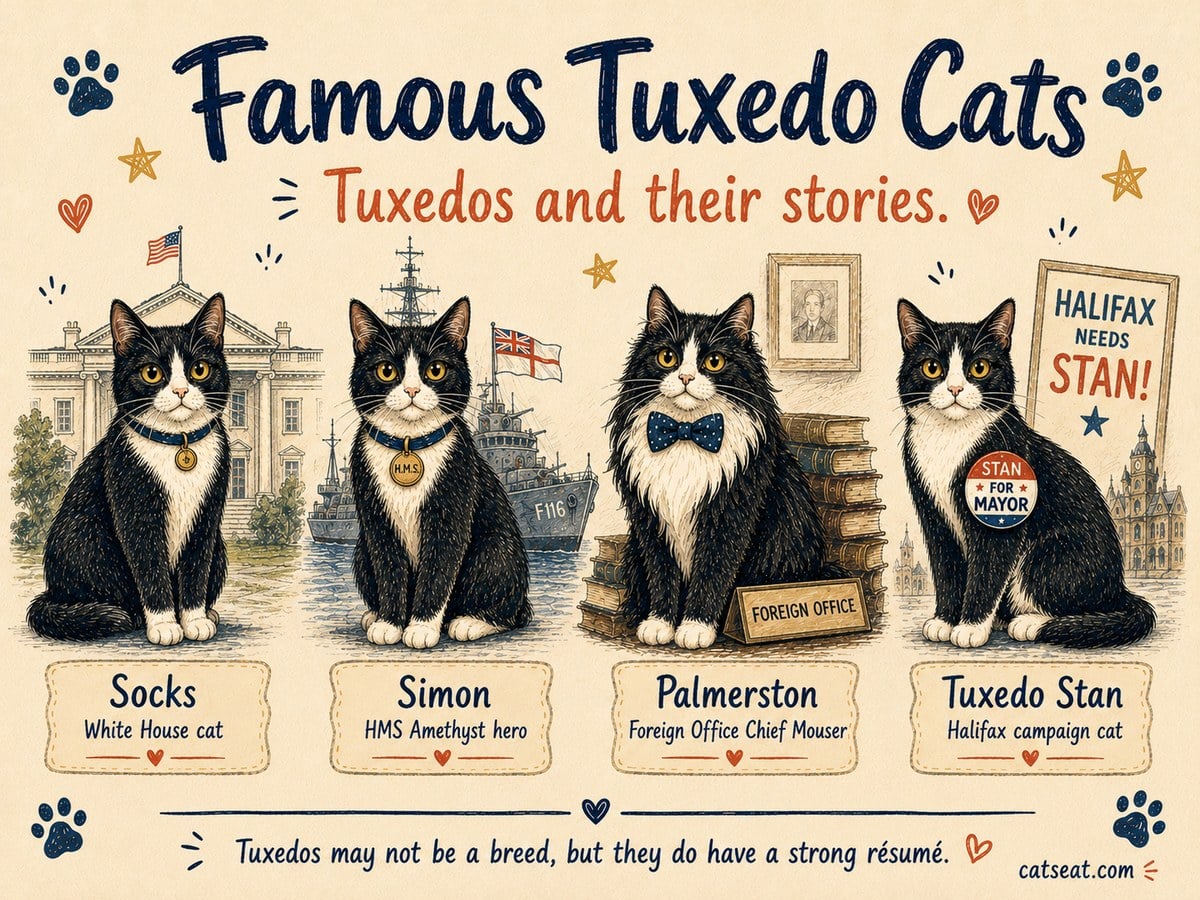
- Socks was Bill Clinton’s cat and lived in the White House from 1993 to 2001, a black-and-white cat named for his white paws and, for a while, one of the most photographed animals in America.
- Simon served aboard the Royal Navy frigate HMS Amethyst and is the only cat ever awarded the Dickin Medal, the animal equivalent of a top military honor, after being wounded during the 1949 Yangtze Incident and continuing to keep the ship’s rat population down.
- Palmerston held the title of Chief Mouser at the UK’s Foreign Office from 2016 until his retirement in 2020, complete with a rivalry with the Prime Minister’s cat down the street.
- Tuxedo Stan ran a campaign for mayor of Halifax, Nova Scotia in 2012 to raise money and awareness for feral-cat welfare. He couldn’t formally appear on the ballot, but the campaign, endorsed by Ellen DeGeneres and Anderson Cooper, helped push the city to fund a spay-and-neuter clinic.
And in fiction, the tuxedo is practically the default cat: Felix the Cat, Sylvester, Figaro from Pinocchio, and Mr. Mistoffelees, the magician cat from T.S. Eliot’s poems and the musical Cats, are all tuxedos.
If you’re thinking about adopting one
The best reason to seek out a tuxedo cat is also the most honest one: they are adorable, and they’re widely available since the pattern is common. And black-and-white cats, like black cats, tend to sit in shelters longer than those with lighter coats. That’s always a good reason to go searching for one!

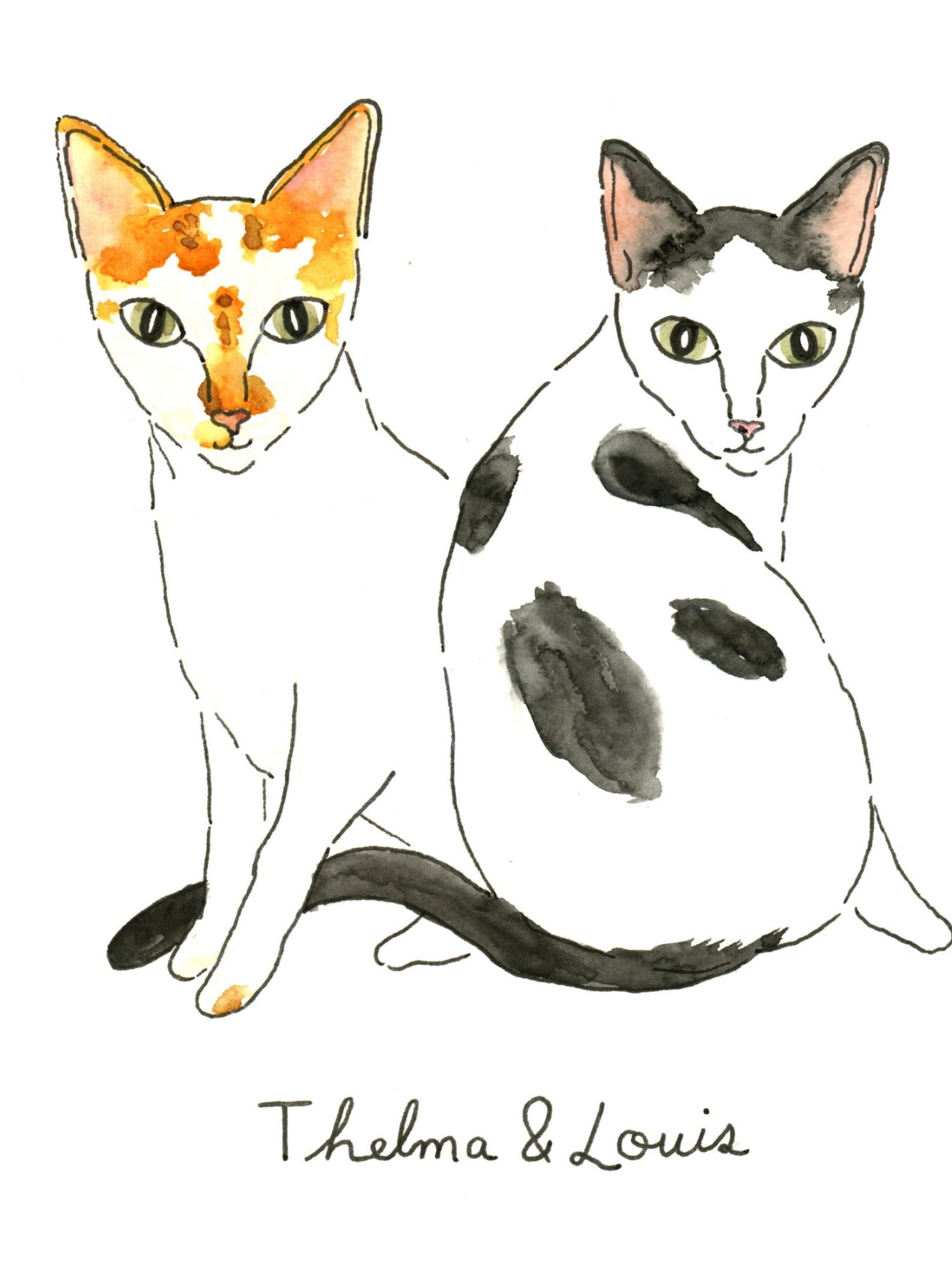
Founder and editor of Cat Seat and cat mom to Thelma and Louis. She’s been writing online since 2000.

I know that our cat vwoosta was a tuxedo cat in coat only. He had a very feisty personality. We lost him to cancer in 2020. He was my first fur baby. We had him 16 years.We were heartbroken. We will see him again.
Sending you lots of hugs! And I know we will see them again!
My blk and white was an egomaniac. He co-exited with an self-realized, champagne Tom that studied sumo wresting. At 25 lbs the Tom could put the blk and white in his place. Both lived to 20 yrs.
LOL! That’s great.
My tuxedo cats name is Twiggy. I can tell when she’s pregnant she’s clinggy and wants to be held all day. She likes only likes me.
Twiggy is such a cute name! And being your cat’s favorite person is literally the best. 🙂
My Tux was Miss Emily. She traveled with us from Oregon to visit all Civil War sites. Her companion was Henry ( the hound ) they got along fine ,were good companions, and company for us.
I love that she traveled with you! That is my dream.
I adopted my very first tuxedo boy I named Quill after Guardians of the Galaxies. He has beautiful green crossed eyes and coloring I can’t describe. He never makes biscuits, never blinks slowly but he loves to hug and kiss me. I love him so much.
Awww I love that he loves to give hugs! Aren’t they the best?
My black and white tux died at 15 and he came to me in a dream and said he came back. 3 weeks later I found a 3 week old kitten. And gray and white tux. My Sox sent me and his sister blacki a baby so we wouldn’t be lonely. And he has some of the same characteristics My Sox did. Shadow is now 3. And is a mischievous little devil.
I love that story, thank you for sharing!!
I have a gray tuxedo cat that was a part of my local TNR program and he is the biggest love bug and follows me everywhere in the house.
Thank you for adopting him and I love that he is a lovebug!
My Simon was 19 and half years when we let him to sleep this past easter. He acted a lot like a dog. Very strong and stubborn personality. I love that he followed us anywhere on the property. When we would move to a new place, I only had to tell him a few times where the property boundary was and he stayed within those parameters. When I would ask him to come see Mommy… He would take few steps in my direction and put his head down and bump my forehead. I really miss him 🙁
Thank you for sharing all this great information about cats 🙂
Aww Simon. I get teary reading this. I am sure you miss him so much. Thanks for sharing!
I have a tuxedo boy named Tux. We live on 5 acres next to a large farm and a rock cliff at the back of our property. My husband and I were sitting on our porch when a beautiful tuxedo boy came out of the sagebrush, walked up to us purring and wanting pets. He was healthy and had a shiny coat. I left fliers at everyone’s mailboxes but no one claimed him. He had already been neutered, we think that he was abandoned because he sometimes eats too fast and throws up. Their loss our gain. Its been 3 years and I am so glad he chose us.
He so chose you!
Five years ago I felt the need for a kitten and my daughter began a search. Soon she sent me an email picture of a handsome ten week old tabby whom I decided to adopt. When I picked him up I found out that his litter mate; who cried when he was removed from the cage they shared; would not stop crying. After taking this majestic looking fellow home, I decided to return for his little sister. And little she was. They have similar markings and avoid each other most of the time. She is all of 7 pounds and looks like a tuxy and he is a very majestic looking tabby. Bonnie thinks and acts like she runs the house and is exceedingly smart. She can open doors and do amazing things. Clyde is a typical cat. Loving and sweet, but afraid of anyone who is not me or Michael. They are quirky, affectionate and fun and make life warm and fun. Here’s to cats!
Carole
Aww I love that story about Bonnie and Clyde! Those are great names.
Our tuxedo cat,Tux, was found abandoned in our orange grove. Our grandsons brought him to us. He was maybe three weeks old. The strange thing is I had a dream two nights prior to this in which my husband and I were trying to figure out a name for our new black kitten. He is now nearly two years old and besties with our Ragdoll who mothered him when he was tiny. He was a gift!
How crazy is that?!
I have a true tuxedo cat who is around 12 or 13 years old. We adopted him and an orange tabby because they both chose us. Rusty crossed the rainbow bridge about 2 years ago but Felix is still with us. He is a total lap cat and loves to be brushed! He is also a scardy cat. He runs and hides whenever someone comes over. Once he gets to know them, he will come out for pets. He is so sweet and smart. He is a real love!
I’m so sorry about Rusty. Felix sounds like the best!
I had a long hair tuxedo kitty named Boo. He lived to be 19. He didnt believe he was a cat. He terrorized my other kitty by just staring at him. My heart is still broken after six years. He was so special. I held him in my arms as he crossed over the rainbow bridge knowing there would never be another Boo.
There will never be another Boo! Thank you for sharing your life with him!
Zelda was the sister to Yoda, her brother. She was a silky grey and white Tuxedo with a huge independant streak. That stopped when a storm was coming though. Then she glued herself to me! The vet explained them as “same mommy, different daddy” since she was 10 lbs. & he was 20lbs. & a Tabby. Yodda was more dog like in behavior and a total mush. I miss them greatly.
Awww they were such gifts!
Our tuxedo is named squeaks and is polydactyl.
He sounds so special!!
My Tuxedo is a female and is 7 years old. She is very independent and she has always been afraid of her own shadow and is very skidish. She sleeps with me and sits on my lap, we are bonded. She does what she wants when she wants. She has a lo of toys but sleeps more than any cat I have ever had. There has been no trauma or abuse in her life, I got her when she was 2 months old. Any information would help.
Our cats are also skittish and they’ve never had any bad thing happen to them! We’re always like, what are you possible so scared about?! I just think it’s in their nature. Your Tuxedo sounds like a cozy sweetheart!!
You say Tuxcedo and Tortillshell don’t have special attitudes I have to disagree. Tories really have definite attitudes, and Tuxcedos are just plain silly.
I can see that!!
I have a DSH black and white Tuxedo, but I have a DSH grey and white Tuxedo. Siblings from the same litter. Feral rescues. Now I’m learning a lot about Feral mating (more than I want to know), the black and white – Gideon has hair and is a pretty big boy, big boned and long. He was diagnosed with diabetes at 5 years old, has a gum issue that I’m told is genetic and had to have 2 teeth removed at 10. His sister, Sadie – grey and white- has fur, is sleek and slender and totally healthy and doesn’t have her brother’s genetic issues. We KNOW they were born from the same mom with 2 other siblings, but the vet said they could have different dads and explained how that could be!!! I didn’t know that could happen!! Since they are feral, we assume they are DSH – I’ve never done a DNA test on them. I’ve shown their pictures at cat shows and they ask if Sadie has any Russian Blue in her – IDK? They are 10 years old now; I got them as kittens. They are totally bonded and a complete joy.
It’s crazy how the same litter can have different dads!