The Cat Beds Our Cats Actually Used
Some links are affiliate, so we may earn a small commission at no cost to you. As an Amazon Associate, we earn from qualifying purchases. Every purr-chase keeps two very demanding cats in treats. Our policy →
Most cat beds get bought with good intentions and then ignored. Cats are picky about where they sleep (and, well, everything else), and the bed you chose often loses out to the cardboard box it came in, a pile of laundry, or a spot on the couch. We’ve bought plenty of beds for Thelma and Louis, and only a few of them ever got real use.
That’s the whole problem with cat beds. We want our cats to have a soft, safe place to sleep, and they want that too, but they just don’t always want the one we picked out. Sigh.
After years of watching Thelma and Louis test, claim, flatten, abandon, and then rediscover the same beds like they’d never seen them before, I’ve decided the bed itself is only part of it. Location matters, and so does texture, scent, warmth, and a cat’s ability to use a bed completely wrong LOL. So this isn’t a list of the one perfect bed every cat will love, because there isn’t one. It’s the beds our cats actually used, the ones that flopped, and what to try before you write off the expensive little marshmallow you bought.
Why cats ignore perfectly good beds
Cats don’t pick their sleeping spots the way we pick out furniture, and that’s the root of it. They want comfort, but they also want safety, warmth, a good view, the right smell, and control over the whole situation. A bed that looks cozy to us can feel too out in the open to them, while a cave bed that seems private can feel too closed in, and a donut bed one cat loves might strike another as deeply suspicious. They’re not being difficult on purpose. (Okay, maybe a little.)
What cats want from a “safe place”
Two feline-medicine groups, the AAFP and ISFM, have guidelines on what cats actually need from their space. They describe a cat’s safe place as a private, secure spot, often raised, where a cat can retreat and feel protected, and they note that a relaxed cat will happily rest and sleep there too. It tends to work best when the spot:
- feels somewhat enclosed, or at least has a sense of cover
- sits up high or gives a view of the room, ideally with a window in sight
- smells familiar, like bedding or a person the cat trusts
- lets the cat come and go entirely on their own terms
If a bed misses most of that list, it doesn’t matter how soft it is.
That explains a lot. A cat bed isn’t just a bed, it’s a decision about location, and scent, and which cat gets which spot. Go looking on Reddit and you’ll see the same thing over and over: one person’s cat ignored a fluffy bed but loved a cardboard box with an old T-shirt in it, another’s cats slept ON TOP of their wool cave beds instead of inside them. So if your cat ignores a bed, the bed might not be the problem. It could be the placement, the scent, the shape, or the fact that their not too happy about how to get in it. Yes, this can be a bit annoying, but useful once you know to look for it.
The beds our cats actually used
Thelma and Louis didn’t use a single one of these beds below the way the product photo promised, which won’t surprise anyone who’s ever met or had a cat. But the ones that worked in our house all had at least one real thing going for them, warmth, a good view, a slightly enclosed shape, or a spot where the cats already liked to be. The ones that flopped looked cute to us but didn’t solve any actual cat problem, which is the part I think most of us get wrong.
And of course Thelma and Louis still sleep in a rotating collection of spots throughout the house. From a random dining room chair to a spot on the top of a cozy chair we have in the office or the ottoman. They really don’t lounge on our leather living room at all (not cozy…see!). At night Thelma is also all about our bed and loves to sleep at our feet.
While they love to catch some zzzzz’s on our furniture, there are several beds that are Thelma and Louis approved, below!
The heated bed
The heated bed was the easiest sell of the bunch, which makes sense when you think about who we’re dealing with. Cats love warmth, and a steady warm spot gives them a reason to come back to the same place instead of chasing sun patches around the house all day.
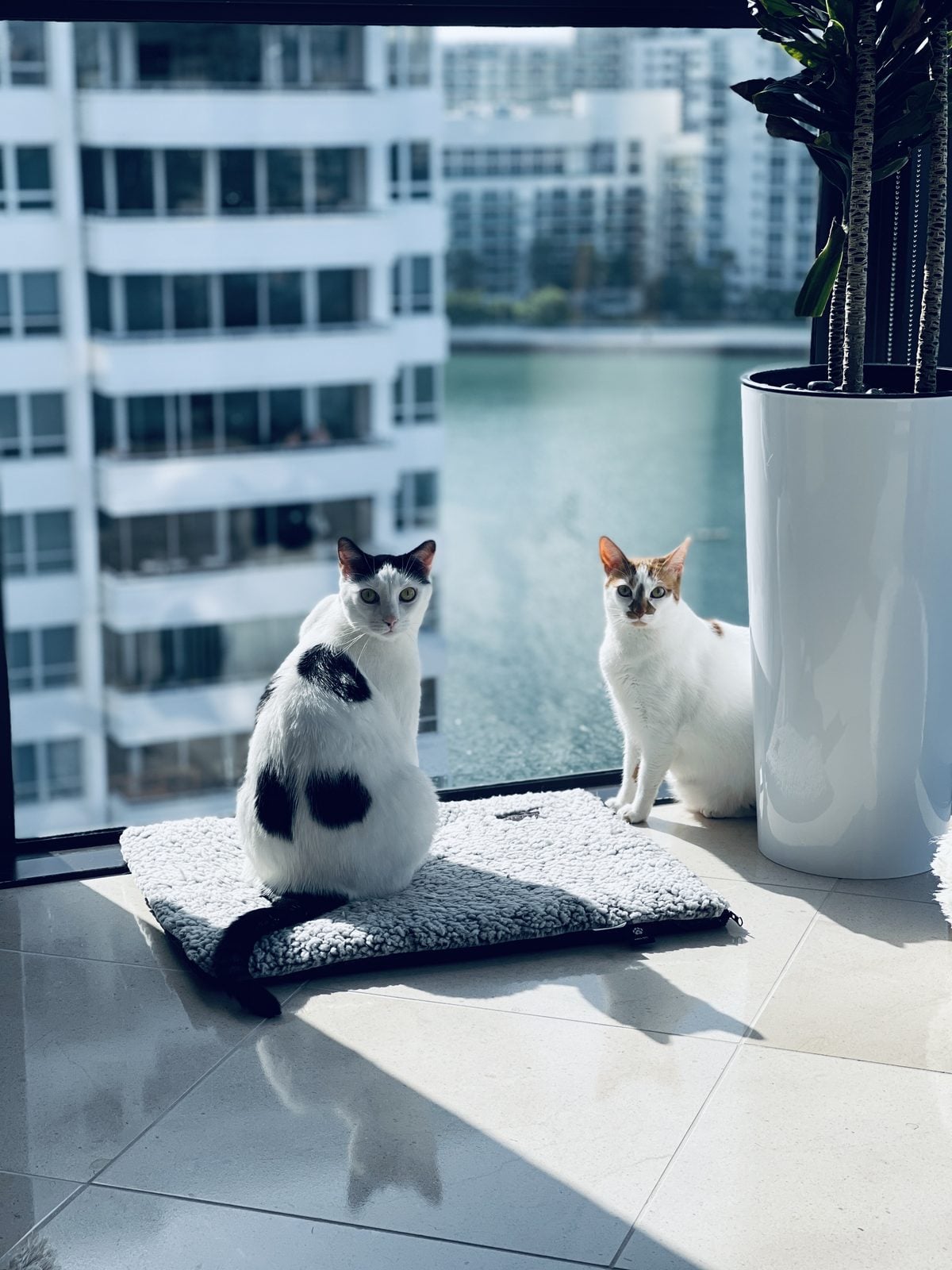
I first saw it on Amazon, and as an easily influenced cat owner LOL, I had to try it. They say it’s self-heating but I’m not sure to what extent. Both Thelma and Louis like it as a different type of bed altogether from their fluffy donut ones.
What “warm enough” means for cats
Cornell’s Feline Health Center recommends keeping things warm for older cats while being careful not to let a resting spot get too hot. It matters most for senior cats and cats with limited mobility, though plenty of younger cats treat warmth as a whole lifestyle. The short version: a heated bed should feel gently warm, never hot, and your cat should always be able to get off it whenever they want.
A good heated bed is one made just for pets, with a removable cover and clear safety instructions. This is not the time to get creative with a random heating pad from the closet. People with senior cats especially swear by them, but they’re a hit with any cat already drawn to sunny windowsills, warm laundry, laptops, or anyone who’s made the mistake of sitting down with a blanket.
Why it works
- It adds warmth without needing direct sunlight.
- It creates a consistent resting spot.
- It makes the bed feel different from every other soft surface in the house.
- It’s especially appealing in cooler rooms.
What to watch for
- The bed should be pet-safe and low-wattage.
- The cover should be washable.
- The cord should be protected from chewing.
- Your cat should be able to leave the warmth whenever they want.
A heated bed isn’t a must-have for every cat, but it’s one of the few that can offer a real, obvious upgrade over the couch. Ours lives over by the window, and Thelma hangs out on it all day but doesn’t actually sleep on it overnight, which tells me the warmth is the daytime draw and not the all-night one. (She has other plans for the night, but we’ll get to that.)
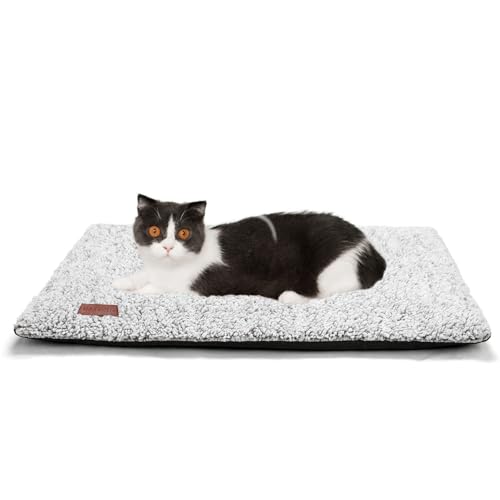
Self Warming Cat Bed Self Heating Cat Dog Mat 24 x 18 inch Extra Warm Thermal Pet Pad for Indoor Outdoor Pets with Removable Cover Non-Slip Bottom Washable Non Electric
The cordless self-warming pad we actually own. No plug and no cord, it reflects their own body heat back, and ours lives by the window where Thelma runs her late-evening and early-morning nature watch.
The window bed or window-adjacent bed
For an indoor cat, windows are the best seat in the house. A window-facing bed combines resting with watching, so birds, leaves, the delivery guy, a dog across the street, and absolutely nothing at all all become part of the day. The beauty of this spot is that the bed doesn’t have to be fancy. The location does most of the work.
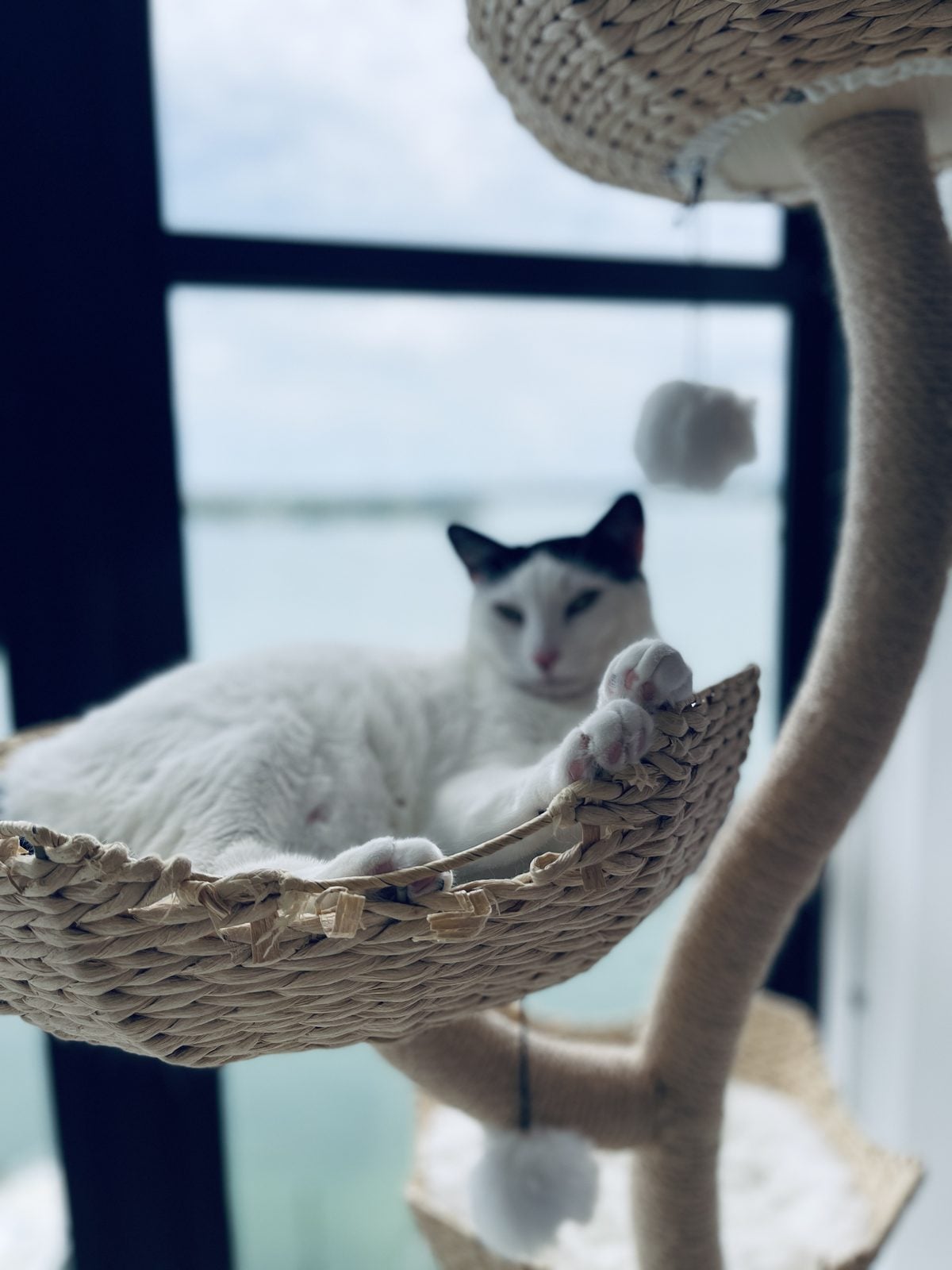
We’ve always had better luck putting beds where the cats already spend time than trying to talk them into a new corner just because it looked nicer to us. Thelma’s more likely to find a bed if it’s near something interesting, and Louis is more likely to commit to one once it feels familiar and safe, he likes to take his time. For instance we have three of the same white fluffy donut beds you’ll find below. Two are by windows and a third is in a corner. Neither of the cats even look at that one.
Why it works
- It gives the cats a view.
- It adds warmth from sunlight.
- It makes the bed part of a routine.
- It lets the cats rest without missing anything important.
What to watch for
- A window perch should be sturdy enough for your cat’s weight.
- Suction-cup styles need regular safety checks.
- A bed near a window shouldn’t overheat in direct sun.
- Senior cats may need steps or a lower option if jumping is difficult.
So if your cat already sleeps on the back of the couch because it happens to face a window, the bed doesn’t need to fight that instinct. It just needs to join it.
The cave bed
Cave beds are tricky. In theory they make perfect sense, cats like safe, enclosed spaces, and those same guidelines list cardboard boxes and carriers as fine safe places, as long as a cat can hide and get out easily. But a cave bed only works if your cat likes the opening and the shape and the texture and the whole feeling of being tucked inside, which is a lot to ask of one small object.
Some cats love them exactly as intended, some sleep on top of them, some crush them flat into a mat, and some use them only for ambush games and never nap inside at all. On Reddit you’ll see it constantly: one person’s cats loved sleeping on top of their wool cave beds even though the beds collapsed right away, and another’s cats nested on top of a donut-style cave without ever going in. So I wouldn’t write off a cave bed just because your cat is “using it wrong.” There’s no wrong. There’s used and not used.
We bought one of those Cattasaurus beds we saw online, and it worked great when Louis was little and it was positioned in front of a window. But when we moved and had to tuck it into a corner, it got used a bit less. Louis still likes it from time to time so we kept it, but the location does, as we mention above, matter.
Why it works
- It offers privacy.
- It gives the cats a soft, enclosed shape.
- It doubles as a play tunnel or ambush spot.
- It still works when flattened.
What to watch for
- The opening should be large enough for your cat.
- The structure shouldn’t collapse in a way that scares them.
- Wool can attract cats, but it can also collect fur.
- Some cave beds are harder to clean than regular beds.
A cave bed is a great pick for cats who already love boxes, bags, closets, and under-bed hideouts, and a riskier one for cats who’d rather stretch out in the open.
The cardboard scratcher bed
The cardboard scratcher bed isn’t fancy, and that’s the point, cats don’t care about that. They care about texture, scent, shape, and whether something feels good to scratch right before they flop down on it. These beds work because they combine two things cats already do, scratching and resting, into one object. Cornell’s Feline Health Center notes that cheap things like cardboard boxes can be entertaining for cats, partly because toys and enrichment let them do what they’re already wired to do, and a cardboard lounger fits right into that. It’s not plush, it’s not pretty, and yes, it sheds cardboard crumbs all over the floor, but a lot of cats use them anyway. The best part is they’re low-stakes: if your cat snubs a cardboard lounger, that stings a lot less than watching them reject the pricey designer cave bed now sitting in your living room doing nothing.
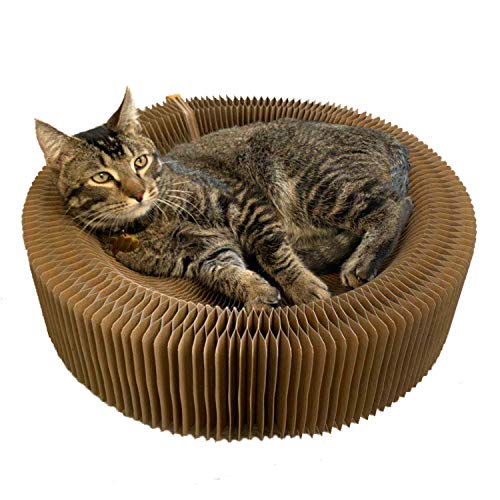
BobbyPet Cat Scratcher Lounge Bed – Collapsible Round Shape for Big Cat, Honeycomb Paper, 20 Inch
The classic curved lounge shape, and the low-stakes way to test whether your cat is a scratcher-bed cat.
Why it works
- It gives the cats something to scratch.
- It has a firm texture.
- It holds scent well.
- It’s easy to move around.
- It doesn’t feel too precious.
What to watch for
- Cardboard can make a mess.
- Some cats chew cardboard, so you need to watch for that.
- It may need replacing more often than a fabric bed.
- It’s not the best choice for cats who need extra cushioning.
That’s the one I’d reach for first if you’ve got a cat who turns up their nose at plush beds but goes feral for a cardboard box.
The soft donut bed
Donut beds look like they should work every time. They’re round, they’re fluffy, they’ve got raised sides to lean into. Some cats love them. Others step into the middle, decide they don’t like the texture, and walk right back out. The raised sides are great for cats who curl up tight or rest their chin on an edge, but some donut beds are too soft or too unstable, and if the center sinks too much, a cat who likes a firmer surface won’t settle in it. Size sneaks up on you too, a bed that looks cozy online can turn out too small once your actual cat climbs in. Cats love a snug spot, but snug and cramped aren’t the same thing.
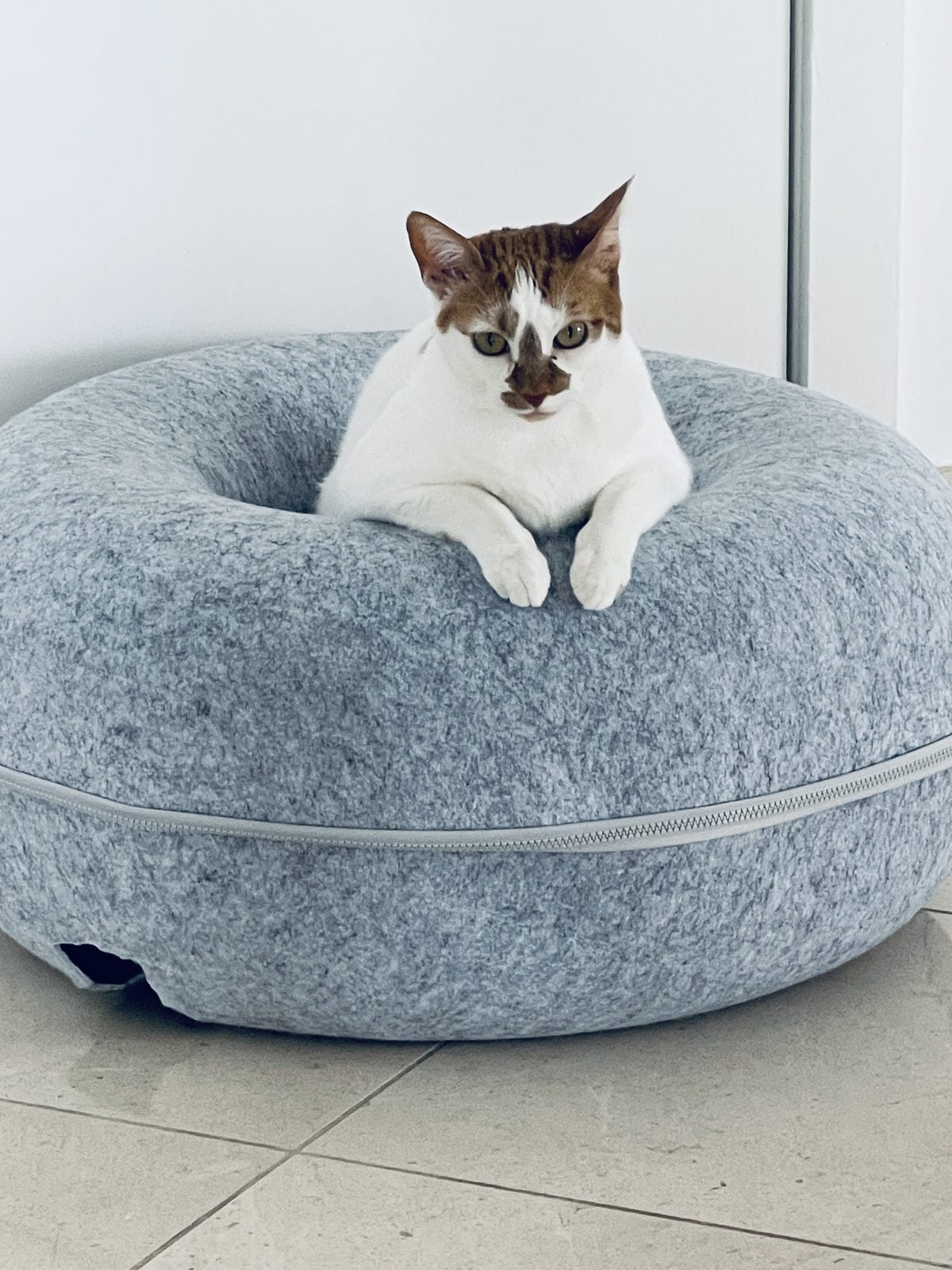
Thankfully our cats love their donut beds, but honestly at 15-pounds Louis is almost sized out of our current one. But it is hands-down both of their favorite safe sleeping spots.
Why it worked
- It gives the cats a curled-up shape.
- It has raised edges for chin resting.
- It workswell in cooler rooms.
- It’s easy to place on a chair, sofa, or low shelf.
What to watch for
- The center should have enough support.
- The bed should be large enough for your cat’s sleeping style.
- Long faux fur can mat or trap crumbs.
- Some cats dislike very fluffy textures.
A donut bed is best for cats who already sleep curled up in tight little circles, and if your cat sprawls out flat like a melted throw blanket, they’ll probably want something flatter too. That said, the donut is the one we kept coming back to and buying again: it’s the Gavenia 20-inch washable, and we’ve actually got three of them placed around the house so the cats have a soft option wherever they decide to plop down, which is the strongest endorsement I can give a bed. Most of the beds we tried got used exactly once, or never, but Thelma in particular has fully claimed these as hers, and Louis rotates through them and politely backs off the second he sees Thelma’s already settled into one.
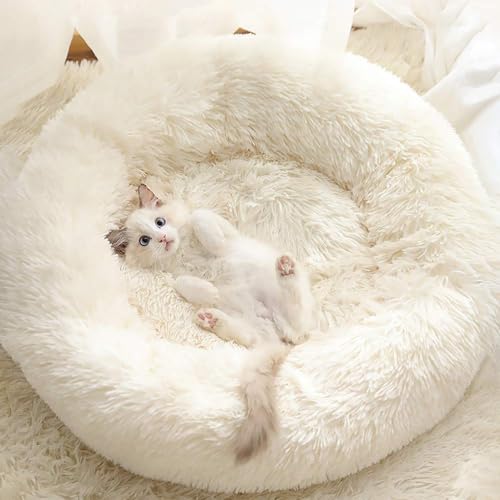
Gavenia Cat and Dog Bed, 20”x20” Washable Donut, Soft Plush Pet Cushion, Waterproof Bottom, Fluffy Calming Self-Warming for Indoor Cats, Sleep Improvement, White
The #1 pick for most cats. The washable donut we own (and replaced once after the first one wore out). 20-inch size fits cats who curl, plush fabric, machine washable, and the rim is high enough that cats feel enclosed but can still see out.
The bed we didn’t mean to buy
Every cat household has at least one accidental bed, and you know exactly what I mean. A tote bag, a laundry basket, a throw blanket over a chair, a cardboard box that was supposed to go out to recycling two weeks ago. None of these are technically cat beds, but they tell you a lot about what your cat likes, if you pay attention. A cat who sleeps on your sweater is probably after your scent; one who curls up in a box likes the enclosure; one who camps on a hard windowsill cares more about the view than the softness; and one who sleeps on top of the cave bed likes the material but not the opening. So before you buy yet another bed, look at where your cat already sleeps. That’s the research, not peer-reviewed, but the most useful data you’ve got.
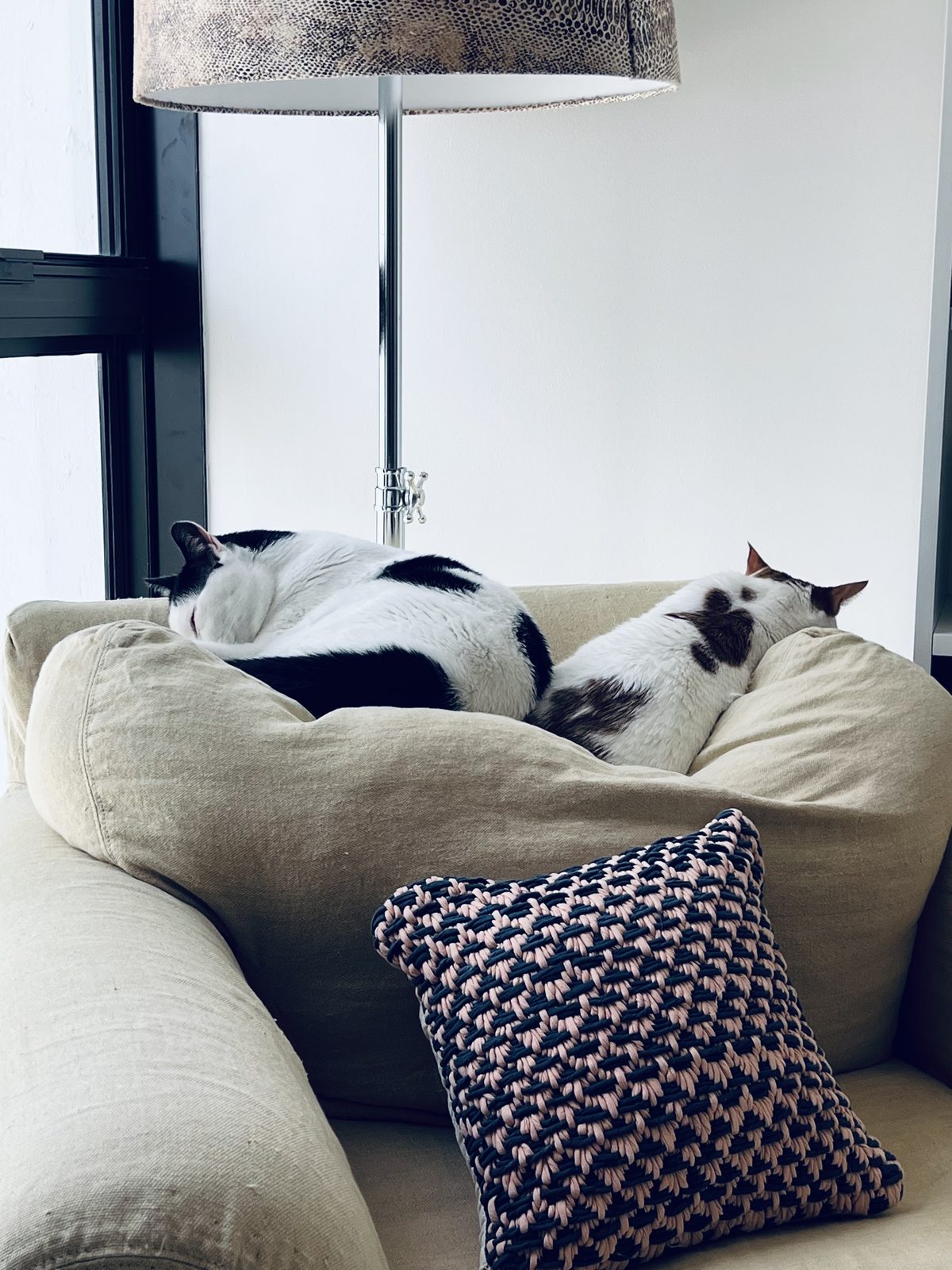
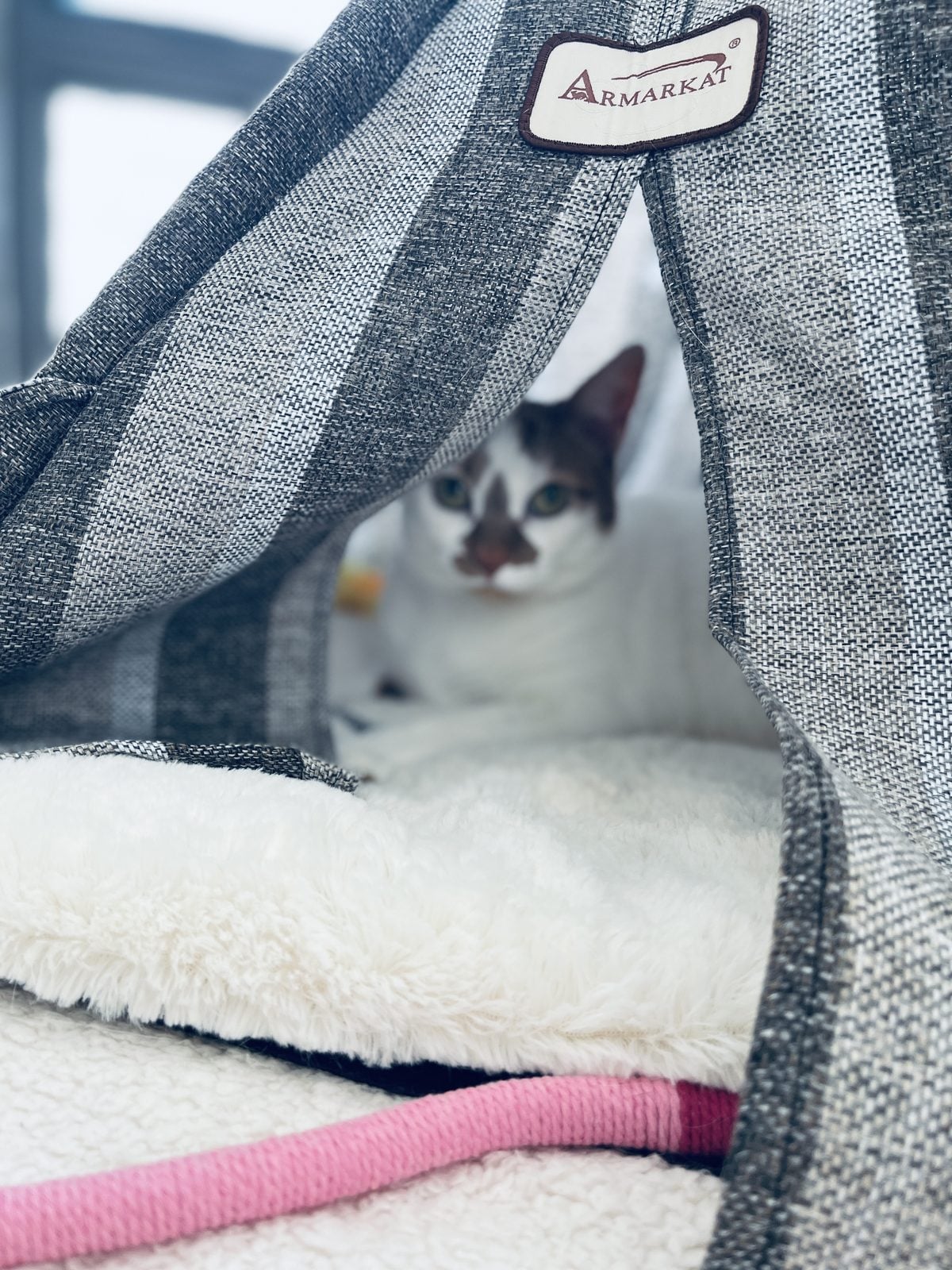
I’m still holding out hope for this one, but we bought the cutest teepee bed. And while we’ll find one of them hanging out in it from time to time and sometimes sleeping, it’s not as much as I thought it would be. It looks so cozy in there I want to hang out in it!
How to make a cat bed more appealing
If your cat is ignoring a new bed, don’t give up on it the first week. Start by moving it: try it near a window, on their favorite chair, beside the couch, next to your bed, or in a quiet corner where your cat already naps. If your cat likes height, put it on a stable raised surface; if your cat’s older, keep it low and easy to climb into. Then make it smell like home…bedding or clothing with a familiar person’s scent helps a cat feel at ease, so it’s worth tossing in a towel, blanket, or T-shirt your cat already knows. You can sprinkle a little catnip or silvervine nearby if your cat’s into that, but don’t overdo it.
Try this before giving up
- You can move the bed to a place your cat already naps.
- You can place it near a window.
- You can add a familiar blanket or T-shirt.
- You can try it on a chair, shelf, or cat tree platform.
- You can give it a week or two before deciding your cat hates it.
- You can let your cat use it the wrong way.
Yes, the last one is especially important! If your cat sleeps on top of the cave bed, the cave bed is working. It’s just working in a way that hurts your feelings a little, and that’s something you’ll have to make peace with.
What makes a cat bed worth buying?
A cat bed is worth buying when it solves a real, specific problem for your cat. When they’re looking for a warm spot to cuddle up in, or a bed with a view to the outside world, or if they want to feel extra safe in a high-up perch, a bed can scratch that itch.
If a bed doesn’t offer any of those things, it doesn’t matter how cute it is…not unless you want to be the one sleeping in it. For instance, see which habit your cat exhibits below, and try to get a bed to match it.
A good cat bed should match your cat’s habits
- A cat who loves boxes might like a cave bed, cardboard bed, or covered bed.
- A cat who loves sun might like a window bed or perch.
- A cat who loves warm laundry might like a heated or self-warming bed.
- A cat who curls tightly might like a donut bed.
- A cat who stretches out might like a flat mat or larger bolster bed.
- A senior cat might need warmth, low sides, and easy access.
- A multi-cat home might need several resting spots in different areas.
What we would buy again
I’d buy the heated bed again in a heartbeat, plus a window-friendly bed and a cardboard scratcher (knowing full well it won’t stay looking nice for long). I’d be a little more careful with cave beds, not because they’re bad, but because cats have stronger opinions about shape and texture than any product photo can predict. For Thelma, she’s far more likely to use something if it’s near the action, in the sun, or somewhere she’s already decided is secretly hers. For Louis, I’d lean into softness, familiarity, and height.
And here’s what actually happens at night, in case you’re wondering what all this bed research bought us: Thelma sleeps at our feet every night, and Louis rotates between sleeping between us, sleeping in Thelma’s donut bed, or curling up on a chair if he needs a little “me” time.
The best thing you can do when starting your search for a new cat bed is to reverse engineer it! Start with your cat’s favorite sleeping spot and their typical habits/behavior. If your cat sleeps by the window, try a window perch or a soft bed right there; if they sleep in boxes, try a cardboard lounger or a cave bed; if they’re forever stealing your warm laundry, try a heated or self-warming bed; and if they curl up against your pillows, try a donut bed with high raised sides. Whatever you do, don’t start with the bed you think looks best. Start with the one that matches what your cat has been telling you for months, because your cat could not care less about the product description, the color, the brand, or the fact that you read 400 reviews before clicking buy. What they care about is the spot, the texture, whether it smells safe, and whether they can keep one eye on the window while pretending they’re not waiting for a bird.
And if none of that works? Well, there’s always the box it came in.

Founder and editor of Cat Seat and cat mom to Thelma and Louis. She’s been writing online since 2000.
Hi! I’m Lindsay. I run this site alongside my hubs Cory and our very opinionated cats, Thelma and Louis. We’re so happy you’re here!