DIY Ways to Enrich Your Cat
 By Lindsay Jones
 ✓Medically reviewed by Dr. Lindsey Mortlock
Some links are affiliate, so we may earn a small commission at no cost to you. As an Amazon Associate, we earn from qualifying purchases. Every purr-chase keeps two very demanding cats in treats. Our policy →
Cat enrichment sounds like it requires a real budget and possibly a degree. It doesn’t. Most of the things that make indoor cats happier are stuff you already have lying around: a cardboard box, a paper bag, a toilet paper roll, a crumpled piece of foil, a sock you’ve been ignoring for too long. None of these cost a cent, and most of them produce more entertainment per dollar than the $40 cat toy you ordered last month and haven’t seen your cat touch since.
Indoor cats need enrichment mostly because they’re bored. They’re smart, they’re wired to hunt, and a lot of them spend most of the day in a small apartment with limited horizons. Enrichment is just the word for giving their brain something to do besides watch you make coffee. And almost all of it can be done with whatever’s sitting in your recycling bin right now.
Why DIY enrichment works better than you think
Most cat toys at the pet store are designed for the human, not the cat. They’re colorful and squeaky and covered in feathers, marketed straight at you, and your cat could not care less. What cats care about is texture, movement, sound, scent, and the sense that an object is interesting enough to investigate. A cardboard box scores on every one of those for free. A laser pointer scores on movement. A paper bag scores on sound, texture, and the privacy of being inside it.
What cats actually need from their day
The Ohio State University Indoor Pet Initiative, a veterinary program focused on indoor-cat welfare, recommends that cats have foraging opportunities, varied resting spots, vertical space to climb, and predictable interactive play. Not one of those things requires an expensive product. They require a little attention and a few household objects, which is exactly what DIY enrichment is built on.
That’s also why your $40 cat tower with the built-in catnip toys gets ignored while a plain delivery box sits in the middle of the floor with a perfectly content cat asleep inside it.
The cardboard box (the foundation of every enrichment plan)
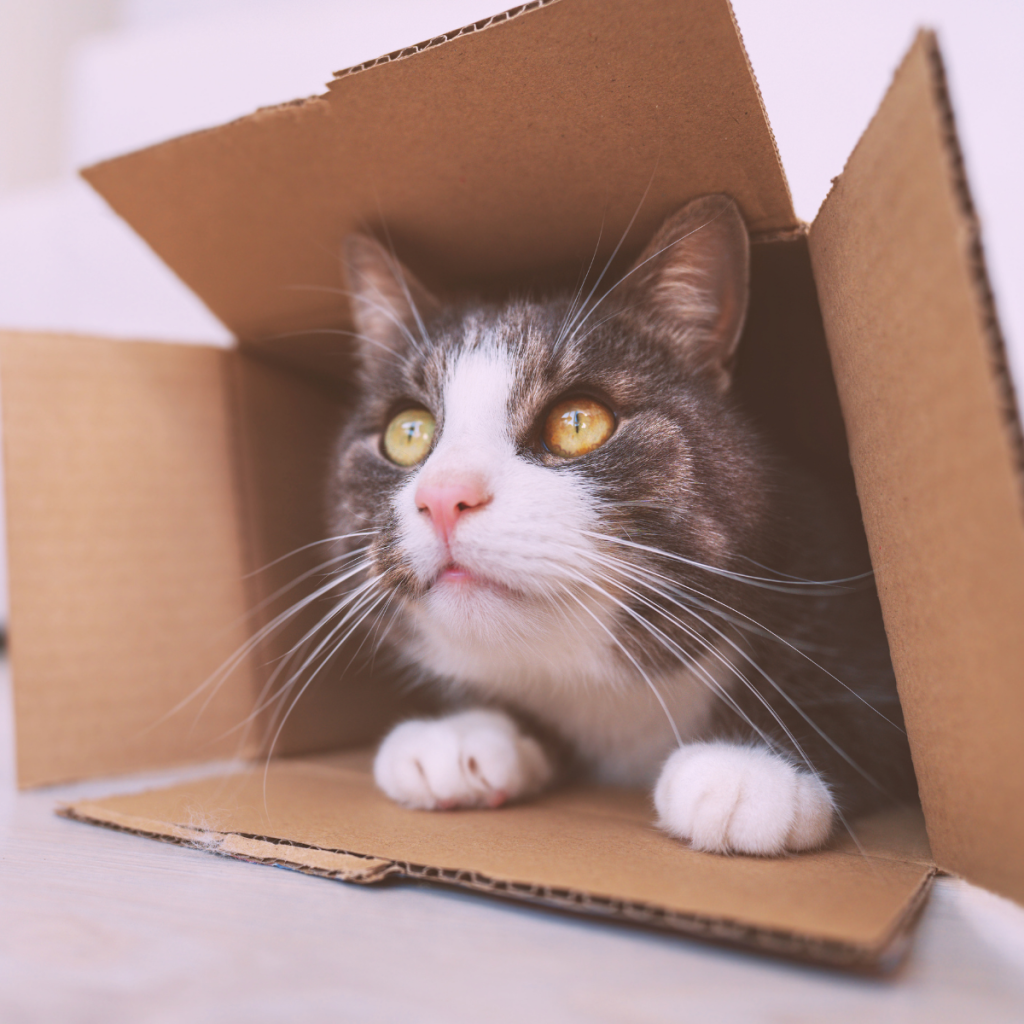
Cardboard boxes are one of the best enrichment tools available. A box gives a cat enclosure, which feels safe. It gives them a place to hide and ambush from, which fires up the hunting instinct. And it smells like wherever it came from and whatever was packed in it, which keeps their nose busy. A box is also endlessly modifiable, cut a hole in one side, drop a treat inside, stack two together, and the cat will treat the same box differently depending on the day and the mood they woke up in.
The Cornell Feline Health Center has noted that inexpensive items like cardboard boxes can be entertaining for cats, one of the few veterinary observations that matches the lived reality of every cat household that has ever existed.
Ways to use the cardboard box you already have
- Leave it on the floor empty and see what happens.
- Cut a few holes in the sides for peeking and pouncing.
- Put a soft blanket inside to make it a hideout bed.
- Put a few treats inside as a basic foraging puzzle.
- Stack two or three together to make a multi-room structure.
- Replace it with a fresh box when the cat loses interest.
The only real downside is that this slowly makes your home look like a moving company’s warehouse, so pick your battles on the boxes visible from the couch.
Toilet paper rolls (free puzzle feeders)
The empty cardboard tube from a roll of toilet paper or paper towels is a small but useful enrichment object. On its own, a roll is something cats will bat around the room for ten minutes. Stuffed with a couple of treats and folded shut at both ends, it becomes a small puzzle feeder that takes a few minutes to crack open. A handful of them dropped into a shoebox turns into a layered foraging puzzle. None of it costs a thing. It’s also the cheapest way to test whether your cat is interested in puzzle feeding at all. If your cat ignores a toilet paper roll with treats inside, they’ll almost certainly ignore a $30 puzzle feeder too. If your cat takes to it, you can upgrade to a real puzzle later with some confidence.
Easy toilet-paper-roll setups
- Fold one end shut, put 3-4 treats inside, fold the other end shut.
- Drop several into a shoebox with treats hidden among them.
- Cut the roll into rings for cats who like to bat small objects.
- Let your cat destroy it. The destroying is part of the appeal.
A paper bag with a hole cut in it
This one sounds like nothing and turns out to be everything. Take a paper grocery bag with no handles (cats can get tangled in handles, so cut those off or skip bags that have them), cut a hole in one side, and leave it open on the floor. Your cat will crawl in, hide, pounce on the bag itself, make it rustle for twenty minutes, and carry small stolen objects inside for what looks like a private celebration. The bag will be destroyed within about a week. You just replace it when it falls apart. This is the highest entertainment-per-dollar item in the whole article.
Catnip socks (a 90-second project)
Take an old sock, stuff it with two or three cotton balls and a tablespoon of dried catnip, tie a knot at the open end, and hand it over. Some cats lose their minds, others don’t react at all, because roughly thirty percent of cats are genetically immune to catnip and the only way to find out which kind you’ve got is to try it. If your cat is a responder, this is about the cheapest joy you can deliver, and you can also rub a little catnip onto cardboard scratchers to refresh their interest in something they’d gotten bored of. If catnip does nothing, silvervine is the next thing to try. Around sixty to seventy percent of cats respond to silvervine even when catnip leaves them cold, so it’s worth running as a second test before you give up on the whole category.
A hidden treat scavenger hunt
If your cat is at all food-motivated, this one is great mental work. Hide five to ten small dry treats around the house at varying heights, on a windowsill, behind a couch leg, on top of a step stool, tucked inside an empty cardboard box, and let your cat work out where they all are. Start with easy, obvious spots so they catch on to the game, then build up the difficulty over time. It taps into their natural foraging instinct, and most cat owners don’t realize how strongly indoor cats want to find their food rather than have it set down in front of them. That’s why a scavenger hunt works so well, it’s a free puzzle feeder spread across the whole house.
How to set up a treat hunt that works
- Start with five treats in easy-to-see spots.
- Add more spots and harder hiding places as your cat catches on.
- Use freeze-dried treats so they hold up to being hidden.
- Repeat the same route a few times so they remember to check.
- Vary it just enough to keep it interesting.
Play is a real need, not a treat
The American Association of Feline Practitioners includes “an opportunity to play and to express normal predatory behavior” among its Five Pillars of a Healthy Feline Environment, the framework a lot of vets lean on when they talk about indoor-cat welfare. Translated out of the clinical language, that means a daily chance to stalk, chase, and “catch” something isn’t a luxury you’re spoiling your cat with; it’s a basic need, and a scavenger hunt or a real wand session is one of the simplest ways to meet it.
Window TV (free, requires only a window)
Cats can spend hours watching whatever’s happening outside a window if you give them a decent perch to do it from. The “window TV” is nothing more than a flat surface they can lie on, an existing piece of furniture, a small bench, or a folded blanket on a wide enough sill, positioned to look out on something with a bit of movement: birds, squirrels, a sidewalk, leaves shifting in a tree. If your view is quiet, a bird feeder hung outside the window (or a hummingbird feeder, if you live somewhere with them) will populate it fast. From there, your cat can watch a single squirrel for an hour and consider it a complete afternoon.
Frozen treats for hot days
For any cat who’ll eat wet food, a small frozen treat is good enrichment plus a little hydration on a warm day. Take a tablespoon of wet food or a small amount of low-sodium broth (no onion, no garlic, no chives, no seasoning, since those can be harmful), spread it into an ice cube tray or a small silicone mold, and freeze it. Pop one out, set it in a shallow dish, and let your cat lick at it. Because it’s frozen, the licking is slow, which is what makes it enrichment rather than just a snack. The hydration is a bonus. If your cat lives somewhere hot, this is one of the few enrichment ideas that doubles as a real cooling-off opportunity.
The wand toy is not technically DIY, but
The wand toy is the highest-impact enrichment object in any cat household. It’s not strictly DIY, but you can cobble one together from a stick, a length of string, and a scrap of fabric tied on the end, because the point of a wand toy was never the toy, it’s the way you move it. Real prey movement, dart, pause, hide, dart again, freeze, sudden motion, is what engages a cat. A wand dragged across the floor in one long straight line is just exercise for you. Done right, fifteen to twenty minutes of wand play before dinner is one of the most reliable ways to tire out a bored cat. If you do nothing else from this article, do this one.
What we actually use in our house
In our house, the things that get the most use are the cardboard boxes (constantly), the wand toy (every evening, plus during the day whenever Louis stares at us with his whole face), the catnip socks (about once a week, treated as a special event), and the scavenger hunt (rarely, but a real hit on the days we set one up). Thelma is more likely to engage with anything new, especially if she suspects it wasn’t meant for her, she’s the cat who’ll climb into an empty Amazon box within thirty seconds of it hitting the floor. Louis is more cautious about new objects up front but becomes religiously committed once he’s decided they’re part of the household. He’s the wand toy cat, and he waits for it. Most of the enrichment we use regularly costs nothing, and while the few things we’ve bought (a cat tree, a puzzle feeder, a window perch) earn their space, the daily entertainment is overwhelmingly cardboard, paper, and that one wand.
When to add structure
If your cat is showing real signs of boredom, knocking things off tables, over-grooming, demanding attention constantly, or putting on weight from sheer inactivity, then a more structured enrichment routine helps, and it doesn’t have to be elaborate to work.
A structured day for an indoor cat could include
- A morning wand-play session before work.
- A foraging puzzle or treat hunt left out for during the day.
- A few toys rotated in and out so they feel new again.
- A second wand session before dinner.
- Some window time at a perch.
- A small evening activity, like a fresh box or a paper bag.
None of this has to happen every day. Even three or four enrichment moments spread across a week makes a noticeable difference in cats who are bored.
A starter DIY enrichment setup
The simplest place to start: save one cardboard box, save one paper bag with no handles, stuff one old sock with dried catnip, buy one wand toy (the only purchase in the whole thing), and plan one fifteen-minute play session before dinner each night for a week. That’s the entire setup, total cost about $8 for the wand. If your cat takes to it, build out from there with more boxes, more scavenger hunts, and eventually a real puzzle feeder if they turn out to be puzzle-cat material. If they ignore all of it, try silvervine instead of catnip and a wand with a different texture on the end before you write anything off.
So, what should you start with?
The cardboard box. Always the cardboard box. If you’ve got a cat and a box, you already own a complete starting kit, and the rest of this article is just variations on that one idea, things your cat can investigate, hide in, hunt, and destroy in a deeply satisfying way. Cat enrichment was never about products. It’s about giving them something interesting to engage with, and for most cats that something is cheap, low-effort, and a little improvised.
Save the box.
Founder and editor of Cat Seat and cat mom to Thelma and Louis. She’s been writing online since 2000.
An emergency veterinarian with a special interest in feline medicine — and a self-proclaimed cat lady with six cats of her own.
Hi! I’m Lindsay. I run this site alongside my hubs Cory and our very opinionated cats, Thelma and Louis. We’re so happy you’re here!