Cat Trees That Don’t Completely Take Over Your Living Room
 By Lindsay Jones
 ✓Medically reviewed by Dr. Lindsey Mortlock
Some links are affiliate, so we may earn a small commission at no cost to you. As an Amazon Associate, we earn from qualifying purchases. Every purr-chase keeps two very demanding cats in treats. Our policy →
Most cat trees look like they were designed in 1998 by someone with strong feelings about beige carpet. They’re tall and wide, they swallow a whole corner of your apartment or house, they come in shades of fawn and sand and oatmeal, and they’ve got dangling toys you’ll be picking off the floor for the rest of the year. And then your cat uses only the bottom platform and looks at you like you’re the one being weird about it.
Cat tree design has improved in the last few years, though. There’s now a small but beautiful category of cat trees that look like furniture, scratch like real scratching posts, and don’t require you to apologize to dinner guests for the carpeted tower in the corner. They’re still cat trees, of course, so your cat may or may not use them the way the product photo promised. Here’s what we’ve actually owned, and what we’ve learned about what makes a cat tree worth the floor space it costs you.
Why cats want a cat tree in the first place
Indoor cats need vertical space, and that’s one of the few cat-behavior claims with real research behind it. The Ohio State University Indoor Pet Initiative, a veterinary research program focused on indoor cats, has published a lot about vertical territory. The short version: cats use height for three things, surveillance, escape, and warmth. A high perch lets them watch a whole room from above, which is how they’re wired to assess what’s going on. In a multi-cat house, it lets one cat opt out of an interaction by simply going up. And the higher spots in a room tend to be warmer, which cats are always looking for.
Why “up” matters so much
The American Association of Feline Practitioners includes “an opportunity to play and an opportunity to express normal predatory behavior,” along with elevated and safe resting places, in its Five Pillars of a Healthy Feline Environment, the framework a lot of vets use when they talk about indoor-cat wellbeing. Vertical territory isn’t a luxury or a design flex; it’s one of the basic resources a cat needs to feel secure, which is why a tree that delivers real height tends to get used and a tree that just looks fluffy tends to get ignored.
That also explains why cat trees that solve those three things get used while the ones that just look fluffy don’t. Your cat isn’t after carpeted decoration, they’re after a vantage point with somewhere soft to sit while they use it.
The cat tree we own
The one we actually own is the Mau Ivy 4, from Mau Pets, a small Brooklyn studio that designs cat furniture as, well, actual furniture. Ours lives in the kitchen and looks like a piece of furniture rather than a cat tree. The frame is real wood instead of particle board, and the scratching post is wrapped in natural sisal rope, which is the material cats actually want to scratch instead of the thin polyester wrap a lot of cat trees use. The top perch is high enough that whichever cat is up there can look down on everything else in the room, which seems to be the entire point as far as Thelma and Louis are concerned. Both cats use it, which is a much higher hit rate than most of the cat furniture we’ve brought into this house.
The three reasons cats climb
According to the Ohio State University Indoor Pet Initiative, cats use height for surveillance (watching a room from above, which is how they assess what’s going on), escape (a way to opt out of an interaction, which matters most in multi-cat homes), and warmth (heat rises, and cats follow it). A cat tree that nails even one of those will get used; one that nails all three becomes the cat’s headquarters.
Why it works
- Real wood frame, not particle board.
- Stable base that doesn’t wobble when a cat launches off the top.
- Real natural sisal rope on the scratching post.
- Looks like furniture, not a pet product.
- Depending on the model, the top perch is high enough to give the cats a real vantage point.
What to watch for
- More expensive than the carpeted tower options at the pet store.
- Assembly takes a real 45 minutes, not the 10 minutes the box implies.
- Footprint is moderate, not tiny.
It’s not the smallest cat tree on the market, and it’s not the cheapest either. But for longevity, materials, and the fact that the cats actually use it, we’d buy it again without thinking twice.
Mau Pets Ivy 4
The cat tree we actually own. Made by a small Brooklyn-based studio that designs cat furniture as actual furniture. Real wood frame, natural sisal scratching post, lives in our kitchen.
Brand-direct link, not affiliate.
The modern cat tree category
A handful of brands have moved into the designer cat-furniture space in the last few years, and most of them sell direct-to-consumer rather than through Amazon, which is why they don’t always show up when you search the big-box pet stores. The names that keep coming up in apartment-design subreddits and lifestyle pet sites are Tuft + Paw, Refined Feline, Vesper (by Hagen / Catit), and Pidan. They’re all chasing the same idea, cat trees that look like furniture, just at very different price points and shapes.
Tuft + Paw is the most-mentioned premium option and often runs $400 to $700. Refined Feline is more moderate at around $150 to $300, with pieces that double as end tables or bookshelves. Vesper is the most affordable of the modern lines and the easiest to find, since it’s stocked through Chewy and Petco. And Pidan leans sculptural, with egg-shaped pods and modular platforms. There’s something in here for most budgets and most rooms.
The modern cat tree at a reasonable price
The Vesper V-High Base is the modern cat tree that’s one of the more affordable options. It’s not a designer studio piece, but it’s also very much not a 1998 carpeted tower, the black-and-oak finish reads as real furniture in a way most pet-store cat trees never manage, and it’s available through Chewy, Petco, and Amazon. It’s what we’d point you toward if the Mau Pets price is too high or the Brooklyn-studio lead times are too long. It doesn’t have the same heirloom feel, but it does the basic job at roughly half the cost.
Why it works
- Clean modern design instead of carpeted beige.
- Available at major retailers, not just direct-to-consumer.
- Reasonable price for the category.
- Solid base for a freestanding tree.
What to watch for
- Materials are not as premium as the small-studio brands.
- Footprint is still substantial.
- Some users report that the sisal wears faster than on higher-end models.
- Color options are limited compared to the designer brands.
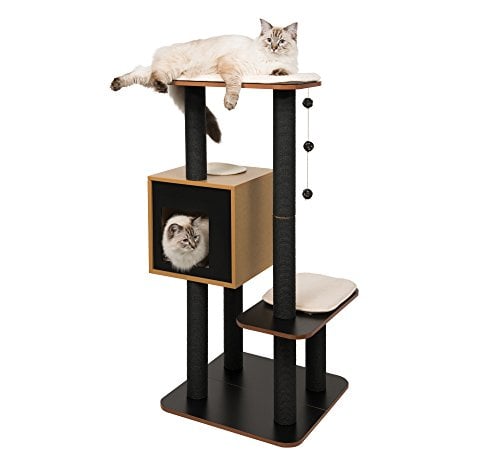
Vesper Cat Tree, High Base, Black , 52046
Modern, clean lines, available at Chewy and Petco, easier to find than the designer brands. Around $150-250 depending on configuration. The black-finish version reads as actual furniture rather than carpeted tower.
The wall-mounted alternative
Wall-mounted cat shelves give cats real vertical territory without using any floor space, and for small apartments that’s often the best option. The setup is more work upfront, you have to find studs, drill into the wall, and map out a climbing path the cat will actually use instead of bolting shelves up at random. But in a tight space the result is hard to beat, since you get all the vertical-territory benefits without giving up a corner to a four-foot tower. Refined Feline makes a popular wall-shelf set, and there are flat-pack options on Amazon if you’d rather mix and match shapes. The main thing is that placement matters more than the shelves themselves: shelves that lead nowhere get ignored, while shelves that connect to a window, a perch, or a path the cat already walks get used constantly.
Why it works
- Uses zero floor space.
- Creates vertical territory in a small footprint.
- Can be designed around windows or existing furniture.
- Less visually intrusive than a freestanding tree.
What to watch for
- Installation requires drilling and finding studs.
- Not landlord-friendly without permission.
- Layout planning matters as much as the shelves.
- Hard to move once installed.
The window perch that counts as a cat tree
A sturdy window perch gives cats height, surveillance, and warmth in one spot, and while it’s technically not a cat tree, for a lot of cats it does the same job. The K&H Universal Mount Window Bed is the most-recommended option in apartment-cat threads. It mounts to the window with suction cups and uses no floor space at all. So if you’re in a small space and not ready to drill wall shelves, a good window perch does most of what a full cat tree does for a lot less fuss.
Why it works
- No floor space required.
- Combines height, view, and warmth in one spot.
- Easier to install than wall shelves.
- Cheaper than a full cat tree.
What to watch for
- Needs a window with usable frame depth.
- Strap-mount holds better than suction cups for heavier cats.
- May need to be repositioned with the sun in summer.
- Single cat at a time, no shared perch.
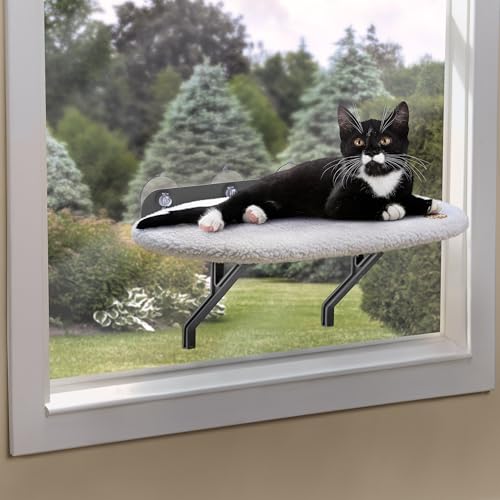
K&H Pet Products Universal Mount Cat Window Perch Bed for Large Cats, Orthopedic Window Hammock Holds 60 lbs, Sturdy Suction Cups, Washable Cover, Indoor Windowsill Furniture Bed – 14 X 24in Fleece
The most-recommended window perch in apartment-cat threads. Uses no floor space, gives the cat height + surveillance + sun in one. The straps attach to existing window frame, no permanent installation.
What to avoid
A few things show up in the negative cat-tree reviews over and over. Wobbly bases are the biggest one: if a tree shifts even slightly when the cat lands on the top platform, the cat eventually stops using the top entirely, which means the weight of the base matters more than the headline height. The carpeted faux-fur look is the second, it photographs well online but fades fast, collects hair, and visibly ages within a year, because that pet-store beige carpet was never durable, just cheap. Dangling toys built into the tree aren’t much use either, since cats stop engaging with them after about a week and they mostly make the tree look junky. And proprietary replacement parts are a real long-term headache, so look for cat trees that use standard sisal rope you can re-wrap yourself instead of ones that lock you into the manufacturer’s specific replacement kits forever.
The cat tree you didn’t mean to install
Cats will turn anything tall into a cat tree, the back of the couch, the top of the fridge, a bookshelf they’ve decided is theirs now, the desk chair you work in (ideally while you’re sitting in it), a windowsill barely wide enough to hold them, or the kitchen counter they know they’re not supposed to be on, which somehow makes it the most appealing surface in the house. None of those are cat trees, but they’re exactly what your cat is telling you. If your cat is constantly straining to get to one specific spot, the most useful cat tree you can buy is the one that puts them at that height in that part of the room. The tree is doing a lot less of the work than the location is.
How to make a cat tree actually get used
If you’ve got a cat tree and your cat is pointedly ignoring it, don’t assume the tree is the problem. The first thing to try is moving it, since most cat trees end up in the wrong spot for the boring reason that we put them where they fit, not where the cat would use them. A tree stuck in a quiet basement room gets far less use than the same tree parked in a sunny window in the room where the household actually spends its time. So move it near a window, near where you sit, or near another spot your cat already gravitates to. Then add scent, a blanket the cat has slept on or a worn T-shirt of yours makes the whole thing feel less alien, and a little catnip or silvervine on the platforms helps with the cats who respond to it.
Try this before giving up
- Move the tree to a spot where your cat already spends time.
- Put it near a window for added view and warmth.
- Add a familiar blanket or worn T-shirt to a platform.
- Sprinkle catnip or silvervine on the highest perch.
- Give it two or three weeks before deciding it’s not working.
What makes a cat tree worth buying?
A cat tree is worth buying when it solves a real problem for your cat, surveillance, escape, warmth, scratching, or a stable high perch, and it’s not worth buying when it’s mostly there to look nice. A six-foot carpeted tower with dangling toys parked in a corner the cat avoids is just floor space you’ve handed over for nothing.
A good cat tree should match your cat’s habits
- A cat who watches the world from a windowsill may want a window-adjacent tree.
- A cat in a multi-cat house may need a tall tree with multiple platforms for escape and personal space.
- A cat who scratches everything needs a tree with real sisal rope, not the thin wrap.
- A cat in a small apartment may benefit from wall shelves or a window perch instead of a freestanding tree.
- A senior cat needs a lower tree with easy steps to each level.
What we would buy again
In our house, the Mau Ivy is the cat tree that earned its space, and we’d buy it again in a heartbeat, the materials hold up, the cats actually use it, and it looks like a piece of furniture instead of a pet product in the corner. For a more budget-friendly modern option, we’d point you straight to the Vesper line. It isn’t as nice, but it does the basic job at about a third of the price, and that’s a trade plenty of people will happily make.
For Thelma, the whole appeal of any cat tree is the top platform and the view. She wants to be the single highest thing in the room, and she’ll defend that spot with a commitment that’s a little startling. For Louis, the appeal is the scratching post and the stable second-level perch where he can be near Thelma without being on her platform, so he uses the lower levels far more than the top, which is completely consistent with his whole personality.
So, what cat tree should you try first?
Start with wherever your cat already wants to be up high, the window, the back of the couch, the top of the bookshelf the cat has claimed. Then buy the cat tree that puts them in that part of the room at the height they’re already trying to reach, skipping the dangling toys and the faux fur and paying instead for base weight and sisal quality, because those are the parts that matter. And if your cat ends up using only the bottom platform after all that, that’s not a failure. As long as it’s getting used that’s a success in our book!
Founder and editor of Cat Seat and cat mom to Thelma and Louis. She’s been writing online since 2000.
An emergency veterinarian with a special interest in feline medicine — and a self-proclaimed cat lady with six cats of her own.
Hi! I’m Lindsay. I run this site alongside my hubs Cory and our very opinionated cats, Thelma and Louis. We’re so happy you’re here!