Puzzle and Slow Feeders for Bored Cats (or Cats That Eat Way Too Fast)
 By Lindsay Jones
 ✓Medically reviewed by Dr. Lindsey Mortlock
Some links are affiliate, so we may earn a small commission at no cost to you. As an Amazon Associate, we earn from qualifying purchases. Every purr-chase keeps two very demanding cats in treats. Our policy →
There are two different reasons to put your cat’s food in a puzzle, and they don’t always overlap. The first is the cat who eats too fast and throws it all up ten minutes later. Some cats have a tiny stomach and the enthusiasm of a Labrador, and a slow feeder is the only thing between them and a redecorated rug. You’ve probably met this cat. You may be this cat’s person.
The second reason is the cat who’s just bored. Indoor cats are smart and under-stimulated, and making them work for their food taps the hunting instinct that a bowl of free kibble skips over. These are different problems with different fixes: a slow feeder is about pace, a puzzle feeder is about engagement. Some products do both, but most cats only need one or the other. Here’s what to know about each, plus what we’ve used in our own house. Louis is firmly in the bored-and-engaged camp and works a puzzle nearly every day. Thelma has never once engaged with one and is completely uninterested in the concept.
Why slow feeders and puzzles work in the first place
Cats aren’t built to eat from a bowl that keeps refilling itself. In the wild, a cat hunts, they stalk, they pounce, they work for the meal, and the work is part of the satisfaction. The Ohio State University Indoor Pet Initiative, a veterinary program focused on indoor-cat wellbeing, recommends giving indoor cats foraging opportunities, meaning they should work for at least some of their food the way they would outdoors. Figuring out how to get food out of a puzzle lights up the same problem-solving and reward circuits hunting does.
Why “working for it” is good for cats
The Ohio State University Indoor Pet Initiative recommends giving indoor cats foraging opportunities, making them work for at least part of their food rather than handing it over in a bowl, because that effort engages the same hunting and problem-solving instincts a cat would use outdoors. It’s one of the cheapest forms of daily enrichment you can offer, and for a bored, food-motivated cat it can take the edge off the restless, look-at-me energy that builds up over an under-stimulated afternoon.
That’s also why some cats inhale a full bowl in ninety seconds and then throw it back up. The bowl is too easy, no work, no pacing, nothing telling them to slow down. A slow feeder fixes that with physical obstacles. A puzzle feeder fixes a different problem by adding actual thinking.
The slow feeder for fast eaters
A slow feeder is a bowl with raised bumps or ridges the cat has to work around to reach the food. The goal is pace, not enrichment, not problem-solving, just a physical structure that makes it impossible to inhale the whole meal in one breath. These work best for cats who eat dry food too fast and vomit shortly after, for cats in multi-cat households who bolt their food so it doesn’t get stolen, and for cats whose anxious eating is stressing everyone out, themselves included.
Why it worked
- Slows down eating without requiring any cat training.
- Cheap entry point into the category.
- Easy to clean, plastic dishwasher-safe in most cases.
- Works immediately, no introduction period needed.
What to watch for
- Best for dry food. Wet food gets stuck in crevices.
- Plastic surfaces hold odors over time.
- Lightweight bowls may slide when the cat pushes.
- Bowls that are too aggressive in design can frustrate the cat into giving up.
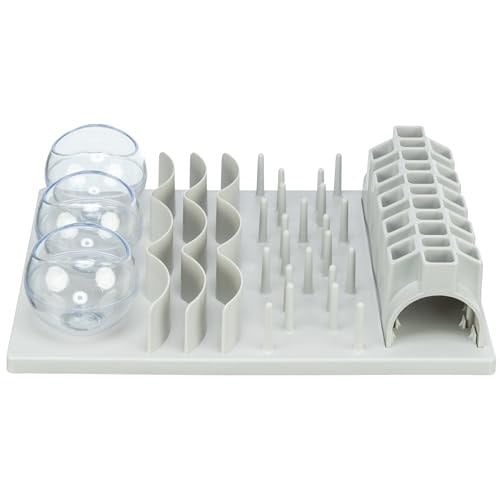
Trixie Activity Fun Board 5-in-1
The cheap entry-point slow feeder. Bumpy bowl shape forces the cat to work around obstacles. Plastic but easy to clean, and the cats-version is smaller than the dog one.
The lickimat for wet-food eaters
Most slow feeders are built around dry kibble, and wet food creates a cleaning problem bumpy bowls don’t handle well. The food gets stuck in the crevices and dries into a multi-step cleanup you’ll come to resent. The Lickimat solves that. It’s a textured silicone mat you spread the wet food across, and the cat has to lick it out of the grooves to get all of it. The result is slower eating, more chewing, and a surprising amount of focus. It also doubles as enrichment, since the licking-and-finding process is engaging in a way a regular bowl isn’t. For cats on wet food, this is the strongest slow-feeder option.
Why it worked
- Designed specifically for wet food and pâté.
- Silicone is dishwasher-safe and easy to deep clean.
- Doubles as enrichment because it requires attention.
- Cheap compared to most puzzle feeders.
What to watch for
- Some cats find the licking-only format frustrating at first.
- Wet food residue still has to be rinsed off promptly.
- Not useful for dry-food-only households.
- May need to be anchored if your cat tries to move it.
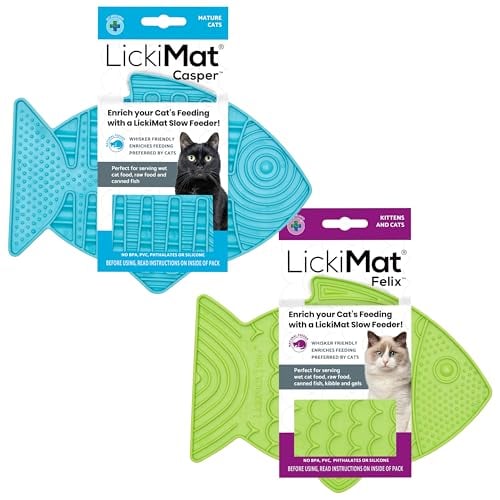
Lickimat Casper & Felix, Fish-Shaped Cat Slow Feeders Lick Mat, Boredom Anxiety Reducer; Perfect for Food, Treats and Anxiety Reduction. (Turquoise & Green)
For wet food and pâté. A textured silicone mat, spread the food across, cat licks it out of the grooves. Works for fast wet-food eaters where bumpy-bowl slow feeders fail entirely. Doubles as enrichment.
The puzzle feeder for bored cats
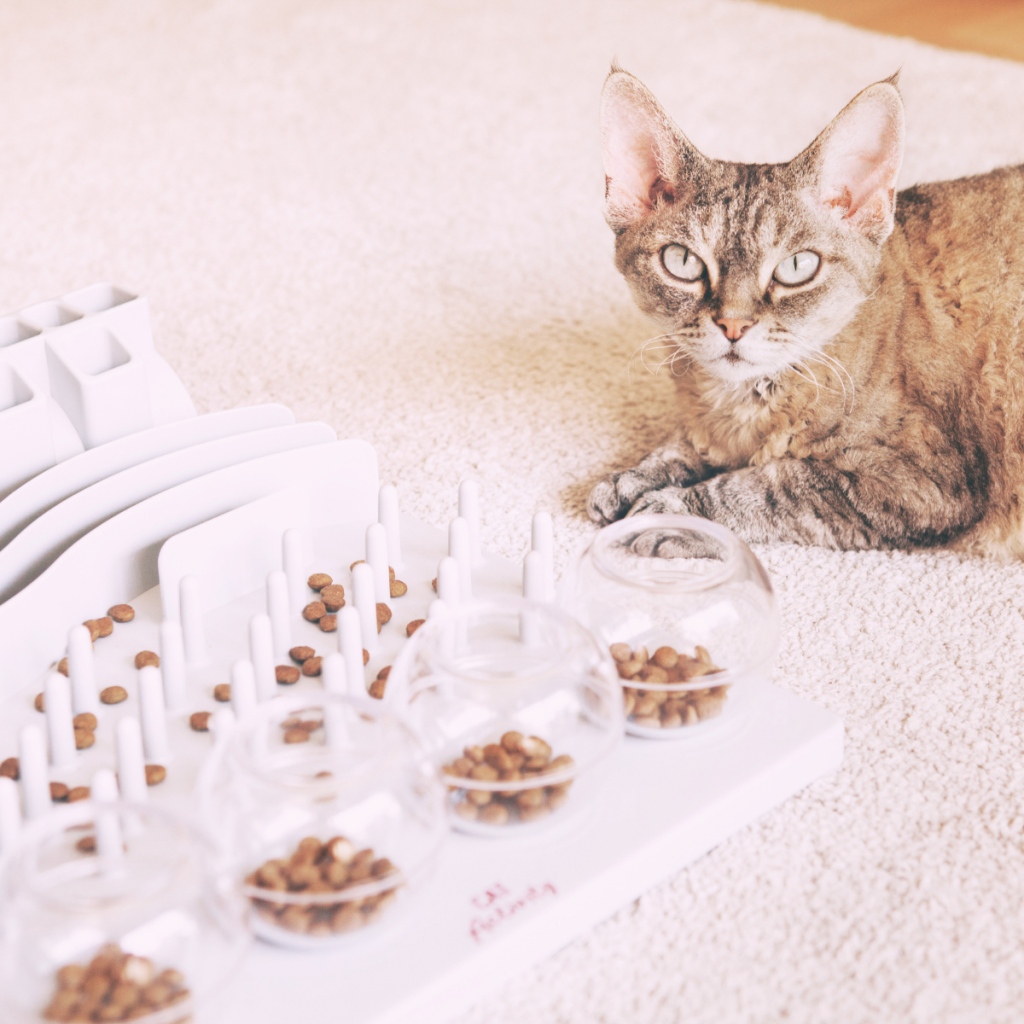
Puzzle feeders are a different category from slow feeders. They’re not about pace, they’re about handing your cat something to figure out. The good ones have multiple stations, each with a different mechanism: pegs to push, sliders to move, cups to flip. Each station hides treats or kibble the cat has to work out how to reach, and that variety keeps the puzzle from becoming a one-time problem the cat solves in two minutes and never touches again. The Trixie Activity Fun Board is the one Louis uses most mornings, and he’s worked it almost daily for months. It’s a five-station tray, and rotating between stations keeps him engaged since no single one hands him the answer right away. Thelma walks past it like it doesn’t exist, and we’ll get to her in a minute.
Play counts as a basic need, not a bonus
The American Association of Feline Practitioners lists “an opportunity to play and to express normal predatory behavior” among its Five Pillars of a Healthy Feline Environment, the framework many vets use to think about indoor-cat welfare. A puzzle feeder isn’t just a cute gadget; for a food-motivated cat it’s one of the easiest ways to deliver that daily predatory outlet, which is why an engaged cat tends to be a calmer, less destructive cat.
Why it worked
- Five different puzzle mechanisms in one tray.
- Easy to swap between kibble and freeze-dried treats.
- Washable, holds up to repeated cleaning.
- Right level of difficulty: challenging enough to engage, not so hard the cat quits.
What to watch for
- Only works for food-motivated cats.
- Some cats will not engage no matter how you introduce it.
- Plastic surfaces hold smells over time.
- Smaller pieces can be batted across the room.

TRIXIE Cat Activity Poker Box Strategy Game, Interactive Puzzle Toy with 4 Modules, Treat Puzzle Feeder for Mental Stimulation & Slow Feeding, Pink/Gray, 12.2 x 12.2 x 2.5 in
The puzzle Louis uses almost daily. Five different small puzzle stations on one tray, pegs, sliders, cups. Different enough that he doesn’t memorize one solution and lose interest. (Thelma walks past it like it doesn’t exist, which is also useful data.)
The hybrid that does both
The Catit Senses 2.0 Digger sits between a slow feeder and a puzzle. It’s a cone-shaped feeder with tubes the cat has to fish the kibble out of with a paw, and that one action does two things at once. It slows the eating down, since fishing out one kibble at a time takes longer than scooping it up, and it engages the brain, since the cat has to work out the angle and the technique. It’s a good middle ground if you don’t yet know whether your cat needs pace or engagement, and it stays interesting longer than a pure slow feeder because fishing is more rewarding than navigating a field of bumps.
Why it worked
- Solves slow eating and adds engagement at the same time.
- Cone shape stays stable while the cat works.
- Affordable for a hybrid product.
- Works with kibble or freeze-dried treats.
What to watch for
- Only works with dry food.
- Cats with limited paw dexterity may struggle.
- Tubes can be a pain to deep clean.
- Some cats just dump it over.
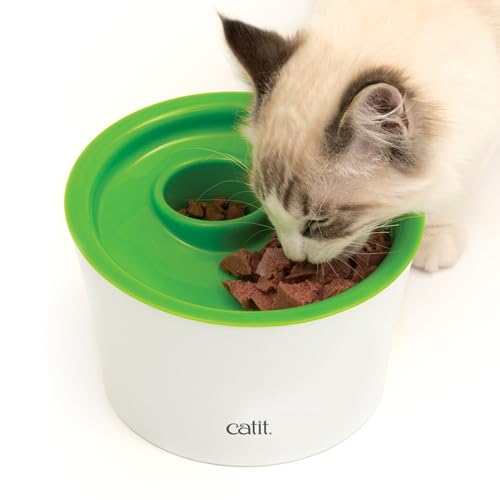
Catit Senses 2.0 Multi Feeder, Interactive Cat Toys
Sits between a slow feeder and a puzzle, cones the cat has to fish kibble out of. Makes them use a paw to work the food out, which adds the enrichment element on top of slowing the eating.
The puzzle feeder we didn’t buy
A lot of perfectly good puzzle feeders can be built from objects you already have, which is worth knowing before you spend a cent. A toilet paper roll with the ends folded in and three or four treats inside becomes a no-cost puzzle that’ll take your cat several minutes to crack open. A shoebox with a few rolls stuffed inside vertically and treats dropped down into them becomes a layered foraging puzzle. An empty egg carton with treats in some of the cups and a scrap of paper over each one is about the cheapest puzzle possible. None of these replace a real puzzle feeder, but they’re a great way to test whether your cat is even interested before you spend money. If your cat ignores a toilet paper roll with treats inside, they’ll almost certainly ignore a $30 puzzle too. Better to find that out first than to discover the expensive way that your cat is a Thelma.
How to introduce a puzzle feeder so your cat actually engages
Cats give up on puzzle feeders easily if they don’t get a quick win on the first try, so the introduction matters more than the product. Start with the puzzle basically solved, food visible and easy to reach, so the cat strolls up and eats it. The point of day one is to associate the puzzle with food, not to make them work for it. Then crank up the difficulty over the following week, hide more of the food, make it harder to reach, and watch what your cat pushes through versus what makes them walk away. If they get frustrated and quit, make the next session easier, not harder. A cat who decides a puzzle is impossible today won’t come back to it tomorrow.
Try this before deciding it doesn’t work
- Start with the puzzle fully solved and food visible.
- Use high-value treats instead of kibble for the first few sessions.
- Sit nearby so the cat doesn’t feel alone with the puzzle.
- Give the cat at least a week to figure it out.
- Switch products if your cat clearly isn’t engaging.
Cat personality matters more than the product
That’s the part most product reviews skip: some cats are puzzle cats and some aren’t, and there’s not much you can do to move a cat from one column to the other. Louis is a puzzle cat through and through. He’s food-motivated, gets bored easily, and a puzzle feeder gives him something to think about during the day, which is why he’s used the Trixie almost daily for months. Thelma is not. She has zero interest in working for food, won’t engage even when we bait it with her favorite treats, and instead sits nearby and waits for Louis to give up so she can eat the leftovers without doing a single puzzle herself, which is also a valid strategy, and arguably the smarter one. In a multi-cat household, you may find one cat takes to puzzles while the others opt out. That’s normal. The puzzle is worth having for the cat who uses it, and you don’t need every cat to engage for it to earn its place on the floor.
What makes a slow feeder or puzzle worth buying?
A slow feeder is worth buying if your cat eats too fast and vomits afterward. The basic Outward Hound bumpy bowl solves that at the lowest price point, and most cats accept it with no introduction period. A puzzle feeder is worth buying if your cat is bored, food-motivated, and already engages with the cardboard puzzles or DIY toys you cobble together from household objects. If your cat ignores those DIY versions, don’t assume a fancier store-bought puzzle will change their mind.
A good slow feeder or puzzle should match your cat
- A fast eater who vomits needs a basic slow feeder.
- A wet-food eater who eats too fast needs a Lickimat.
- A bored, food-motivated cat needs a multi-station puzzle.
- A cat who is neither fast nor bored may not need either.
- A cat who has rejected three different puzzles is a Thelma, and that is fine.
What we would buy again
The Trixie puzzle is the one Louis uses daily and the one we’d buy again without hesitation. The five-station design is what makes it work, he never memorizes one solution and quits. Right behind it, the Lickimat is the one we’d point to for wet-food households where regular slow feeders don’t cut it. The Outward Hound is the right entry point if your cat is a fast eater and you’re not sure you want to commit to a full puzzle.
For Thelma, none of these worked even a little, and that’s fine. She doesn’t need a puzzle. She’s chosen a different path, which consists mostly of napping in the donut bed and waiting for Louis to finish his food.
So, where should you start?
If your cat eats too fast and vomits, start with a basic slow feeder. It’s the cheapest fix and it solves the most common version of this problem. If your cat seems bored and you want enrichment alongside the food, start with a toilet paper roll and a few treats. If the cat engages, upgrade to a real puzzle. If the cat ignores the toilet paper roll, you save the $30. If your cat is on wet food only, go straight to the Lickimat and skip the rest.
And if your cat ignores every puzzle you try, you have a Thelma situation, which is perfectly fine. Not every cat needs a puzzle. Leave it on the floor for the cat who does.
Founder and editor of Cat Seat and cat mom to Thelma and Louis. She’s been writing online since 2000.
An emergency veterinarian with a special interest in feline medicine — and a self-proclaimed cat lady with six cats of her own.
Hi! I’m Lindsay. I run this site alongside my hubs Cory and our very opinionated cats, Thelma and Louis. We’re so happy you’re here!