Learn to Speak Cat: A Guide to Meows, Trills, Chirps and Yowls
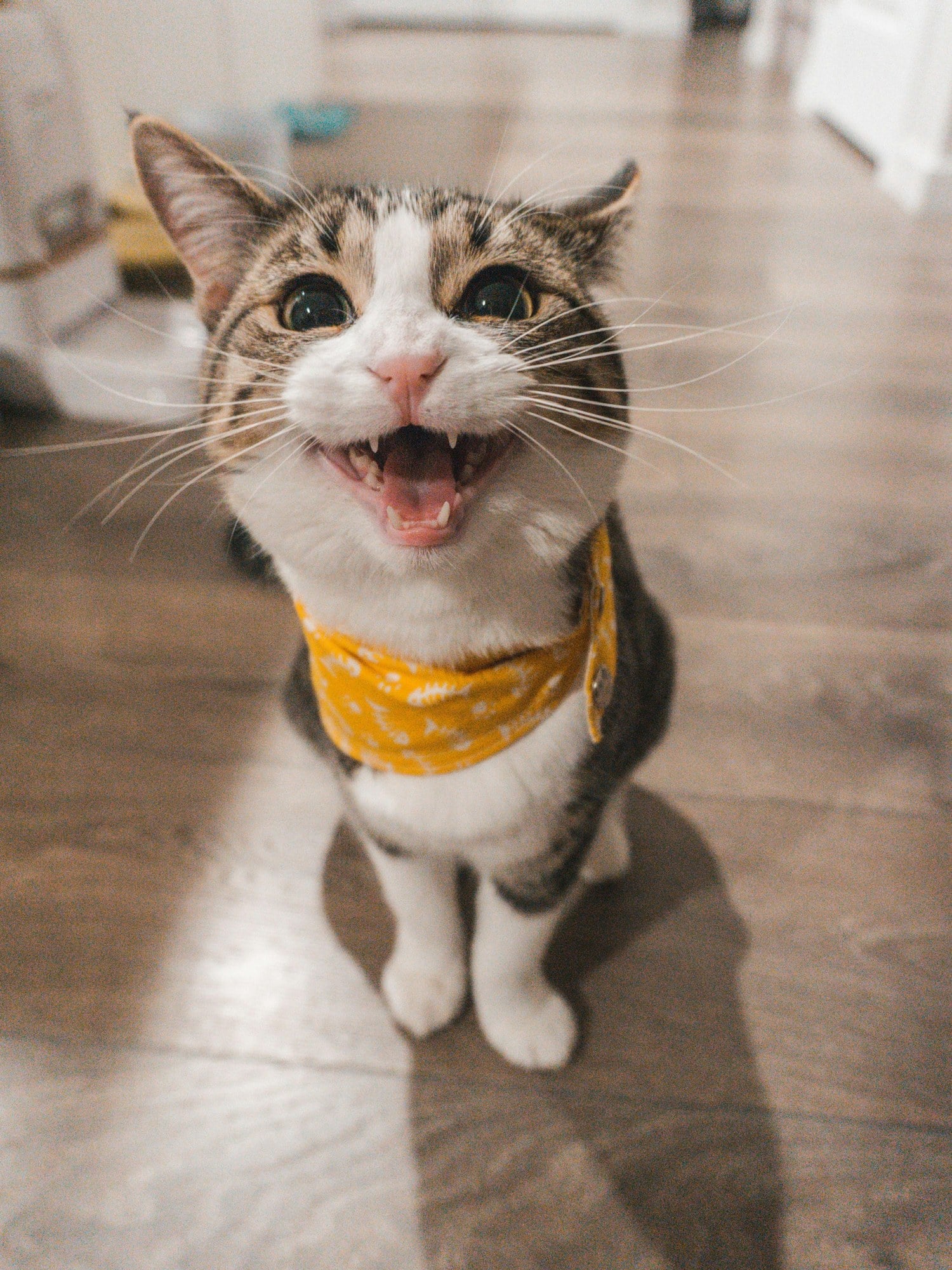
As our cats Thelma and Louis have gotten older, they’ve gotten a lot more vocal. They meow for food. They meow when they’re wondering where the heck we are. They meow when they bring us a toy. They meow when they greet us at the door when we come home. To the average listener, they can easily sound like the same sort of sound. But when you listen a little more intently, you can tell they have a wide range of sounds that come from them that each mean slightly different things.
From purring and trilling to chirping and different meows for different situations (including sounds of alarm and distress), this is a guide to the sound of our favorite fur babies.
Three ways a cat makes a sound
One easy method of sorting cat sounds is based on how the cat’s mouth moves when making the noise. Sounds can be divided into one of three groups. Some are made with a closed mouth (the purr, the trill), some with a mouth that opens and gradually shuts (the meow and louder variations on this theme, like the yowl) and others with a mouth held open in one position (the hiss, the spit, the growl).
This categorization goes all the way back to a 1944 study by Mildred Moelk, and the cat behavior researcher John Bradshaw used the same three groups in 2000. It’s helpful to know that the meaning of the sound can be worked out this way. IE: closed mouth noises are probably friendly or relaxed, opening and shutting sounds are probably asking or complaining, and a mouth held open is a warning.
The meow is for you
According to the Cornell researchers who studied cat meows, the meow is the most common sound cats make at humans and is seldom heard between adult cats. Wild cats will meow as kittens but rarely at humans as adults. Dr. Alison Gerken, a veterinary behaviorist, says the same thing, that meowing is mainly used by adult cats to communicate with humans. The meow is basically a sound they kept for us!
The ASPCA lists the reasons your cat may be meowing at you:
- To say hi when you get home or come into the room
- When they want some attention or playtime
- To let you know it’s feeding time, when they see you walking into the kitchen, or to wake you up in the morning to feed them
- To get you to open a door for them
- Unfixed cats meow to find a mate
- Disoriented senior cats may meow more (more on that below)
Dr. Gerken says a meow that’s lower in pitch, longer, or more insistent than normal may mean boredom, illness, anxiety or frustration. There isn’t a chart you can reference to tell you exactly what your cat’s meow means, because it largely depends on what’s normal for your cat. One person on Reddit described their cat’s version this way:
[I] lived with one of them so long I actually started understanding what each meow meant (food, attention, or outside to sunbathe, he’s not a very complicated cat)
— via Reddit.com
Why nobody can really read a meow (except maybe you)
Do other humans understand cats? Researchers at Cornell wondered this too and ran a study on it in 2003. Participants listened to recordings of twelve cats meowing in different circumstances and then matched the meows to the circumstance. They did only slightly better than chance, but participants who had lived with cats did better than those who hadn’t.
A second study, done in Italy in 2020, found the same thing. 225 adults listened to six different cat meows and matched them with the situation they were recorded in. Fewer than half got it right, but cat owners once again did better than non-owners. The most commonly identified meow was the food meow, which makes sense since every cat owner hears that one every day. Women and cat owners were also more likely to correctly identify the meow a cat makes when it’s left alone and the one it makes while being brushed.
How the Cornell meow study worked
For the 2003 study in the Journal of Comparative Psychology, Nicholas Nicastro and Michael Owren recorded 535 meows from 12 house cats in five situations: waiting to be fed, being antagonized (like vigorous brushing), asking for affection, asking for help with a closed door or window, and being put in a car. Twenty-eight listeners then tried to match each meow to its situation.
- They did better than chance, “but modestly so,” and hearing a string of meows helped more than a single one.
- People who had lived with and liked cats scored higher.
- The authors’ conclusion: meows are “nonspecific, somewhat negatively toned stimuli that attract attention from humans.”
So the two studies say humans can essentially, kinda, sorta know why a cat is meowing, but familiarity goes a long way! Paying attention to the sounds your cat makes at the door, or on your bed, or at 5 a.m., is what makes all the difference. I’ve written before about how much of this runs the other direction too, since cats know their own name and your voice.
Purring, and why it isn’t always a happy sound
Most of the time, if you pet your purring cat and assume they’re purring because they’re happy to see you, you’re right. According to Dr. Gerken, a purr is a low, continuous, rhythmic noise that a cat makes while breathing, and typically it means the cat is content and relaxed. Humane World for Animals (the group that used to be the Humane Society of the United States) points out that cats will even purr while they eat.
But a purring cat doesn’t always mean a happy, relaxed cat. Cats also purr in response to feeling ill or being in pain, or out of fear or stress, and it’s thought that in these situations purring is a way for them to self-soothe. If you’ve ever seen your cat purring on the exam table at the vet, chances are they weren’t purring with joy! To tell whether a purr is a contented purr or a stressed-out purr, Dr. Gerken advises looking for other physical cues. Flattened ears, dilated pupils or a tense, hunched posture mean your cat isn’t relaxed or isn’t feeling well. And if your cat has begun to purr a lot and is acting differently than usual, call your vet instead of assuming everything is fine because she’s purring.
Cats also have a special purr they use on us to get fed, with a higher, urgent sound buried inside it, and you can read about that one in my post about talking to your cat. And in 2023, researchers in Vienna found the actual mechanics of the purr may not be what scientists thought. That one is a little more science-y than most people want to read, so I put a briefer recap in the box below.
How a purr is made (maybe)
For a long time the explanation was that purring is a muscle thing: the brain sends a signal, the muscles in the voice box twitch, and they keep twitching 20 to 30 times a second for as long as the cat purrs. In 2023 a team at the University of Vienna, led by Christian Herbst, tested that in the lab and found it may be simpler than that. When they pushed air through a cat’s voice box, it made a purring sound on its own, with no signals from the brain and no twitching.
- The trick seems to be a little pad of tissue inside the vocal folds, which lets a small animal make a very low sound.
- It works a lot like the creaky, low “vocal fry” voice some people slip into at the end of a sentence.
- The researchers say this doesn’t prove the old explanation wrong, just that purring is still not fully understood.
Trills and chirrups
A trill is sort of like a purr, but higher pitched and softer, with almost a rolled r sound to it, and it’s made with the mouth closed. Dr. Gerken describes it as a friendly hello or a thank you, usually when you’re petting the cat or greeting them, or at mealtimes. Humane World for Animals says trills and chirrups are a mother cat’s way of telling her kittens to follow her, and that when a cat does it to the humans in the house it’s likely saying the same thing, come follow me (probably to the food dish). In homes with more than one cat, the cats may trill at each other too.
If your cat trills at you when you walk into the room, you’re receiving one of the nicest noises a cat makes. One person on Reddit had this to say about trilling back:
Mine seems to love when I trill back at her “mrRrrRrRrppp”. That makes her happy.
— via Reddit.com
Chirping and chattering at the window
Chirping is different from chattering. A chirp is a short, high-pitched sound (kind of like a bird would make) that means your cat is interested or excited about something nearby. Chattering is the jaws moving together fast in a smacking, clicking sort of way, usually with no voice behind it at all.
Both show up in the same situation. Humane World for Animals describes chattering as the noise cats make when they’re sitting in the window watching birds or squirrels, and Dr. Gerken reads it as a combination of excitement, concentration and frustration, over not being able to get to what’s on the other side of the glass. Some cats chirp at a lot more than birds, though:
I’ve had several cats in my life, but I never knew some chirped… until we got our latest. Sees me? Chirps. If I touch her while she’s tracking a bird in the window? Chirps. Jumps up on the bed? Chirps.
— via Reddit.com
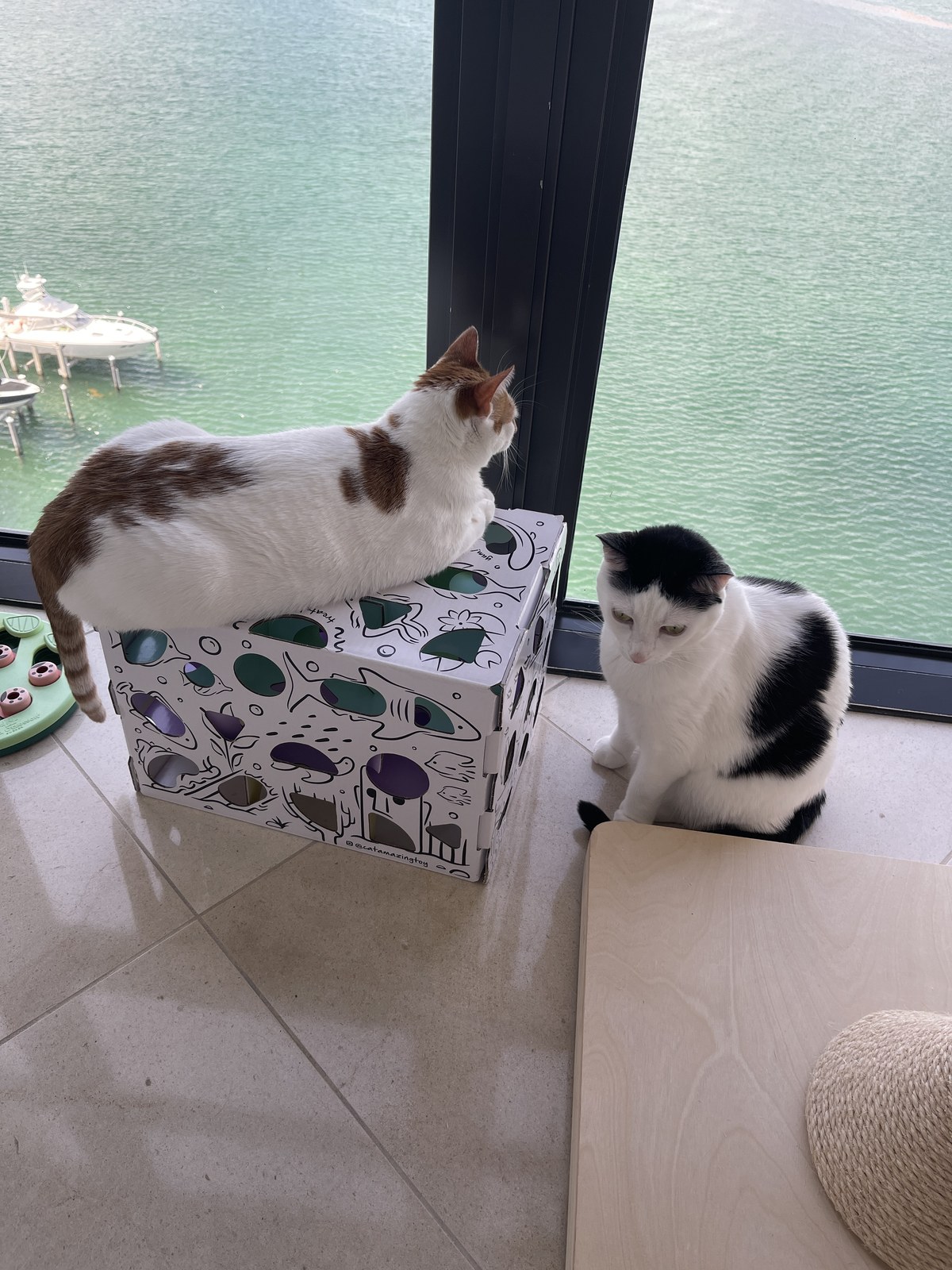
Thelma is our window watcher. I think she’s the more natural hunter of the two, and she twitches her tail at birds, the occasional dog on the sidewalk below, and even bugs that land on the glass.
And both of them chirp. Louis mostly does it when he sees reflections from something that’s moving (IE: our iPhones or watches when the sun reflects off them onto the wall), and Thelma loves to chirp at bugs on the window.
Hissing, growling and spitting
The hiss, spit and growl all involve an open mouth. The hiss is a low, drawn-out sound made by blowing air quickly out of the mouth, usually with the teeth showing, and Dr. Gerken says hissing is often an automatic response to being startled or feeling threatened. The spit is a short, explosive version of the hiss. Growling is a low rumbling noise used to warn off whatever the cat thinks is a threat, and it sometimes comes right before swatting or biting. Basically, all of these sounds say back off. Humane World for Animals says they mean your cat is annoyed, scared, angry or being defensive, and advises leaving the cat alone, and Dr. Gerken says the same: stop what you’re doing, give the cat space and don’t try to hold or restrain them.
Typically the hiss isn’t a cat’s first warning. You’ll see body language warnings, like the ears going back or the tail swishing, before your cat resorts to hissing, so if you pay attention to those you’ll usually have a chance to back off before anyone has to hiss at all. And a hiss out of nowhere from a cat who never hisses is worth thinking about, because sometimes finding out why they’re startled is important.
I had a cat who craved attention,and then one day I came behind the cat tree where was lounging to pet him and he hissed at me. Then it was as though he realized it was just me and calmed down. Turns out, he had started to lose his hearing and he couldn’t hear me approaching, and I had given him a scare.
— via Reddit.com
Yowling, howling and caterwauling
A yowl is described by Dr. Gerken as a loud, drawn-out meow, while a howl is the same sound in a shorter form. The ASPCA describes a yowl as longer and more melodic than a meow, and says that adult cats keep the meow for people and use yowling with other cats, most commonly during mating season.
The classic yowler is the female in heat. If your unspayed female yowls, acts extra affectionate, rubs on things, rolls around on the floor and seems to meow non-stop, chances are she’s in heat. The ASPCA says this lasts anywhere from four to 10 days, and if she isn’t bred she’ll start again in another 18 to 24 days during the breeding season (roughly February through September, though indoor cats may cycle all year). Unneutered males who can tell there’s a female in heat nearby will pace and meow nonstop. The ASPCA’s solution for him and her is the same: spay and neuter.
Yowling can also just be distress. Humane World for Animals says a cat that’s stuck somewhere, looking for you, or in pain may yowl. We found this out first hand on the drive to the vet: after about 15 calm minutes in the car, Louis gets extremely stressed and extremely vocal, and that’s the reason we switched to a mobile vet who comes to us. Funny enough, when the Cornell researchers needed recordings of distressed meows for their study, the way they got them was by putting the cats in cars, so Louis is apparently normal.
When the sound changes, call the vet
The pattern that matters most isn’t any one sound, it’s a change. Dr. Gerken says a sudden change in your cat’s vocal behavior should never be ignored. The ASPCA says aging cats are prone to kidney disease and an overactive thyroid, and either one can make a cat meow a lot more, so even if your cat has been a food beggar all her life, she should be thoroughly checked by a vet if she’s suddenly meowing a lot. The veterinary behaviorists Dr. Debra Horwitz and Dr. Gary Landsberg at VCA recommend an exam for any middle-aged or older cat who starts vocalizing, to rule out pain, hormone problems and high blood pressure, and they point out that older cats can also get loud because their hearing and eyesight are fading, or because of cognitive decline, which is the cat version of dementia.
Please get his thyroid checked. My kitty did this when she got older and it was hyperthyroidism. She lived many years after with no yowling or worsening symptoms thanks to a simple daily med. Not saying that’s it but worth a check.
— via Reddit.com
If all’s well at the vet, it’s possible your cat has simply learned that if she meows long and hard enough, you’ll cave and provide whatever she’s after. Both the ASPCA and the VCA vets recommend withholding whatever she wants (attention, food) until she stops meowing, and giving it as soon as she stops. Feeding on a regular schedule helps too, and so does an automatic feeder if she’s a persistent 5 a.m. breakfast solicitor. You may find the problem gets worse before it gets better, which VCA says to expect. And of course never, ever, scold a cat for meowing or anything else!
The ASPCA has one more rule I like. Don’t ignore a meow unless you’re certain what your cat is trying to tell you, because meowing with no obvious cause could mean something’s wrong, like a litter box she can’t get to, an empty water bowl, or a cat who got shut in a closet. Most of the time you know she’s just telling you it’s dinnertime. But there’s no reason not to check, just in case it’s the one time it isn’t.

Founder and editor of Cat Seat and cat mom to Thelma and Louis. She’s been writing online since 2000.
Hi! I’m Lindsay. I run this site alongside my hubs Cory and our very opinionated cats, Thelma and Louis. We’re so happy you’re here!