Cat Tail Meanings: The Question Mark, the Quiver, the Bottle Brush and the Thump
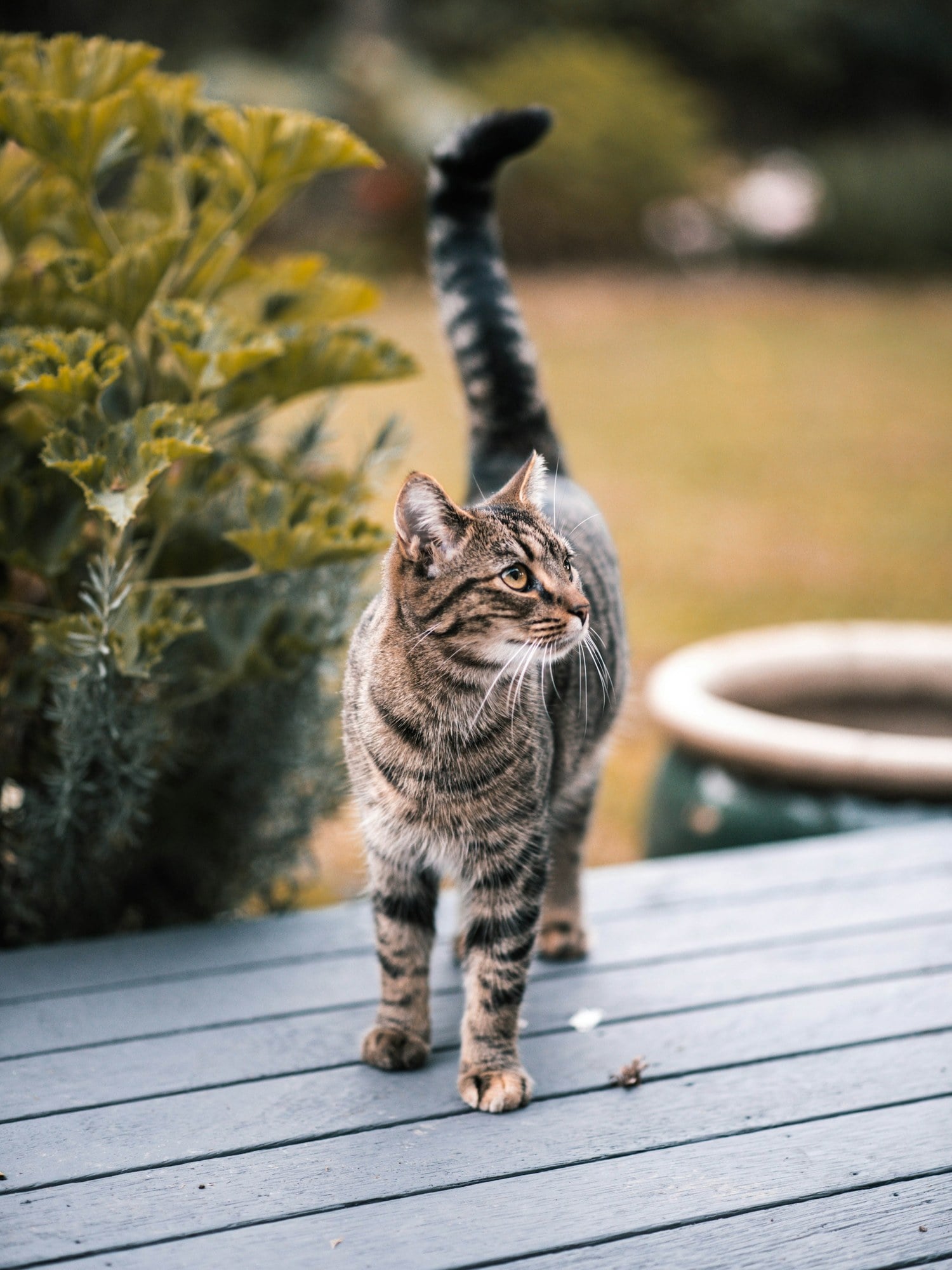
It was my husband Cory who actually introduced me to the idea of a cat’s tail position having meaning. When we got Thelma and Louis, he would point out the classic “question mark tail” (happy cat) and of course the “bottle brush” (scared cat), the latter of which we’ve thankfully only seen once or twice. Now that I know what all the positions mean, I love seeing what Thelma and Louis do.
Louis is the king of the question mark position, which makes me happy knowing that he’s apparently happy. Thelma walks around with a bit more hesitation (she’s probably wondering if her brother is going to come out and bother her). She walks with her tail straight out, but if I’m walking beside her and say “Thelma get that tail up” she actually will! Another thing that Thelma does that I absolutely love is her tail will quiver when she’s about to get a meal, which I just think is the cutest thing in the world! But these things sort of align with their overall personalities. Louis is the type of cat who will come up to strangers and flop down on the floor in front of them so they can rub his belly. Thelma is a little more on edge when it comes to greetings. I have to stick out a finger for her to sniff, and then she makes her decision on whether she feels like saying hi.
Ironically, the more dog behavior we grew up around, the more likely we are to misread a cat. A happy, excited dog wags their tail. A wagging cat tail is most likely telling us to stop whatever we’re currently doing. Another example is a tail held upright. With dogs we see the tail held up like a flag. With cats, an upright tail is their way of greeting you.
So let’s go through all the tail meanings! Below are the tails held high in the air, the ones hooking like question marks, quivering, puffing out like bottle brushes, slowly swishing and thumping the ground, and the tail signs that mean something is physically wrong (which usually get left off of the tail charts).
Why the tail is worth learning
Cats display more subtle signs when they are in pain, afraid or feeling anxious, and the more blatant signals, like swatting, hissing and acting defensively, come later on and only in very extreme circumstances. That’s according to the University of Edinburgh’s veterinary school in its guide to feline body language. Fortunately, a cat’s tail gives us one of the earliest signals that is easy to notice if you’re paying attention.
Additionally, you can use the tail along with your cat’s eyes, ears and body, though Humane World for Animals also points out that they can each send contrasting messages, which is why you have to look at all of them together to work out how a cat is feeling.
I wrote more about this in a separate article on reading your cat’s body language, to give you more details on what the ears, eyes, and whisker movements and positions really mean.
Fun fact: Did you know that only house cats raise their tails in the air as a greeting? The adults of other cat species don’t do this! More on that in the box below, because it’s one of my favorite cat facts.
Where the straight-up tail came from
In a 1997 University of Southampton thesis, Charlotte Cameron-Beaumont compared house cats with four undomesticated small cat species and found the wild cats used most of the same social signals, with one exception: as adults, none of them raised the tail as a friendly greeting. Her conclusion was that the tail-up signal probably evolved during domestication, and that in house cats it goes together with rubbing.
- In wild species the raised tail is something kittens do to their mothers. House cats are the ones that kept doing it as adults.
- A 2009 study in Behavioural Processes watched a free-living cat colony in Italy and found the lower-ranking cats did most of the tail-raising, and the higher-ranking cats were on the receiving end.
- The authors read tail up as a cat’s way of acknowledging that the other cat outranks it, offered along with friendly behaviors like rubbing.
Straight up: the friendly flag
A tail held straight up means your cat is feeling friendly and social, and Dr. Alison Gerken, a board-certified veterinary behaviorist, adds that that’s also how kittens greet their mothers. So when the tail is in that position, it’s OK to give them pets or play with them, because they’re basically telling you they’re happy to see you and up for it right now!
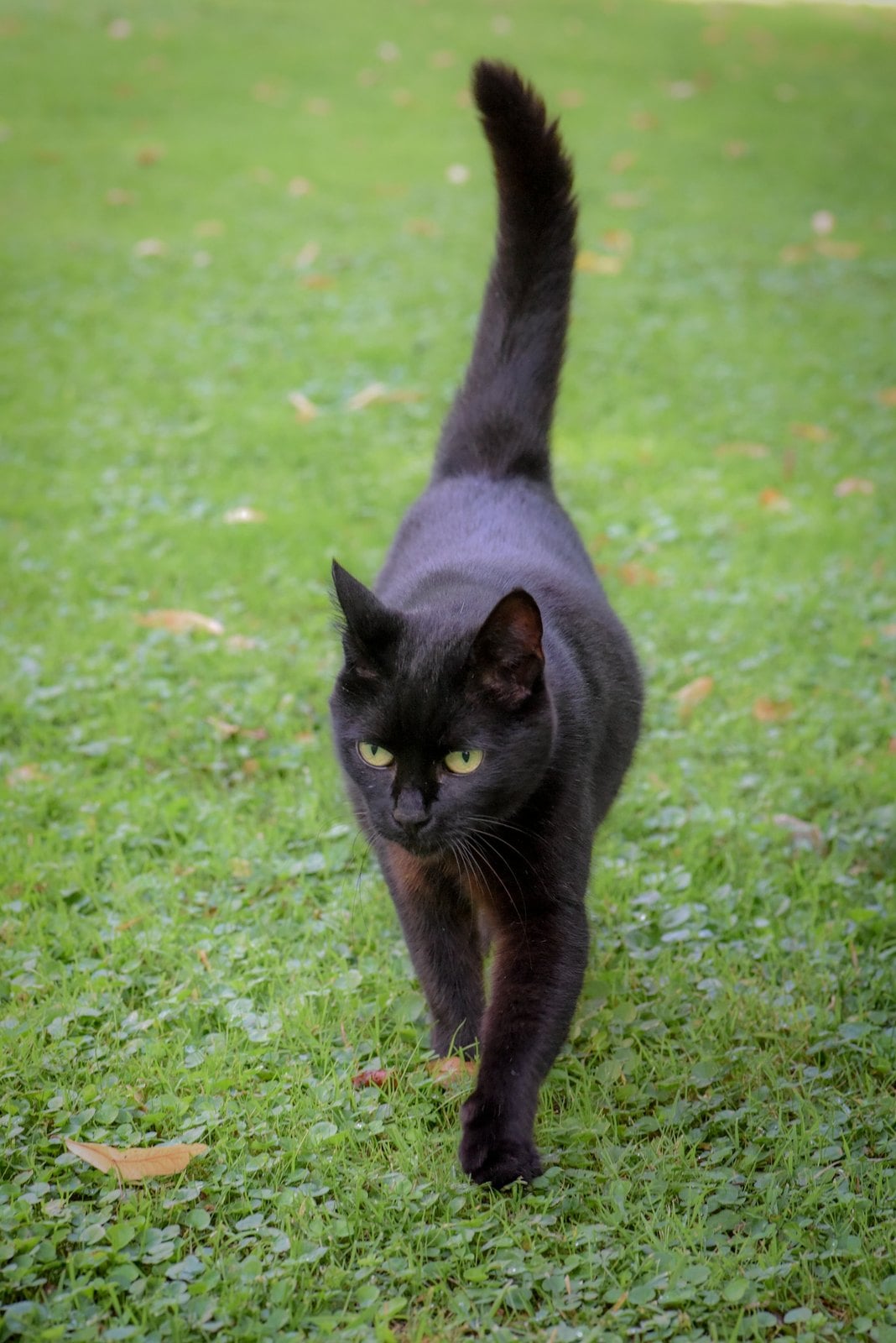
A researcher at the University of Southampton back in 1997 tested whether cats could tell a friendly cat from an unfriendly one using life-sized cat silhouettes, one with its tail up and one with its tail down. The cats approached the tail-up silhouette quicker and with less hesitation than the tail-down one. So cats read the tail on a cutout the same way they read it on a real cat.
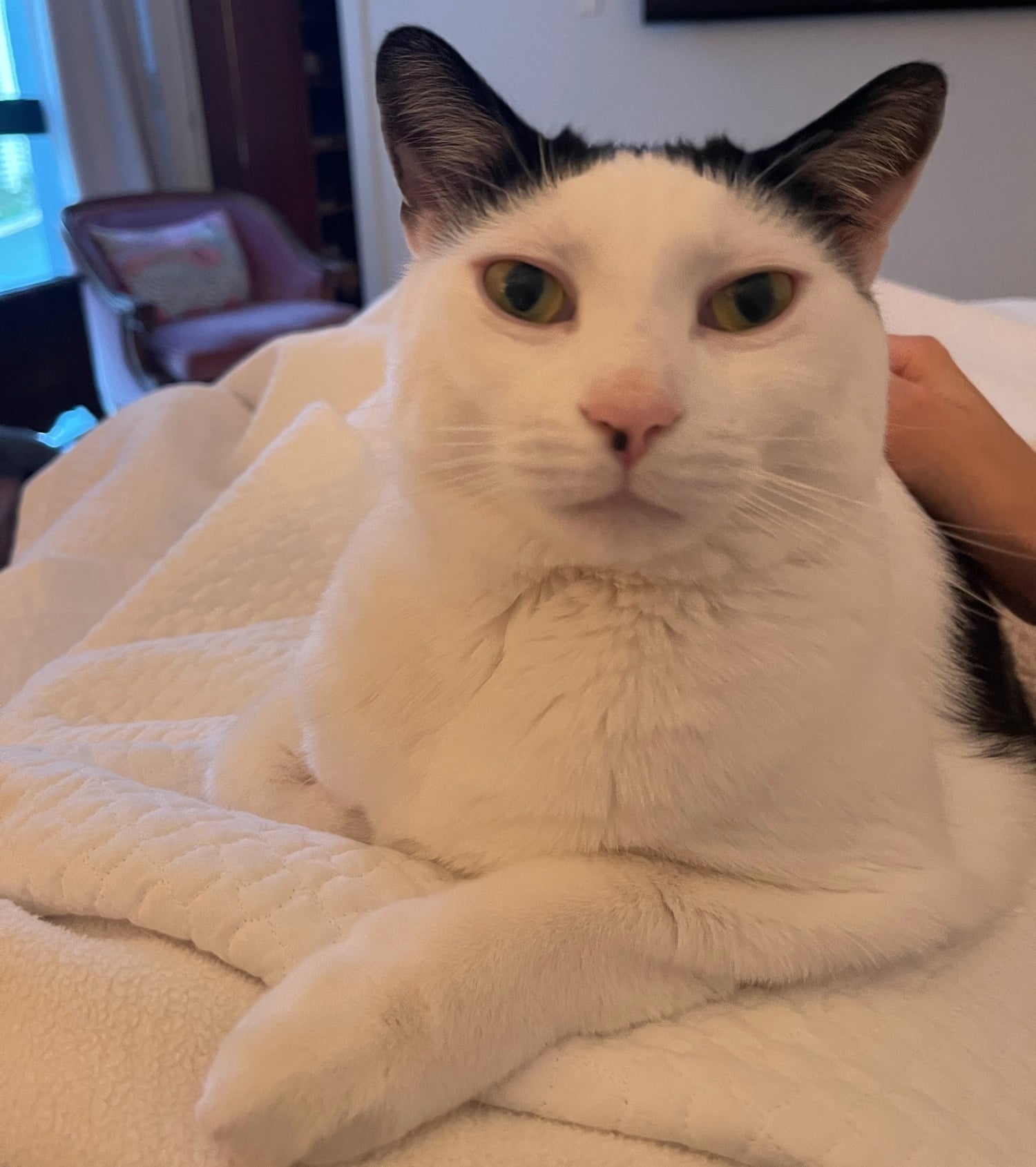
I’ve noticed that Louis has his tail up quite a bit. He’ll strut around the house with his tail up like a flag (see the pictures). Thelma does it too but less often.
The question mark
A tail held high with the tip curved over, like a question mark or a shepherd’s hook, is also a friendly greeting, according to Dr. Gerken, and an invitation to interact. Essentially your cat is waving hello to you.
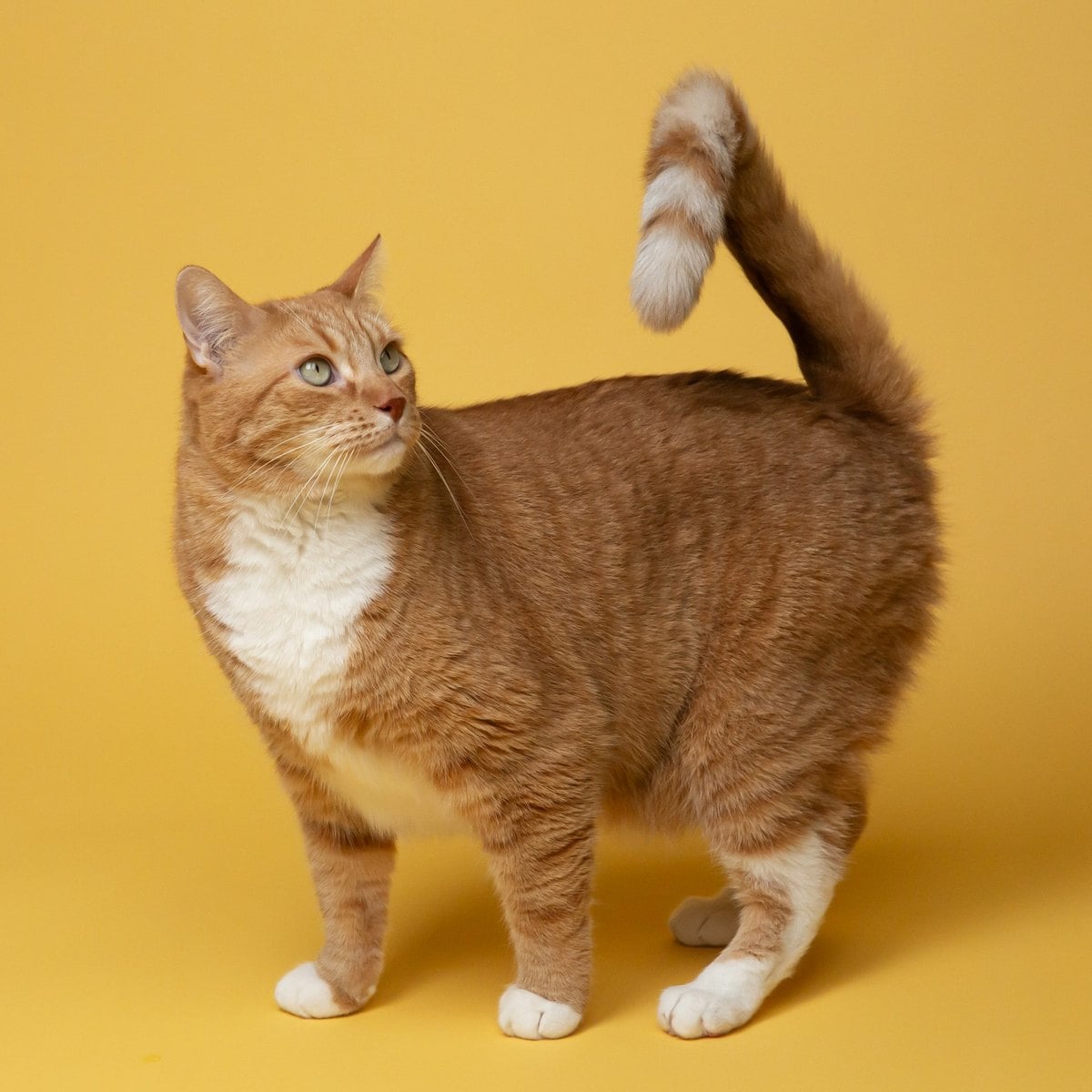
I think of this one when I’m scrolling through pictures of Louis. Almost half of the pictures I have of him ambling along on our rug have his tail upright and curved at the tip, and now that I know what it means I smile every time I see it, because he’s telling us he wants to interact.
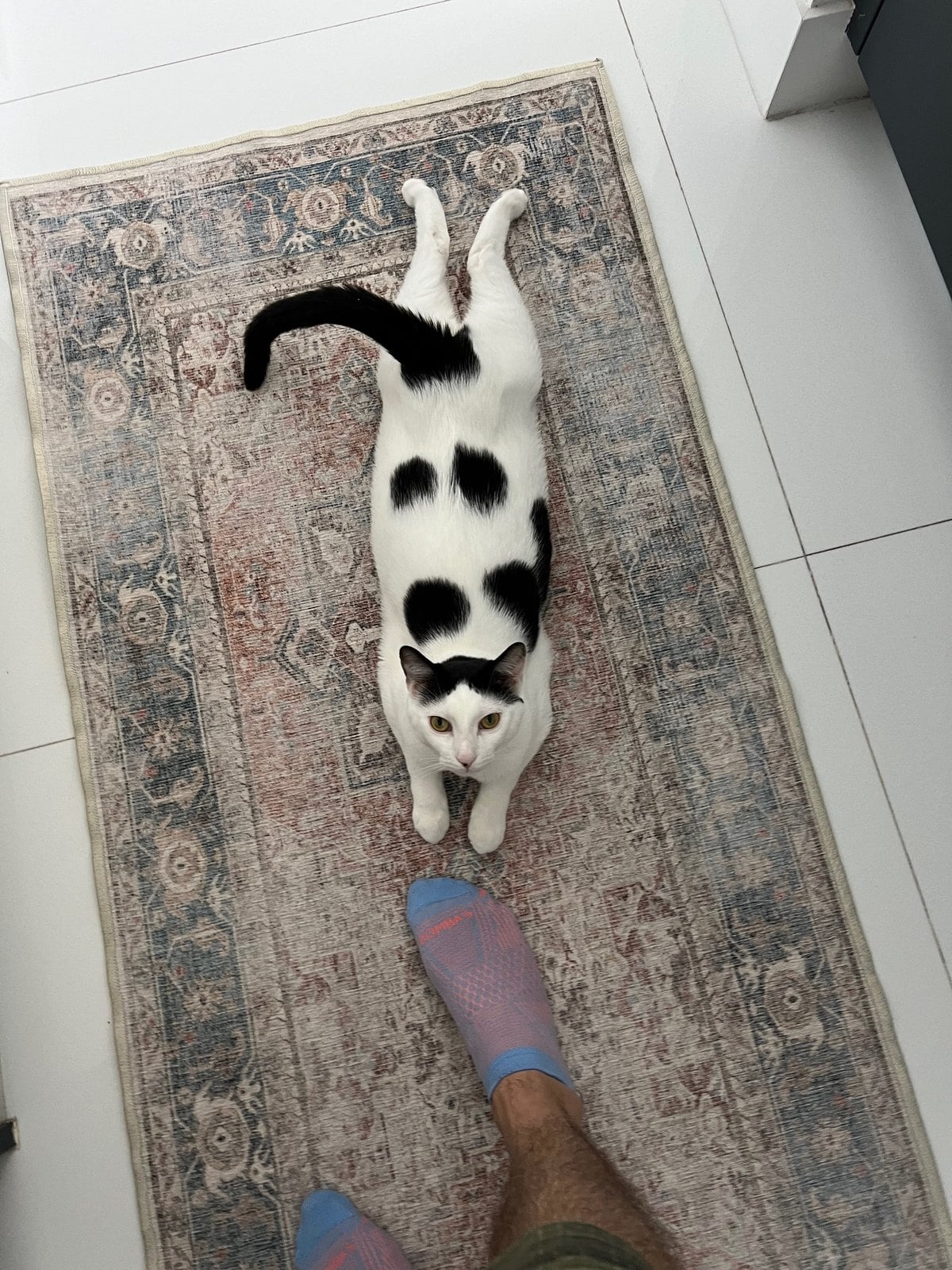
The friendly part of this position is about wanting to interact (play, pets), NOT about petting the tail. According to Dr. Gerken, most cats enjoy being petted around the cheeks, chin and ears, and the tail is not somewhere most of them want handled. Louis likes his chin rubbed (and his belly when he’s up and about), and Thelma likes her head and chin, so the hook gets us over there and then the petting happens somewhere else entirely. I don’t know about you, but we pet their tails OFTEN. We’ll start mid-body and extend all the way to the tip with a little tug. They seem to like it!
The quiver
What may look a bit startling the first time you see it is actually cause for celebration. A straight-up tail that vibrates, a fast little shiver from base to tip, is a cat that’s excited to see you (or another cat), Dr. Gerken says, and Humane World for Animals reads the quivering upright tail as excited or very happy. So if you come home to find your cat shaking their tail at you, that’s how happy they are to see you.
There is one exception. Dr. Gerken says that if the cat is quivering the tail while backing up against a wall or a piece of furniture, it could be in the process of urine marking, and Humane World for Animals says an unneutered or unspayed cat doing the quiver may be about to spray. So if the quiver is aimed at you as you walk through the door, it’s a greeting. If the tail is aimed at the side of your couch, it wouldn’t hurt to have a peek.
My fixed girl does this. I call it “happy tail” or “shaky tail”. She mostly does it when she thinks she’s getting a treat.
— via Reddit.com
Wrapped around you, or around themselves
According to Dr. Gerken, tail wrapping can also be a greeting, especially when a cat wraps their tail around your leg or another cat’s tail. She calls it an affiliative behavior that demonstrates a willingness to interact. Translation: your cat likes you.
When sitting, a relaxed cat may wrap their tail loosely around their feet, and that’s just a cat sitting down. The RSPCA describes a happy sitting cat as one with the tail held out loosely from the body, and a worried cat as one with the tail tucked tightly into the body. So it’s not the wrapping that matters, it’s whether the tail is tucked in tight.
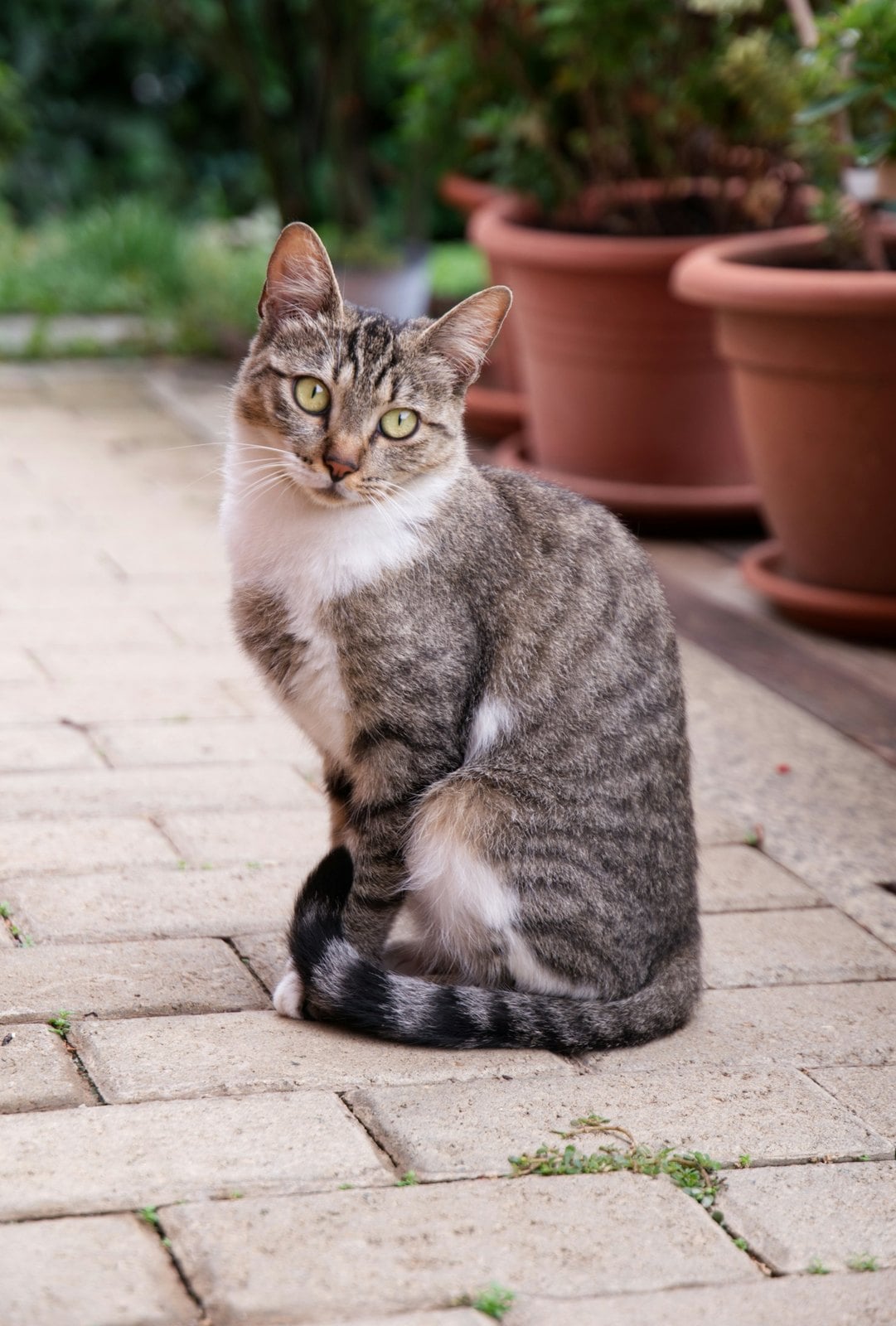
However, according to Dr. Gerken, if the tail is tightly wrapped around the body, that can also mean your cat is feeling fearful, on the defense, or in some type of physical pain, and the University of Edinburgh guide lists a crouch with the tail wrapped around the body as a defensive posture. If your cat is frequently in that position for more than a few days, Dr. Gerken recommends giving your vet a call to make sure your cat isn’t feeling sick or in pain.
Low, straight out, or tucked
I think this is probably the hardest one to figure out. A tail held straight out behind the cat, roughly level with the back, is an observant cat who is still not quite sure how they feel. When one of ours goes into a room it’s not used to, this is exactly what they do. Thelma skulks into the room and creeps around to investigate, and Louis saunters in like a lumberjack.
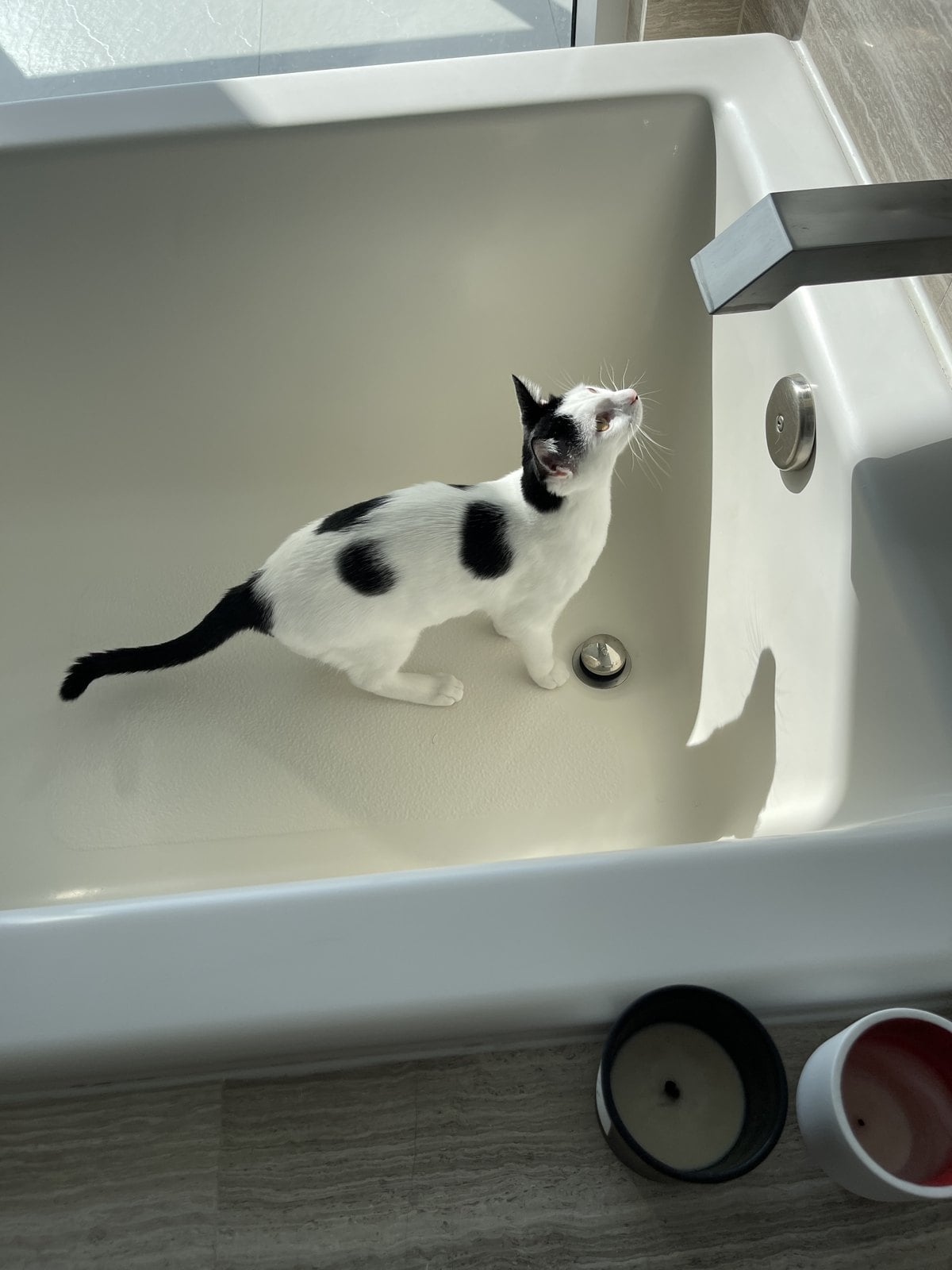
A cat holding its tail below the level of its spine is a cat whose confidence is dropping. Dr. Gerken says a tail held lower than the line of the back means some anxiety or fear, and Humane World for Animals reads a tail held very low or tucked between the legs as insecure or anxious.
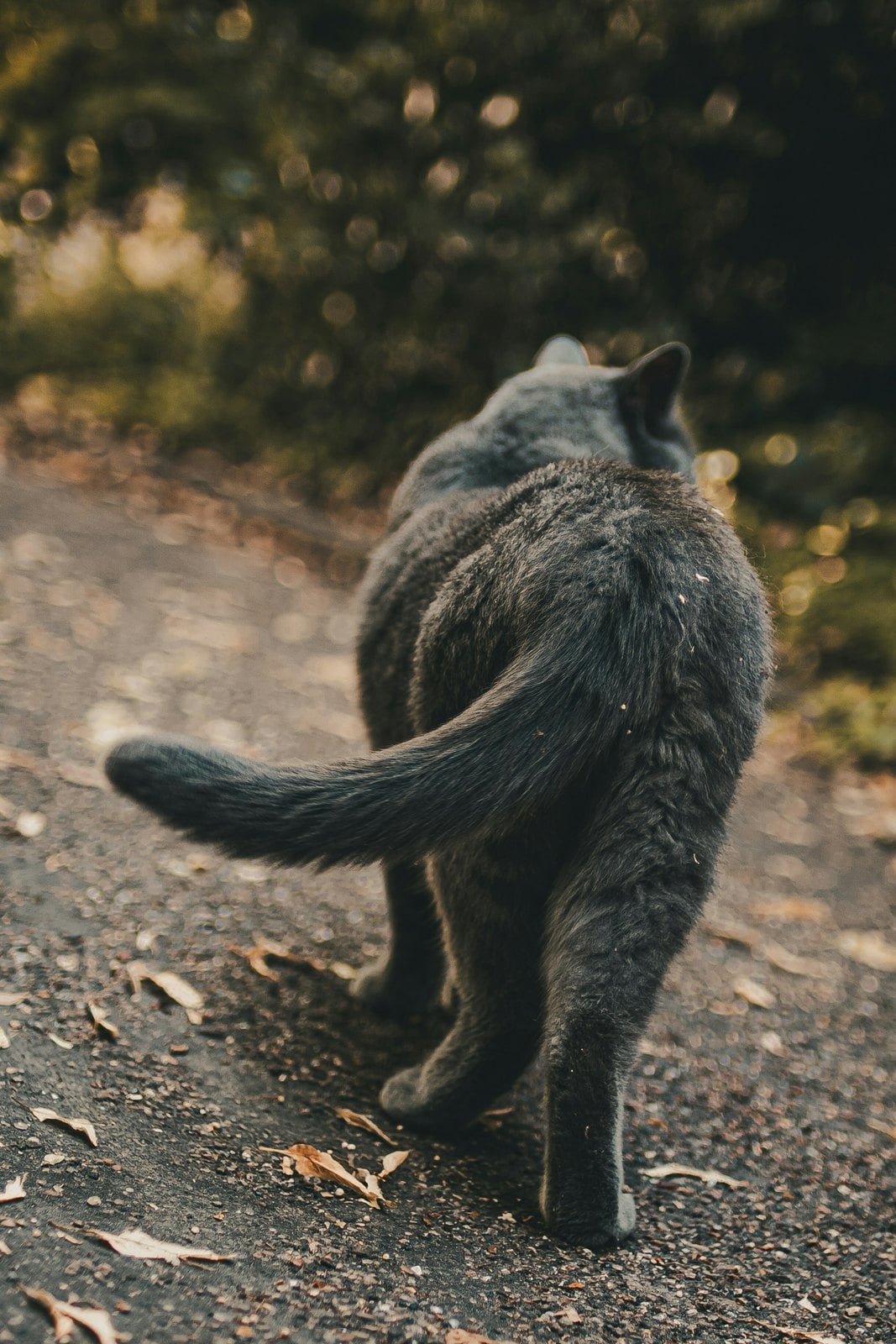
A cat who has the tail completely tucked in between the back legs is really scared, Dr. Gerken says, and it can also mean pain. We’ve also seen this happen whenever I pull a trash bag out of the bin or my husband sneezes, and both cats bolt down the hall and under the bed with their tails tucked in. It’s amazing how scared they get considering nothing bad has ever happened to them in their life! LOL.
The bottle brush
Everyone knows this one from the Halloween decorations. I’ve seen it a couple of times with our cats (for different reasons, which I’ll get to), but I had never really thought about what was going on. Dr. Gerken explains that a puffed-up tail means the cat has been startled or frightened by a sudden, severe threat and is trying to look bigger. According to Humane World for Animals, hair standing on end is another sign a cat is frightened or angry, and the University of Edinburgh guide says an arched back and raised hair is a cat that’s ready to react.
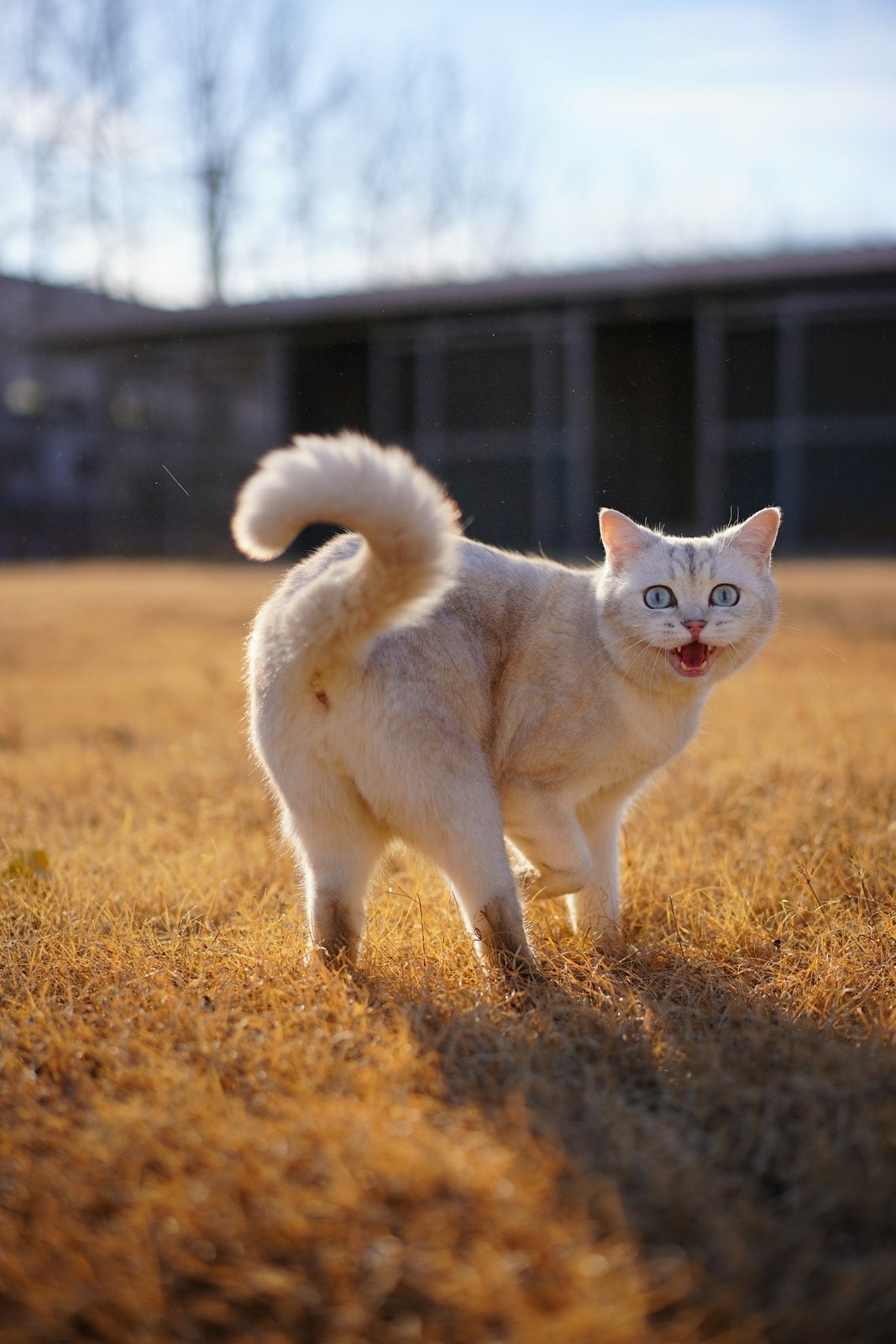
So if you see your cat in the full classic Halloween cat pose (arched back, standing hair and a bottle brush tail), it’s scared and thinking about what to do. What should you do? According to Dr. Gerken, don’t react directly to the cat. Take away the source of the reaction and step away. Give the cat room to relax, because going up to your scared cat may be interpreted as yet another threat, in which case you may receive a swat or a bite for your trouble.
As I mentioned earlier, we’ve only seen this a couple times in Thelma and Louis. Once was when a dog came over, the other was likely Thelma scared of Louis after he pounced on her and she backed away. One person on Reddit described what they do when they see their cat do this:
…the moment you see that fur standing on end, you need to disengage! My orange boy has a skinny tail, but when he first interacted with dogs, his tail would get SO big. He has his dog friends now, so it doesn’t happen as much anymore.
— via Reddit.com
Twitch, swish, thump: the moving tail
If your cat’s tail starts swishing back and forth, don’t make the mistake of taking dog tail wagging as a benchmark. Instead of signaling happiness, it usually means your cat is starting to get a tad annoyed, but a moving tail isn’t one thing, it’s a scale. Humane World for Animals gives the general guideline that the faster a cat’s tail is moving, the angrier they are, and the University of Edinburgh guide breaks it down into three steps. Tail flicking is mild irritation, tail lashing is annoyed, and tail thumping means your cat is getting frustrated. One person on Reddit summed the scale up for a new owner:
Tail swishing like that is fine. A lazy flick of the tip is fine. Thrashing or thumping against the ground means he’s upset. If you see it you’ll recognise it immediately.
— via Reddit.com
At the quiet end is the twitching tail tip. Thelma loves sitting at the window and watching anything and everything that goes on outside. Whether it’s a dog walking by downstairs, a bird, or a bug that’s landed on the glass (she loves chirping at those), her tail tip is twitching. According to Dr. Gerken, a twitching tail tip is usually a sign of predatory behavior, a cat that’s stalking, playing or hunting. So if your cat isn’t fixed intently on something, it probably means they’re a little annoyed or frustrated.
Dr. Gerken says a slower swishing from side to side can also mean focus, particularly if your cat is fixated on a toy, another animal, or something they see outside, and they may be about to pounce. Predatory play is a good way to enrich an indoor cat’s life, so if the swish is aimed at a toy on a wand, let ‘er rip.
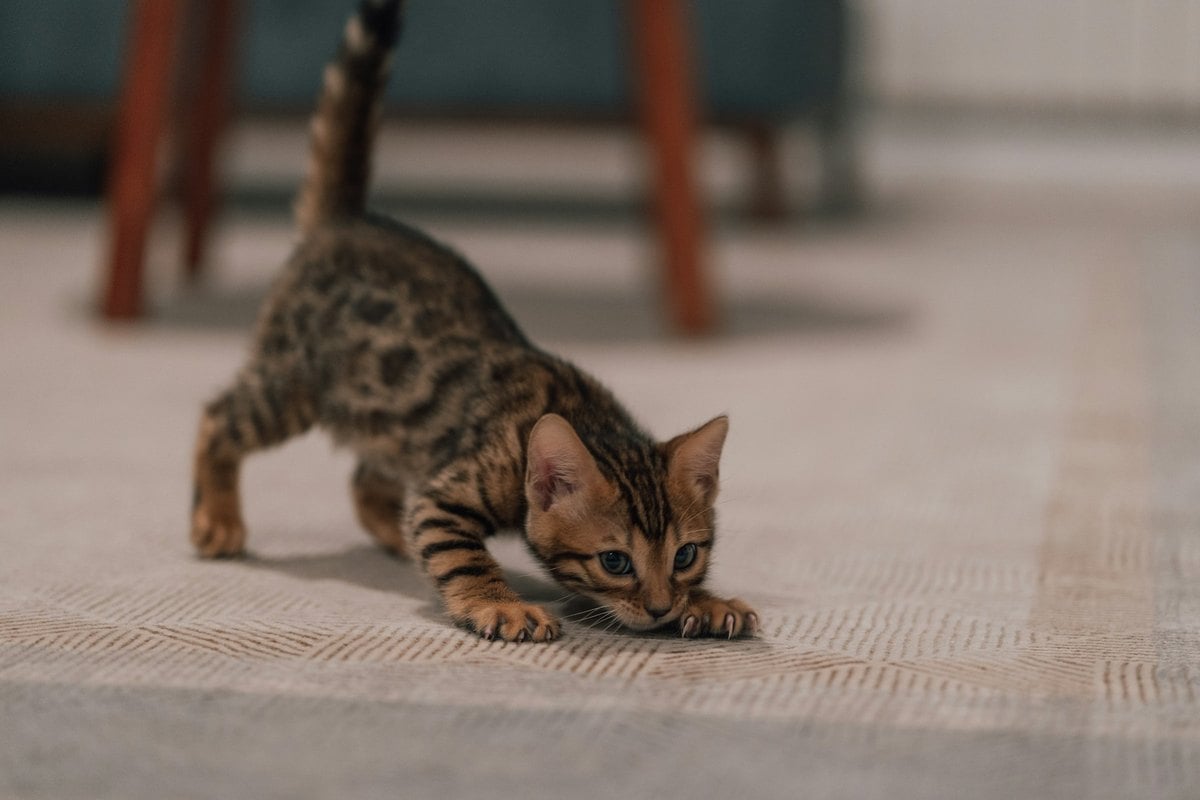
A thrashing or thumping tail is the one to respect. Dr. Gerken calls it a distance-increasing signal, meaning your cat is very annoyed, irritated or even angry and would like some space, and she says a thrashing tail may be a prelude to hissing, growling, swatting or biting. In our house the petting cue works a little differently. Both of my cats love being petted in a spot we call their squeamies, right on the butt by the tail, but when Louis has had enough squeamies he puts the brakes on by gently biting my hand.
This happens whenever one of my cats lays down on my chest and i pet her for a while. If i make eye contact after patting her for 15 minutes her pupils dilate full size and her tail starts wagging and she uses my face as a chew toy then proceeds to prance off to take a nap on the other corner of the bed. She owns the house.
— via Reddit.com
The tail at rest
A still tail is a content tail. Humane World for Animals considers a basically stationary tail to be a sign of contentment, and so does the RSPCA, whose picture of a happy sitting cat has the tail resting casually away from the body, while their happy standing cat has the tail pointing straight up with the tip curled.
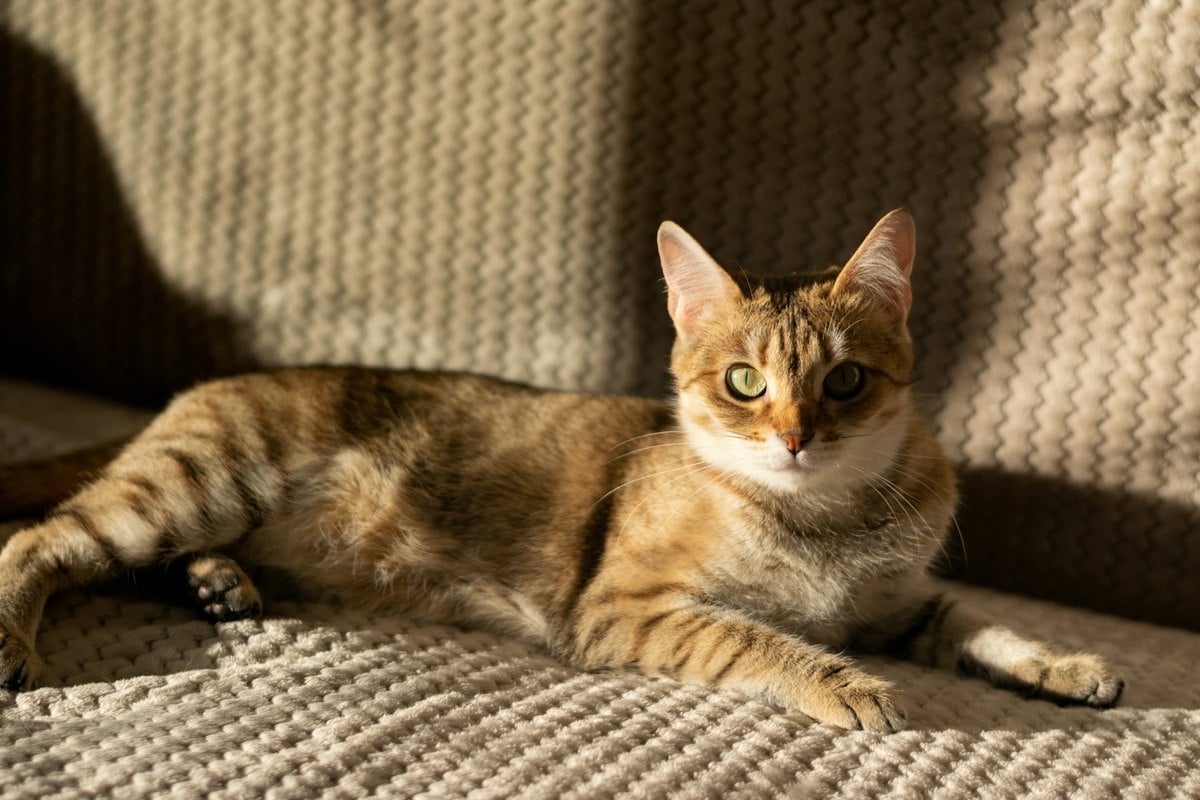
Occasionally I catch Thelma relaxing with her front paws crossed and her tail casually at rest beside her, and I like to think she’s having her own moment of zen.
When the tail itself is the problem
Most of the tail charts you’ll come across focus on your cat’s mood rather than injuries, but tail trauma is more common than you think. Dr. Katie Freeman of Veterinary Emergency Group lists doors (and windows), being accidentally stepped on, fights with other animals and falls from a height as the most common reasons cats hurt their tails. The door one is the one I always worry about, or us accidentally stepping on a tail, because our cats love to sit right next to us when we’re doing things like cooking.
If your cat’s tail is swollen, that can be a sign of a broken tail, so don’t just keep an eye on it at home, because an X-ray will usually be needed. The signs she lists are a tail that’s limp, not moving, or not moving the way it usually does; swelling or a visible kink; pain or aggression when the tail is touched; trouble urinating or defecating; and behavior changes like hiding, avoiding contact or being less active than normal.
Take your cat to the vet immediately if they’re having any trouble passing urine or stool along with a tail injury, because the nerves that control both run through the base of the tail. And Dr. Gerken’s rule from earlier applies here too: a cat crouching with the tail tightly wrapped for more than a few days should be checked for pain. Those are the two tail situations where the answer isn’t to read the mood, it’s to pick up the phone.

Founder and editor of Cat Seat and cat mom to Thelma and Louis. She’s been writing online since 2000.
Hi! I’m Lindsay. I run this site alongside my hubs Cory and our very opinionated cats, Thelma and Louis. We’re so happy you’re here!