9 Common Cat Behaviors Explained (and When to Pay Attention)
 By Cory Jones
Your cat is a fun, little weirdo. And that’s because every cat is a fun, little weirdo. But there’s a reason why everyone’s cats do all the crazy (and hilarious) things they do and it comes down to their ancestors.
To understand your cat’s quirky behaviors we have to take a look at their evolutionary history. Cats were predators but were also prey to bigger animals. This means they needed safe places to sleep, opportunities to practice their predatory instincts and a way to delineate their territory.
Now that cats are living in houses, these instincts have to be exercised in the best ways available, such as sprinting across your bed at 3 a.m., stalking the couch, ignoring their pricey beds in favor of the box you got them in or acting territorial by hovering in the doorway while you fold the laundry.
Understanding the reasoning behind your cat’s behavior, such as these nine adorable ways your cat thinks of you as its parent, can help you and your kitty strengthen your already-affectionate bond.
And if any of these behaviors suddenly change in your cat, consult with your veterinarian. Here are nine common cat behaviors that might puzzle you, what they mean and how to respond:
1. Sleeping (and sleeping some more)
When you leave for work, the cat is asleep. When you get home, the cat is asleep in a different place. Aside from the change in location, there's scant evidence to suggest that your cat accomplished anything.
You'll often hear that cats sleep sixteen hours a day. Sleep needs vary, though, and sixteen isn't a universal average. In Cornell's CatWatch, veterinary behaviorist Katherine Houpt, VMD, PhD, put a typical house cat's sleep at roughly ten hours daily, with some sleeping sixteen and "sometimes as much as 18 hours in hot weather." Cornell's sleep overview also describes cats alternating between lighter sleep and brief periods of deeper sleep.
This also depends on the cat's age: kittens require tons of rest and older cats often sleep more, too. In one 2020 survey of over 1,200 cats who were eleven and older published in Veterinary Sciences, nearly 40 percent reportedly slept over three-quarters of the day. Another reason for their naps is that cats have what's known as a crepuscular nature; this means they're the most active during dawn and dusk hours.
"Over millions of years, cats have evolved to be low-light predators, with their eyesight specifically adapted for activity at twilight," animal psychologist Dr. David Sands told BBC Science Focus.
Chances are, your cat has gotten used to living on your schedule. It's quite possible they'll sleep through your (long) meeting in the afternoon and then come out swinging afterwards. Cats are programmed to conserve their energy when they're not using it.
When to pay attention: Significant changes in your pet's daily routine, especially if they occur alongside changes in appetite, energy, and/or comfort. Keep in mind that knowing your pet's normal is much more valuable than memorizing some number that someone else determined to be normal.
For our cats, Louis and Thelma, they tend to sleep a lot, like most other cats. The problem is Louis likes to wake up around 4:40am (every morning) and sit on my chest to see if I'm awake. Which I am because he's sitting on my chest, looking for head scratches. They both like to sleep in their favorite spots. At night Thelma sleeps at Lindsay's feet. During the day they rotate from their cat beds to the back of a fluffy chair and then in their cat tree. It's like clockwork.
2. Kneading, or making biscuits
Kneading stems from kittenhood. Kittens knead their mother's belly while nursing. Many cats continue to knead as they get older, especially when they've found a comfy place to lay down. Ever have a cat get up on your lap, start purring, and start kneading? It's super adorable, until you feel their pointy claw sink into your leg. Ouch!
"Kittens use a kneading action to stimulate milk production from their mother cat when nursing," veterinarian Hannah Hart writes for PetMD.
Meanwhile, at our house…
Louis likes to make biscuits only when he's in a very specific place: on what we call his "suckle blanket" (for obvious reasons) in between us in bed. Thelma likes to make biscuits only on a specific type of bed. Louis will knead us, but Thelma typically only kneads the bed. Everyone has their own biscuit kitchen, I guess.
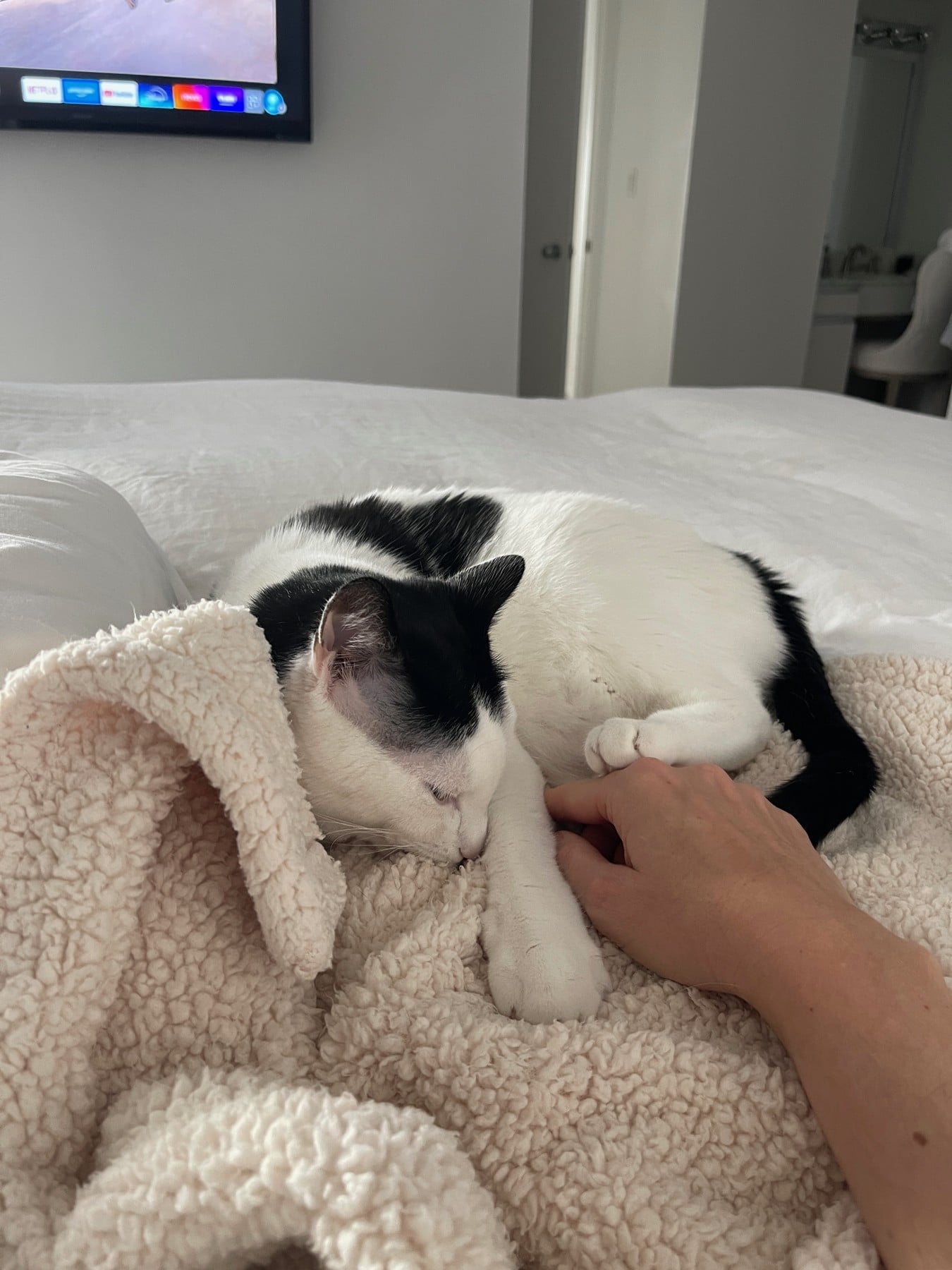
As for the kneading aimed at you, VCA Animal Hospitals puts it plainly: "Cats don't usually knead on animals and humans that they don't like. If your cat is kneading on you, they likely feel relaxed around you."
The fact is cats have scent glands in their paws, so they may be leaving their scent on you, your bed, your favorite blanket, etc., when they knead. We discussed this behavior's parental ties here.
Now we're not sure what you were wearing when your cat first started doing this, but if you're in shorts and they extend their claws when kneading, it might be worth rolling up a blanket and laying it over your lap.
When to pay attention: If your cat suddenly seems reluctant to use a paw, doesn't want to be touched, or you've noticed a number of changes in their behavior. And if they've been doing it on you for some time now and not exhibiting any other strange behaviors, chances are it's not anything to worry about.
3. Stalking and pouncing
No amount of cat food will deter the hunting instinct, as everyone who has seen a well-fed cat stalk a moth understands.
"The motivation to hunt prey is only partly related to hunger," International Cat Care explains. Given the opportunity, a cat may hunt "regardless of whether they're hungry or not at the time."
When a cat crouches behind the chair and patiently waits to spring forward, this is the same behavior it uses to capture prey.
"For cats, play is pseudo-predatory behavior, meaning that it is very similar in form to hunting behavior," says feline behavior researcher Mikel Delgado, PhD.
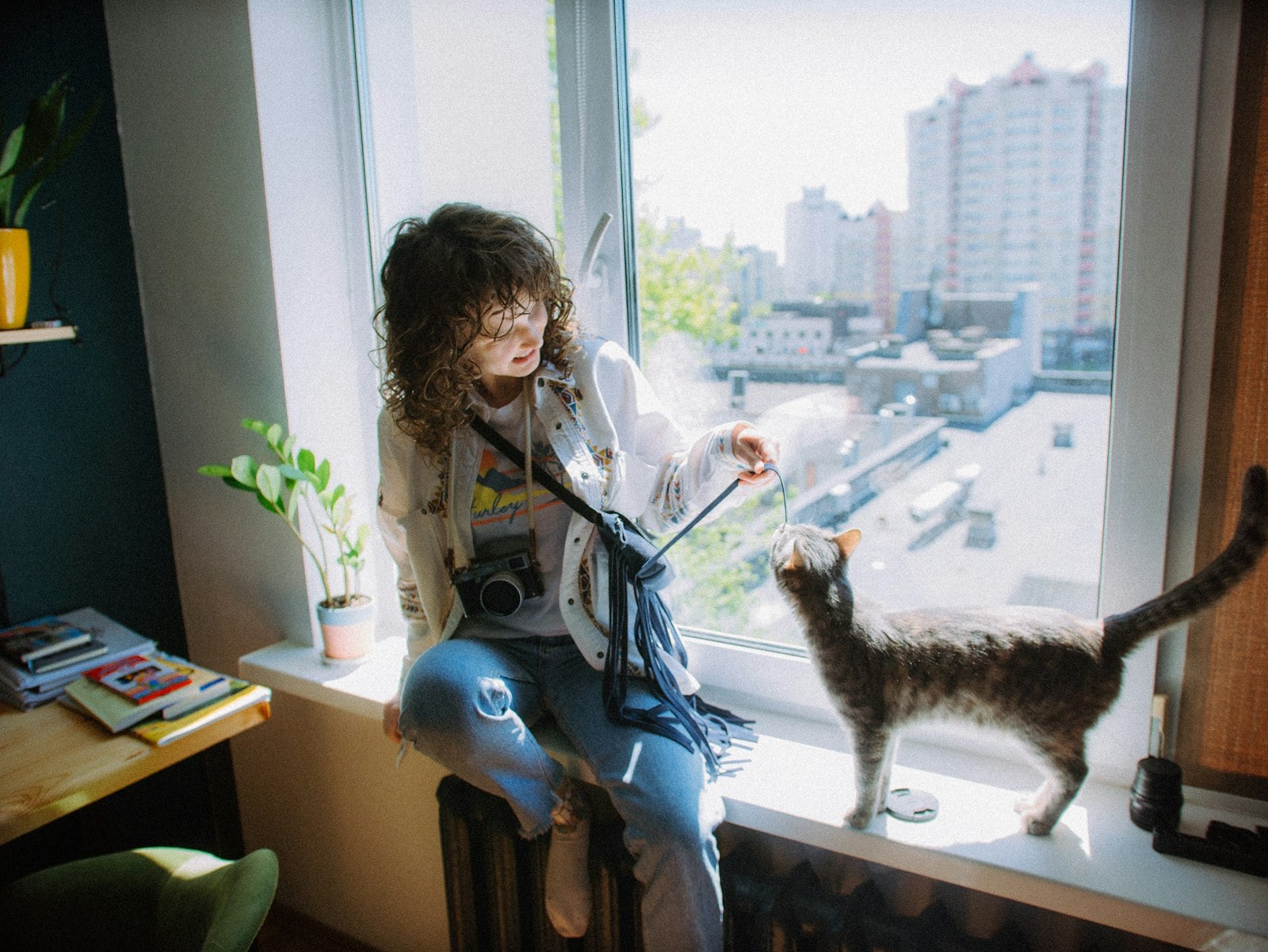
Play with your cat using a wand toy. Let them stalk and capture the "prey". Try to emulate prey behavior, for example, hide behind a corner and come out, stop, start moving etc.
Meanwhile, at our house…
We try to play with them after dinner every night. They went crazy for it when they were younger, but have really gotten lazy as they've turned two. Or maybe they're just bored, although we have a ridiculous amount of toys in their toy box, but it doesn't seem to work as much. The one thing that still drives them crazy is a little brown bird. This is the second (we lost the first one in a move) but it doesn't seem to matter. We toss it under a stool that they have to slink down and stretch to get under. They go totally crazy for it and inevitably end up patting it under the couch. Which means 40% of my day is digging it out from under there so they can start the process all over again.
The study monitored 355 cats from 219 households over twelve weeks. University of Exeter researchers found that cats that were played with for five to ten minutes a day brought home 25 percent fewer prey items. Cats fed differently brought home 36 percent fewer animals. This study looks at them separately.
Cats who were given a puzzle feeder brought home more prey, but that's not saying puzzle feeders are a bad enrichment item, it's saying cats given a puzzle feeder in the context of this particular study brought home more prey.
During play, give the cat a chance to win/catch the item. Never letting them catch it will just frustrate a cat during play.
"With laser pointers and any other chasing-type toys, you should let your cat catch them occasionally," veterinarian Tiffany Paul writes for PetMD. "No one likes to play a game they can never win, and the same goes for your cat."
Always end laser-pointer play with something your cat can catch. Laser dots can't be caught, which is frustrating for some cats.
When to pay attention: If your cat stalks and attacks your ankles during stalking/pouncing games, your cat isn't getting adequate stalking/pouncing outlets elsewhere. Aggression that comes on suddenly, seems overly intense, or is otherwise out of character should be explored with your veterinarian or a feline behaviorist. Pain or fright can result in sudden or out-of-character aggression.
4. Head-butting you
Cats have scent glands on their heads, around their lips, chins and cheeks. Some cats will rub their heads on their owner's hands as a greeting, lightly bonking their foreheads against your hand, others will bonk them much more aggressively against your shins. This stops you in your tracks. This greeting behavior is known as bunting and they're leaving behind their scent. Cats also rub their heads together if they're friendly, this helps them keep a common group scent.
"Transfer of scent helps to build up a 'colony odour' or group scent which shows cats are part of the same social group," psychologist and animal behavior writer Zazie Todd explains.
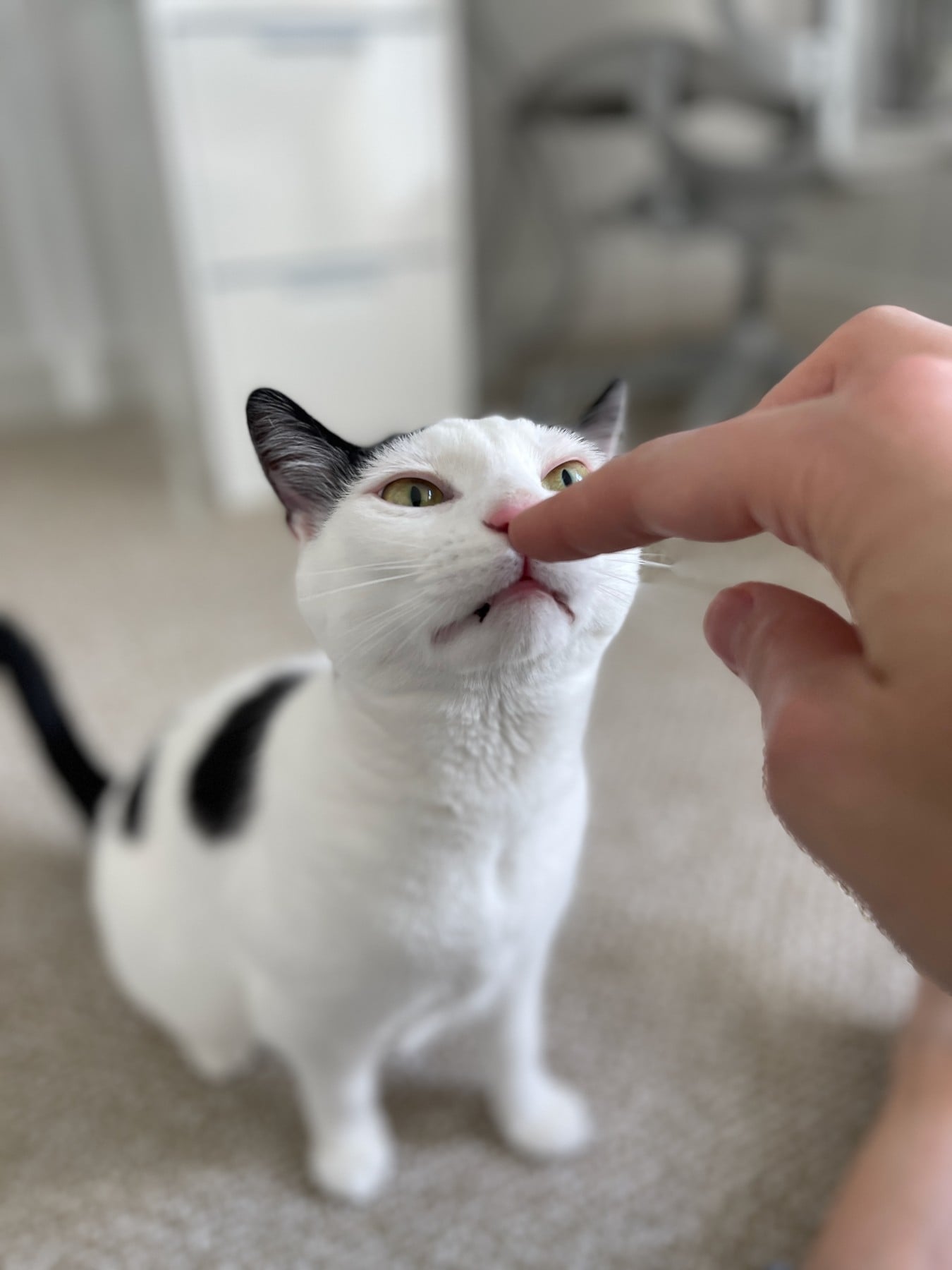
Forehead bonking can be a form of greeting. Cats will also use it for friendly contact and scent-marking. Cats that bunt against humans are marking you as someone they're okay being really up close and personal with.
When to pay attention: Bunting and head pressing are two different things. With bunting your cat will rub against you and move on. Head pressing is when your cat's head is pressed against a wall or some other object continuously and seemingly for no apparent reason.
Veterinarian Jennifer Grota describes it for PetMD as "the compulsive act of pressing the head against a wall or other object for no apparent reason," and says it is "much more forceful and persistent" than a head-butt.
This behavior warrants immediate attention by a veterinarian.
Louis is a head-butter. He is the classic boy cat that needs more attention than his sister. And when he's not had enough he will let out a few meows, come into my office and bonk his head against my leg. Thelma is not a head-butter. But she does do this pretty cute thing where when she's looking for pets her head gives a little wiggle letting you know she wants some face scratches.
5. Squeezing into boxes
Meanwhile, at our house…
Thelma is the box queen around our house. If there's a box, she will try to make it her home. We actually started buying her little box-shaped toys (a soccer field as one example) that she likes to sit in. The smaller the better. Louis has a little tepee that is his safe space, as well as one of those Catasaurus circular little homes. He'll nap in there once or twice a week.
Why does your cat always prefer the box it came in to the fancy new cat bed you've just un-boxed and lovingly positioned in an attractive location? This is because cats prefer small enclosed spaces where they have a sense of control of their environment. It's difficult for a creature that is a predator as well as prey to watch everything going on in every direction at once.
Researchers at Utrecht University gave hiding boxes to ten out of the 19 newly admitted cats. Cats with boxes had significantly lower stress scores on days three and four than cats without boxes. In a subsequent randomized trial, hiding boxes were shown to help shelter cats adjust more quickly to their new surroundings.
"Hiding is a behavioral strategy of the species to cope with environmental changes and stressors," lead researcher Claudia Vinke said.
According to one study, the box may help cats adjust to new surroundings, although it's important to note that a box won't cure all your cat's stresses in life. Still, this study provides some justification to continue offering your cat places to hide. Cats may also like boxes because they're cozy. According to a 2016 review, cats' "thermoneutral zone", which is the temperature range in which they can maintain their body temperature with the least amount of effort, is about 86 to 100 degrees Fahrenheit. Tight, enclosed spaces may help cats stay toasty within that range, which is nice since most of us don't keep our houses at 90 degrees. Another possible explanation for cats' love of boxes comes from a small-scale, citizen-science project published in 2021 that found cats will approach squares outlined with tape on the floor, as well as optical illusions that give the appearance of squares.
When to pay attention: Having a favorite hiding place is totally normal and healthy. A sudden increase in time spent hiding may be a sign of illness or stress.
"Cats need a safe spot to hide when they can't control their environment," feline medicine professor Danielle Gunn-Moore told Popular Science. "But for a cat to be hiding all the time, it's really not good."
Determine what's typical for your cat. Increased hiding that's persistent and seemingly unexplained is reason to call your vet. So is hiding that comes with other behavior or physical changes.
6. Getting the zoomies
What's that sound that cats make when they're turning the corner really fast?
Well, the scientific term for zoomies is a frenetic random activity period, or FRAP. Many of these periods are bursts of energy for an excited cat.
"They're just having fun," veterinarian Jose Arce told Live Science. "They get really happy and excited, and they run up and down the hall and jump on the couch."
Bursts of energy can happen at inconvenient times. A partial explanation is that cats are crepuscular, or active at dawn and dusk, by inclination, although a given cat's daily schedule needn't follow a neat timetable.
"Playful zoomies often occur when a cat has been inactive and suddenly feels energized," says veterinary behaviorist Alison Gerken.
But what's behind the seemingly random behavior? Elizabeth Stelow, a veterinary behaviorist, has a possible explanation.
"We know that defecating stimulates the vagus nerve, which can lead to a feeling of release/relief. Depending on the cat's personality, that might lead to excitement and zoomies."
One owner on Reddit reported calming a zooming kitten by humming. The kitten climbed onto the bed and fell asleep, inspiring the comment: "I think your cat thinks you are purring."
So that's no proof that humming can solve your kitten's energy issues. But if your cat seems overly energetic, try spending more time playing with your kitty.
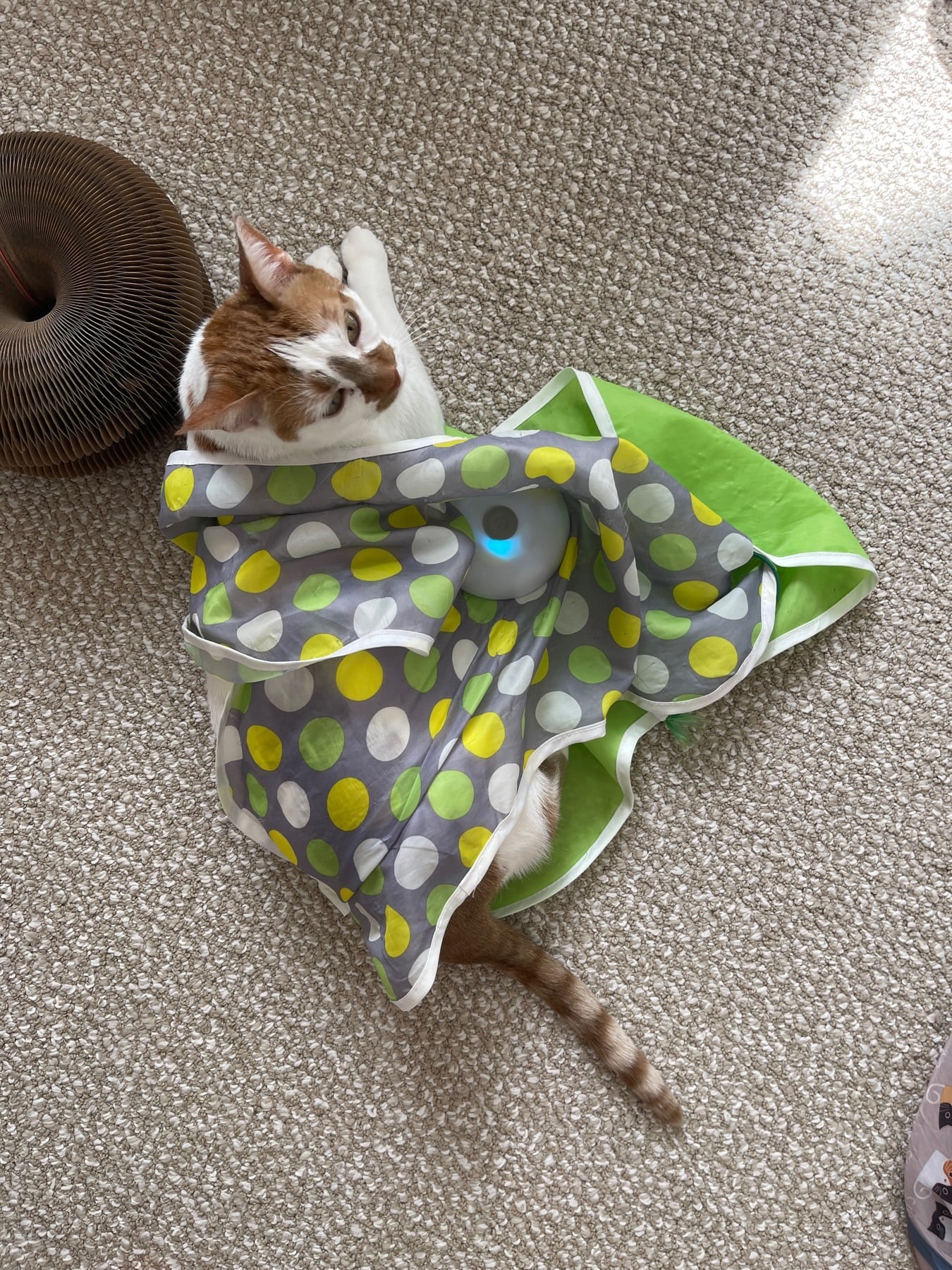
When to pay attention: If your cat's energetic zoomies are frantic rather than playful, especially if they seem distressed, act strangely, and meow or cry out as they zoom around the house, something may be medically or psychologically wrong. Also, if your cat is older and has become more energetic all of a sudden, consult your vet. Increased energy level is a symptom of hyperthyroidism in cats. Cornell's guide to feline hyperthyroidism includes decreased weight and increased appetite.
If you're concerned about a particular behavior your animal exhibits, videotape it. It can help the vet understand what you're seeing.
The post-litter box zoomies are definitely a thing. But it's not every time for our cats. It seems to be hit or miss (when they really had to go, maybe?) Sometimes they'll go to the litter box and go back to snoozing. Other times it's like they're at the Indy 500 running around the apartment at 200 miles per hour.
7. Licking you (and sometimes biting)
When they decide to give your hand a thorough and vigorous grooming, it feels like they're going to lick away a layer of skin. What's going on?
Georgia Tech researchers recently discovered why cat's tongues are so rough. It turns out those little spines, technically called papillae, point backward and are made of keratin. Their ends are hollow and help to work saliva into your cat's fur.
"A cat tongue works like a very smart comb," bioengineer David Hu told National Geographic.
It's called allogrooming and it's common in cats, often indicative of a friendly relationship. Similarly, when a cat licks a person it may have a similar effect.
"This type of licking is similar to a cat-to-cat behaviour known as allogrooming, which is basically mutual grooming," Dr. David Sands told BBC Science Focus.
And this leads us neatly into the olfactory aspect of socialization: members of a group all smell pretty similar thanks to mutual grooming. One minute they're giving you licks, the next WHOMP teeth. Owners may choose to think of these as love bites. It's more helpful to pay attention to body language and attitude in general.
"Licking can turn to biting if the cat is too overstimulated, becomes unhappy with the interaction, or is in pain," Gerken writes.
If the tail starts lashing, the ears turn back or the body tenses, stop petting and give your cat room. You don't need to wait for teeth to confirm the message.
When to pay attention: Occasional social licking is different from persistent grooming that leaves bald patches or focuses on one area of the cat's body. Itching, pain and stress can all contribute to excessive licking. Cornell's guide to overgrooming recommends checking for medical causes.
Our cats are pretty bad when it comes to grooming us. Maybe bad's not the right word...lazy. If they are laying there giving themselves a bath, I'll go up to them and hold out my hand. The most I get is two...maybe three licks before they go back to cleaning themselves. It's more of a gesture than a full-fledged cleaning. I appreciate it either way.
8. Bringing you gifts
Some say it's their way of teaching you how to hunt since they figure you must be pretty incompetent at it. Although that's a nice hypothesis and an easily memorable one, there's no certain evidence for it. More likely it's the reason they bring in their other treasures: your socks or toys.
Cats Protection, the UK's largest cat charity, calls the teaching idea a myth outright: "Another myth is that the cat is trying to teach their owner how to hunt, presenting the result of a successful catch to show them what they need to do."
One possible explanation for cats bringing their prey back to the house is that they are taking them to a familiar, secure location. Hunting behavior may continue regardless of cats having adequate food. We don't know for sure, but these are reasonable explanations.
We can observe the delivery. We're less certain about the exact intention behind it.
Indoor cats may carry toys around and announce their arrival with a distinctive muffled meow. Whatever the motivation, it can feel very much like you're being summoned to appreciate something.
When to pay attention: For outdoor hunters, the Exeter research suggests daily interactive play can reduce prey brought home, although it won't eliminate hunting.
Note that carrying around an appropriate cat toy indoors is okay, but chewing or swallowing fabric or small objects is not. If you find that your cat is chewing and swallowing household objects, take them to your veterinarian. Keep track of the objects your indoor cat is carrying around.
There's something hilarious about the ways that cats meow when they have a toy in their mouth. It's like a guttural, lower meow. And I don't know what it is, but it just sounds hilarious to me because I know what's coming. We tend to get them taking toys from the living room to the bedroom or office. And it's usually two of the same toys that they cart around. They won't bring them onto the bed, but they'll typically drop them near the door so we'll get up and throw it for them. We really need to teach them how to play catch.
9. Staring at you
Some things don't have profound or even interesting explanations. Look up from what you're doing to see that your cat is gazing at you. Go back to what you're doing. Look up again: it's still gazing at you. That's okay. Simple things have their charms.
"Some cats have been known to stare at their pet parents when it's feeding time," veterinary behaviorist Wailani Sung writes for PetMD.
Another Reddit commenter offered up a cuter theory. And maybe this is true, but, hey, knowing what you're up to gives your pet actionable information about what's going to happen next. Who opens up doors and gates? Who fetches fun things? Who provides food? Who sits in places big enough to also fit a cat? You.
"Me: Bro, you can look anywhere you want in the whole world. Why are you always looking at me? Cat: Because you are my whole world, bro. Me: Bro. Cat: Bro."
— via Reddit
Two experiments published in 2020 in a study in Scientific Reports found that cats were more likely to approach a stranger after slow-blinking at them. For instructions on how to give the all-important slow blink, check out this explanation from Karen McComb, a professor who has expertise in the phenomenon:
"Try narrowing your eyes at them as you would in a relaxed smile, followed by closing your eyes for a couple of seconds."
Keep the interaction gentle and let your cat choose whether to respond.
Read the whole body, too. A soft expression and relaxed posture carry a different message from a rigid body and flattened ears. Pupil size alone isn't a reliable mood detector, because lighting also changes it.
When to pay attention: If the stare comes with tension, a lashing tail or ears pinned back, give your cat space. Persistent staring that seems unusual for your cat, especially alongside confusion or other behavioral changes, is worth discussing with your vet.
Thelma does this for sure. And mostly with me. She likes to sit on top of a chair behind me in my office. And sometimes I'll turn around and she's just staring at me. So I stare back and give her a slow blink. And then she gives me a slow blink and I turn back around and we both continue about our business. This is why cats are the best.
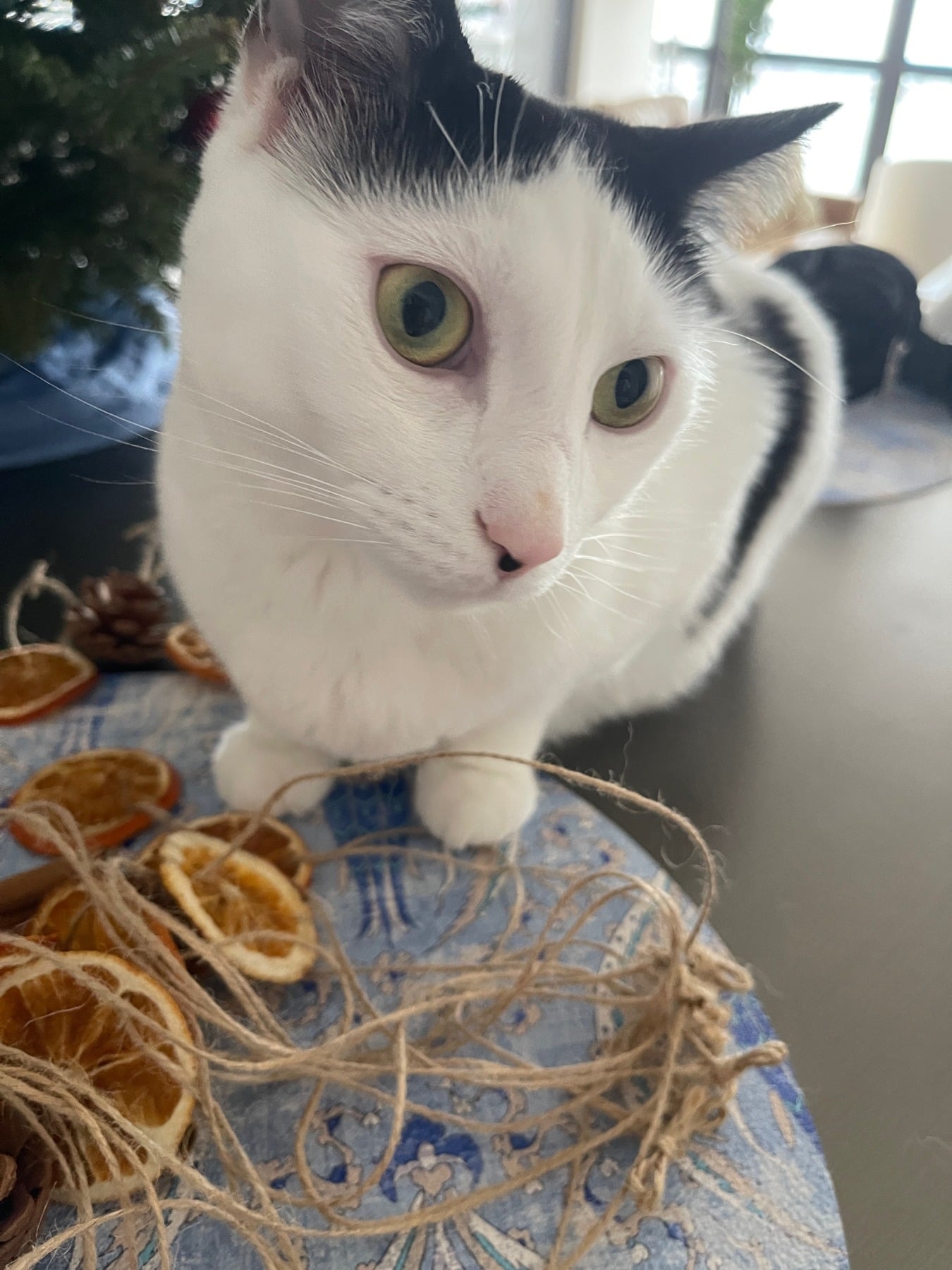
Getting to know your particular little weirdo
Knowing why cats do these things makes living with them a little easier. A box becomes somewhere to feel secure. A wand toy gives a hunter something appropriate to chase. A head-butt tells you that close contact is welcome.
It also helps you notice when something is different.
The cat who always disappears during vacuuming may simply be following a sensible household policy. The cat who suddenly hides through dinner deserves a closer look. A familiar evening sprint and a new bout of frantic activity aren't necessarily the same thing.
You don't need to analyze each and every blink to understand your pet. Start with the behaviors that are important to them, like where they like to sleep, how they like to play, signals for seeking or avoiding contact or space. Chances are you're already paying attention to these things and incorporating them into conversations with friends ("You won't believe what the cat did today."). That's a win.
Meanwhile, at our house…
An ordinary day with Louis and Thelma starts at 4:40am with a visit from Louis onto my chest. Then we drift off back asleep as Louis moves to his suckle blanket between us. They get up with us and mill about looking for breakfast and some mid-morning treats. Then there's some brown bird time crawling under a stool and chasing after it when I throw it. Then meowing at me when it's under the couch. Then it's nap time for about 6 hours before it's post-nap treat time before dinner. Then maybe some more napping before a bit of evening playtime. Then, if we aren't in bed at the right time, Thelma comes out to let us know we're late and we need to get into bed.
And then it starts all over again the next day.