Do Cats Have a Sixth Sense? 7 Spooky Stories and the Science Behind Them
 By Cory Jones
You’re relaxing in the living room when all of a sudden your cat comes to a screeching halt. Ears pointed forward, your cat fixes its eyes on some particular spot on an otherwise empty wall. You turn your head to take a look for yourself. There’s nothing there. So why is your cat staring at nothing?
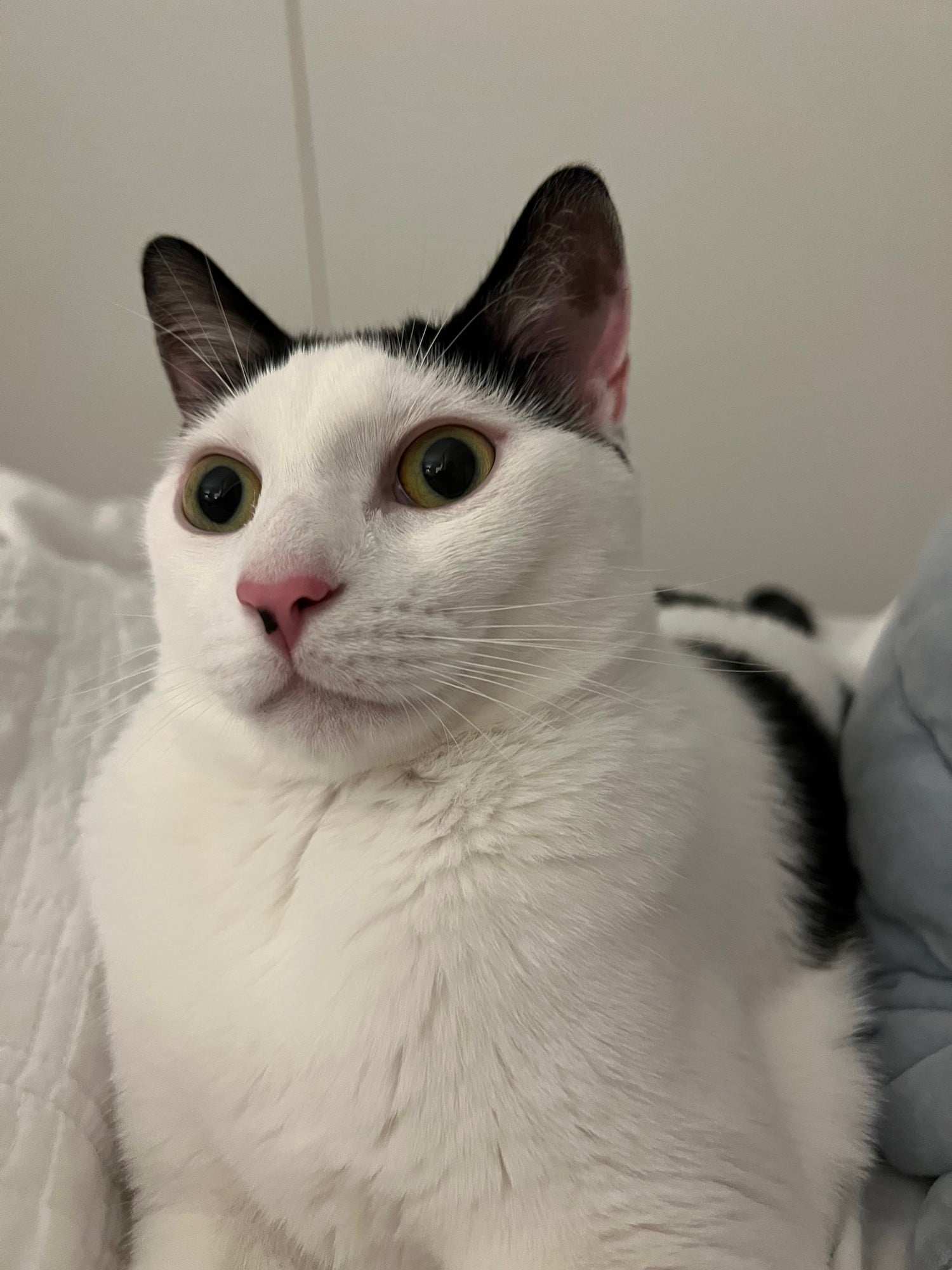
We’ve wondered what our cats see when they seemingly stare at nothing for thousands of years. Many cultures believed that cats can see ghosts and ascribed other supernatural powers to these seemingly clairvoyant creatures. Sailors used to trust the ship’s cat to foretell an approaching storm and in 2007 a gray-and-white cat living in a Rhode Island nursing home became famous for an odd behavior that is not completely understood.
While some of the cat’s apparent sixth sense is simply down to senses we humans share, just not as strong versions, some of these mysteries surrounding our feline friends’ behavior defy explanation.
As CatSeat readers will know, we have two cats (Louis and Thelma) and we’ve seen some of these behaviors firsthand. There’s been so many times where I will wake up at three in the morning, look over and see Louis just staring straight at a wall. And he’ll do it for 20 minutes and then run away. It’s hard to get back to sleep after that!
It turns out, we’re not alone! Here are other stories of cats being other-worldly, and the supposed rationale behind them.
1. Oscar, the Cat Who Kept Watch
Here’s a tale that set off a flurry of chatter about feline premonitions, and yes, it actually happened. In 2005, Steere House Nursing and Rehabilitation Center in Providence, RI took in a kitten named Oscar. Oscar resided on a ward that specialized in caring for patients suffering from end-stage Alzheimer’s disease, Parkinson’s disease and other ailments.
Most reports say that Oscar did not take well to human contact. The staff considered him to be rather antisocial, and if guests came too close for comfort, he would hiss.
About six months after he arrived, the staff started to notice something. Oscar spent most of his day making rounds, walking the halls and checking rooms. Then, every so often, he would hop onto a resident’s bed, curl up and stay. The residents he chose tended to die within hours. One of the facility’s physicians, Dr. Joan Teno, told the Associated Press he “always seems to be in the last two hours.”
In 2007, geriatrician Dr. David Dosa wrote about Oscar in the New England Journal of Medicine in an essay called “A Day in the Life of Oscar the Cat.” By then Oscar had been right about 25 times. Later accounts put the number at around 50, and some press reports went as high as 100. Dosa went on to write a book about him, Making Rounds with Oscar: The Extraordinary Gift of an Ordinary Cat, published in 2010.
While both of our cats are definitely snuggly and cuddly, neither of them would qualify as a nurse. When either of us have had Covid or the flu, they seem to actually steer clear of us a little more than usual. When I try to think back to when I’ve been sick and have been in bed all day, they didn’t visit me as much as I expected. They stuck to their normal nightly routine of coming up either when we get into bed or at 3am.
The reason the Oscar story became news, rather than being filed as another nursing-home tale, is how the staff acted on it. Once they were convinced of the pattern, they began phoning families as soon as Oscar took up residence on a patient’s bed, so family members would have time to arrive for a final visit. The same cat that many thought of as aloof gave families a chance at closure they might never have had. Oscar remained at Steere House for the remainder of his life, and he passed away in 2022 at around 17 years old.
So how did he do it? Nobody knows for sure. Dosa and Teno suggested Oscar might have been responding to a smell, some chemical change that happens in the body near the end of life that a cat’s nose could pick up and a person’s couldn’t.
Animal behaviorists interviewed at the time offered another explanation: maybe Oscar had noticed how quiet and still those residents had become.
Critics argue that people remember the hits and forget the misses, and a cat who made his rounds all day long was sure to be on the right bed some of the time.
But it seemed to happen far too often for it to just be coincidence. Even if you give him the benefit of the doubt for just having it happen once in a while that would be incredible odds for it happen that much. But if someone is skeptical, you’re probably not going to change their mind.
The one thing everyone can agree on is that Oscar selected these beds himself. Whatever he saw, he saw it first.
2. Staring at Nothing (That Isn’t Nothing)
Has your cat ever stared intensely at an empty space for an abnormally long amount of time? They may have inspired the tale that cats can see ghosts. (Which isn’t exactly disproved, but we digress. There are still plenty of things to stare at.)
One reason that cats may seem to be staring at nothing has to do with the ultraviolet (UV) light spectrum. Your lens filters out UV before it reaches your retina. Scientists assumed that for the most part, the eyes of mammals function like humans’.
But, a 2014 study published in Proceedings of the Royal Society B studied the eyes of dozens of mammals and found that many of them, cats and dogs included, have lenses that allow UV light to pass through. Which suggests there’s something cats see that we don’t. So that squeaky clean, blank white wall may not be squeaky clean and blank to your cat.
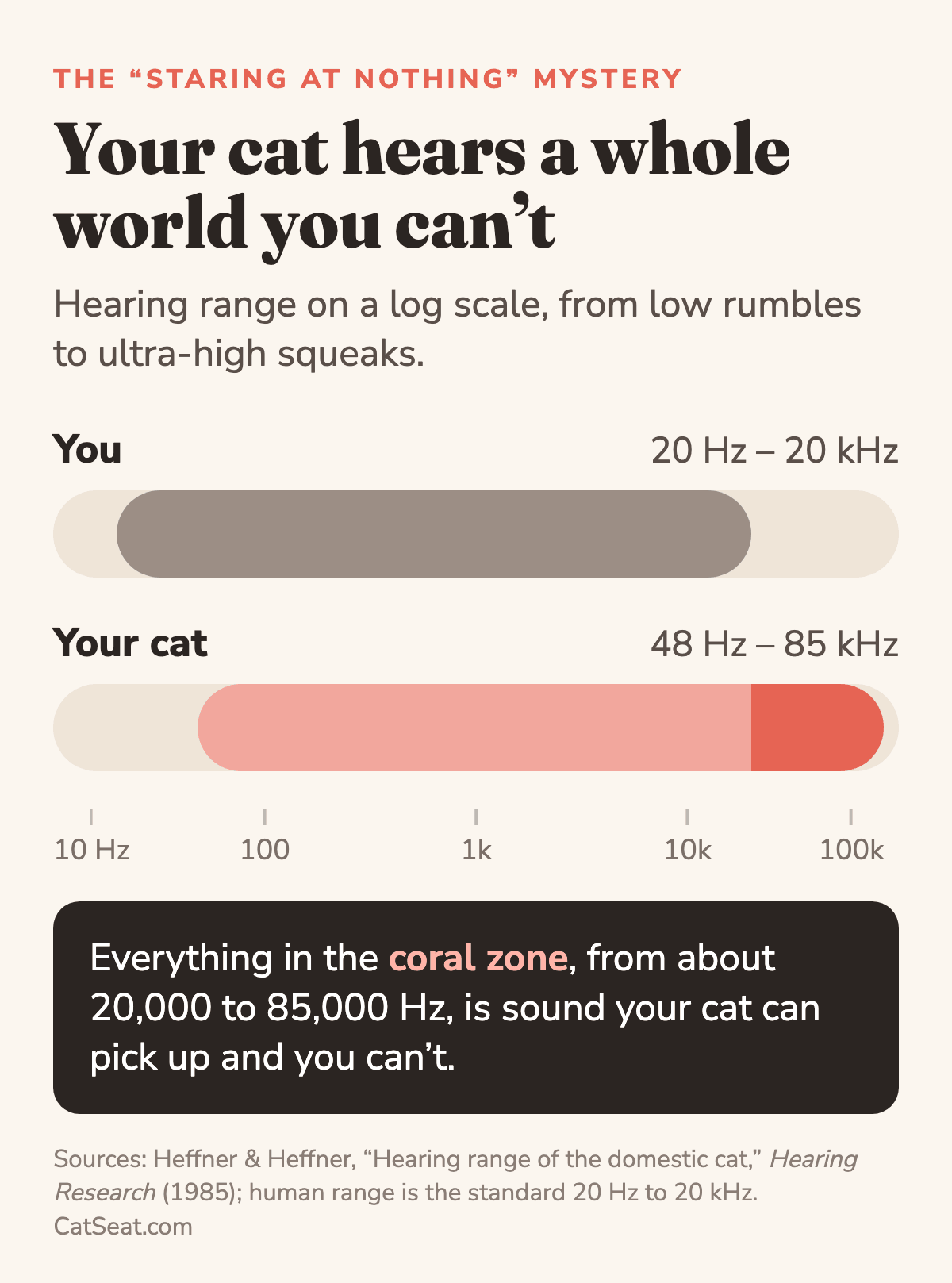
Another reason is that cats definitely hear sounds we don’t. According to a classic 1985 study, cats’ hearing ranges from 48 Hz to approximately 85 kHz, one of the widest ranges in the mammal world. Humans can only hear up to about 20 kHz.
So that time your cat stared intently at one particular spot, they most likely heard a mouse squeaking inside the wall, an insect crawling in the baseboards, or a sound emitted from the TV that you couldn’t.
Lastly, cats are predators, their sight and nervous system is tuned in to movement, especially in low light situations. So to them, a tiny shadow that passes across the ceiling or a speck of dust dancing in a ray of sunlight is a huge deal.
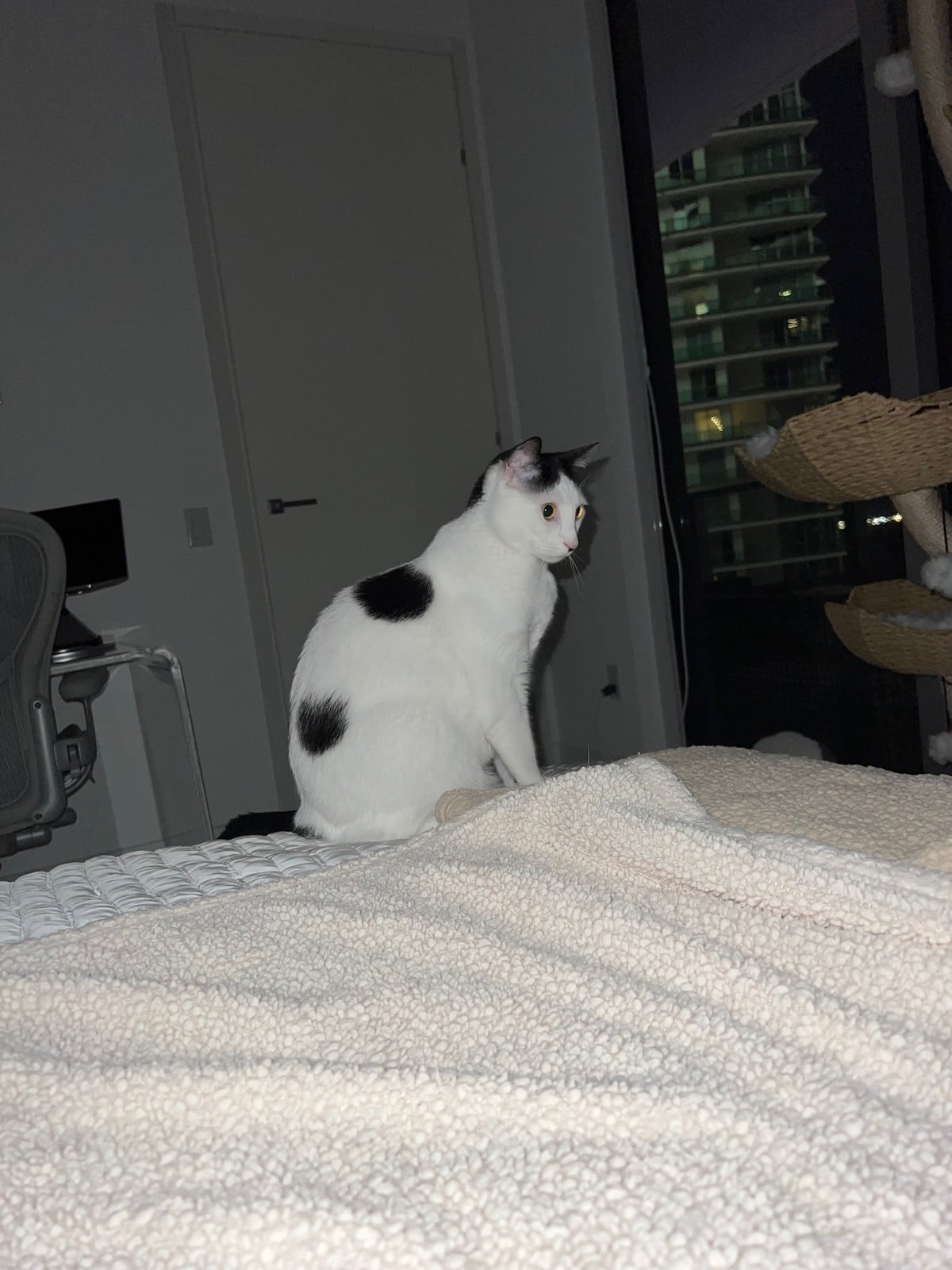
As I mentioned, Louis will just stare at walls in the middle of the night. But one time I was sitting on the couch and Thelma was sitting on the pillow a little bit above me and behind me. I turned around to look at her and she was clearly looking just to the left of me. Not at me, just a little off like there was something behind me. Which is always disconcerting!
3. Feeling Earthquakes Before They Hit
It’s not a new phenomenon; tales of pets behaving oddly prior to an earthquake date back thousands of years. Cats hiding, walking back and forth, or running away outdoors just before an earthquake hits are among the most frequently reported stories.
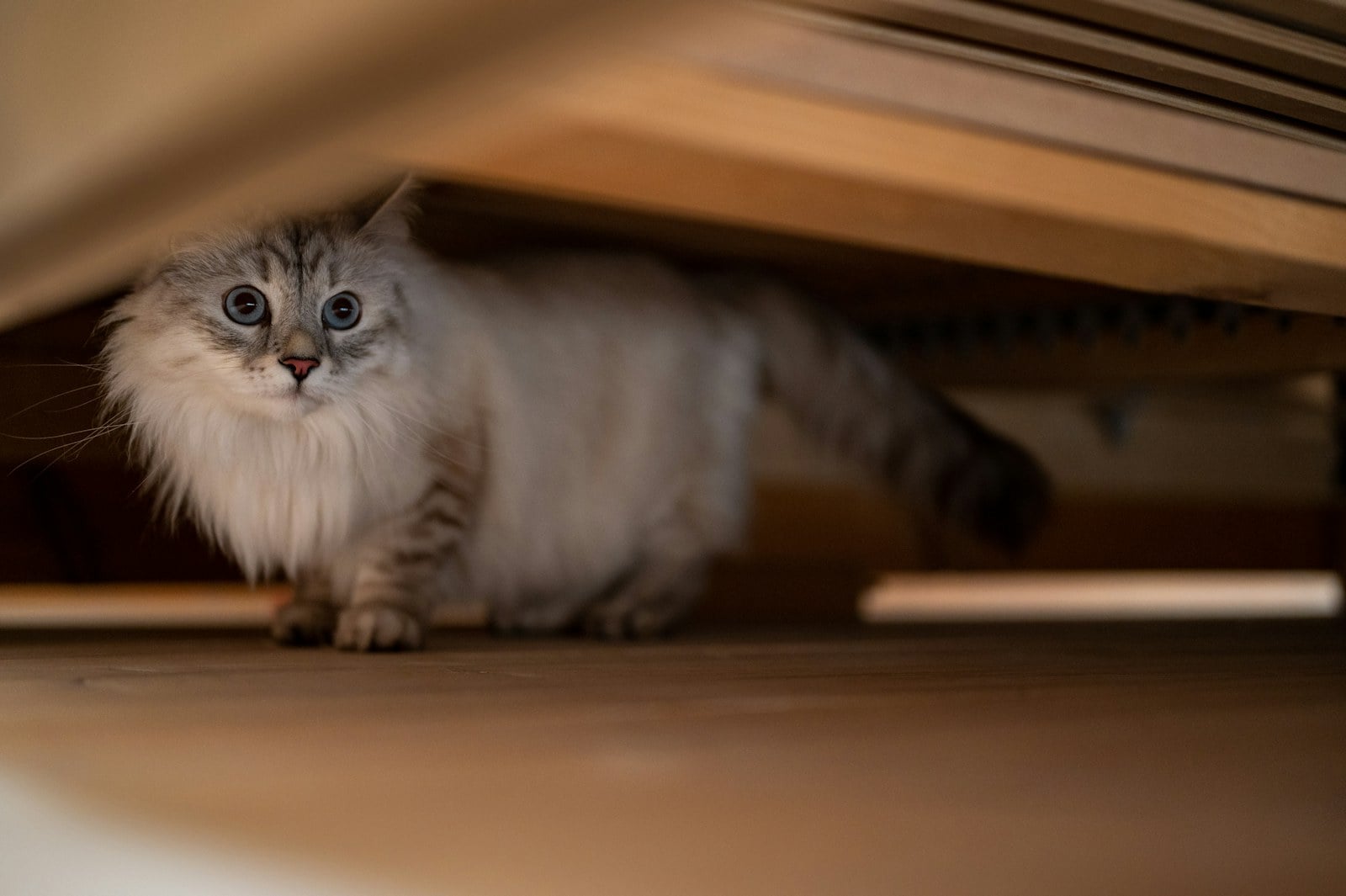
We live in a condo and there’s always construction being done somewhere. When we first moved in, they would dart under the bed if they heard a loud noise. And the same with thunder. We live in Miami so we get some really big thunderstorms. But they have definitely gotten used to those sounds now and a huge bang somewhere in the middle of the day doesn’t phase them at all. And now they won’t even wake up from a nap if there’s a huge storm.
The U.S. Geological Survey has heard these stories too, but it has always been careful as to the “why.” It says anecdotal evidence of strange animal behavior before quakes “abounds,” but consistent, reliable behavior before seismic events, “and a mechanism explaining how it could work, still eludes us.” In other words, there is no evidence that cats can sense an earthquake days or weeks before it happens.
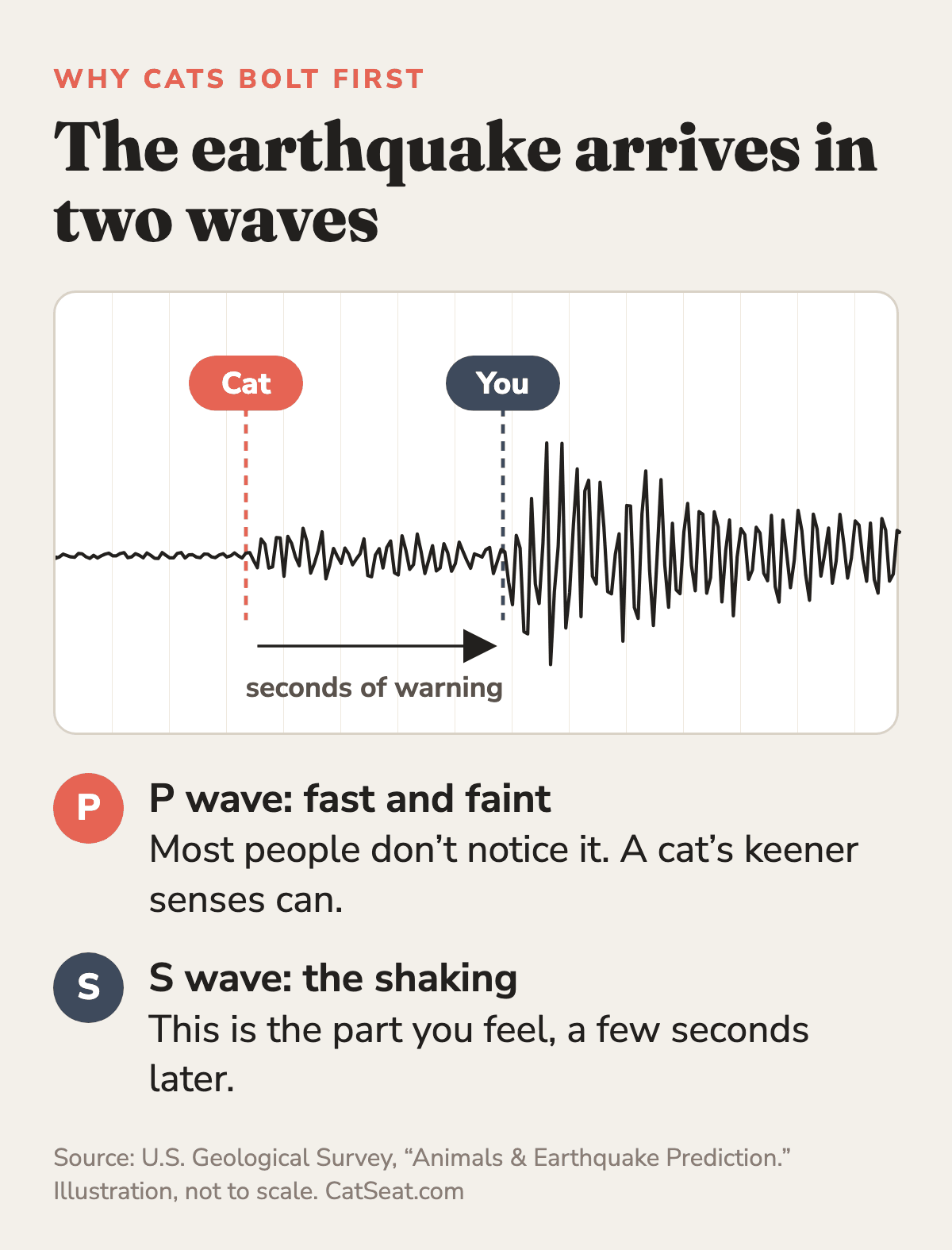
Sensing an earthquake seconds before is a different story, however, and it has nothing to do with magic. Earthquakes consist of two types of waves: P waves, which travel faster but are less powerful (and go undetected by most humans), and S waves, which are the shaking we can feel. According to the USGS, “many animals with more keen senses are able to feel the P wave seconds before the S wave arrives.” So the next time your cat runs under the bed just before an earthquake, it’s not predicting anything. It simply feels it before you do.
One particularly bizarre theory has even been tested by researchers. In the San Francisco Bay Area, some people claimed that a spike in lost-pet ads in the San Jose Mercury News meant a big earthquake was coming, because animals run away before they hit. But a 1988 study compared more than 41,000 lost-pet reports with 224 earthquakes over three years and found no connection.
4. The Ship’s Cat Weather Report
According to The Old Farmer’s Almanac, cats were traditionally considered to be reliable weather predictors! Here are a few examples:
In Wales and in other parts of Britain, rain was said to be imminent when a cat was seen cleaning behind their ears. In Holland, when a cat scratched at the carpets or curtains, the people expected wind. In early America, a cat with her back to the fire meant a cold snap was on the way, and when a cat slept with all four feet tucked under her (basically what we call breadboxing), bad weather was coming.
Cats were also considered to be weather predictors on ships. Sneezing predicted rain, being frisky predicted wind, and when the ship’s cat would lick itself against the grain it meant hail was on the way. Some even believed cats could raise a storm! So the goal for the crew was to keep a cat happy and healthy, so she didn’t create bad weather.
Cats can hear thunder long before we can; they have a highly-developed sense of smell and might pick up on the change in atmosphere that accompanies rain. The Almanac also says that a cat’s inner-ear may be responding to changes in air pressure. But really? Cats bathe behind their ears a lot, and it rains a lot in Wales. Coincidence? Who knows!
5. Knowing You’re Home Before You Walk In
If your cats are anything like Thelma and Louis, they seem to know you’re about to walk through the door long before you put the key in. We live in an apartment building, and I swear as soon as we get off the elevator the cats can sense it. By the time we open the door, they seem like they’ve been waiting by the door for at least a couple minutes. So, how do they know that?
There is not (to my knowledge) a study that examines whether cats can tell the difference between their owner’s footsteps and the neighbor’s. But there are at least three things we know about cats that together offer a reasonable explanation, and none of it requires magic.
First, the ears. The same hearing that picks up a mouse in the walls (I covered that in number 2) picks up an elevator chime, a particular set of footsteps on the hallway carpet, the jangling of keys or a car engine, possibly a combination of all of them, well before any of it reaches us on the couch.
Thelma and Louis definitely hear stuff before we do. If someone’s delivering something or something is going on out in our condo hallway. This one isn’t ghosts, it’s just their better hearing, I think.
Second, cats learn which sounds are yours. In 2013, researchers at the University of Tokyo published a study in Animal Cognition in which they played 20 cats recordings of three strangers’ voices and then their own owner’s. The cats did not see their owner, only heard them calling the cat’s name. Most cats tuned out by the third stranger’s voice, but perked up again, rotating their ears and heads, when they heard their owner. (The cats didn’t meow back or move their tails, which the researchers point out, and which any cat owner could have told them.) The results indicated that cats can tell the difference between humans based on hearing alone.
This ability to recognize a voice is one piece of a cat’s larger ability to pick up on patterns in sound. A cat that can pick out its owner’s voice from a group has no trouble recognizing the sound of their keys, their particular footstep, or the way they close the elevator door. Cats are paying closer attention than you might think, not for magical portents, just the right set of sounds.
I’m pretty sure our cats know the sound of how we walk when we’re coming home. They seem to know it’s us even if we haven’t said a word before we’ve gotten to our door. And if only I’m home and Lindsay is coming back, they dart to the door well before she’s put her keys in the door. And she hasn’t said anything, either, so it wasn’t her voice.
Third, cats keep track of where you are even when they can’t see you. In a 2021 study published in the journal PLOS ONE, a team at Kyoto University found that cats “have mental representations about their out-of-sight owner.” During the study, 50 cats, some house cats and some residents of cat cafes, heard their owner calling their name from a speaker outside the room, and then, moments later, from a speaker on the far side of the room. The cats seemed visibly surprised at their owner’s apparent ability to teleport. When the same trick was done with a beep or a familiar cat’s meow, they weren’t.
Bottom line, your cat knows where you are and notices when you turn up somewhere unexpected. Which means your cat has a map of sorts in their head. If you got off the elevator, walked down the hall and stopped at the front door, your cat doesn’t need to have seen any of it to update your spot on the map. They heard you.
Combine that with a sense of time (cats, like people, live by a daily routine, so they know when you typically leave and come back) and the ability to recognize your sounds, and suddenly cats don’t seem so magical after all. Your cat isn’t mind-reading, but you can bet they’re more attuned to where you are than you thought.
6. Reading Your Mood
Some people report that their cats always seem to know when they’ve had a rough day. That’s also got a bit of science to back it up, but again, less dramatic than the stories.
In 2016, psychologists Moriah Galvan and Jennifer Vonk at Oakland University published a study in the journal Animal Cognition based on two experiments. In the first, the cats watched their owner or a stranger act happy or angry with their face and body language, with no sound. In the second, the cats listened in as their owner and an experimenter had either a friendly or a tense conversation. Overall, cats were “only modestly sensitive to emotion, particularly when displayed by their owner.” The cats seemed to pick up on it a little, mostly from their own humans, but didn’t otherwise react.
In 2020, researchers from the University of Bari in Italy published a smaller study looking at how ten pet cats responded to pictures of happy and angry human faces played alongside happy or angry-sounding voices. They found the cats looked longer at the pictures that matched the emotional tone of the voice, especially for the stronger, more obvious emotions. Based on the results, the researchers concluded cats have “a general mental representation of the emotions of their social partners,” including humans and other cats.
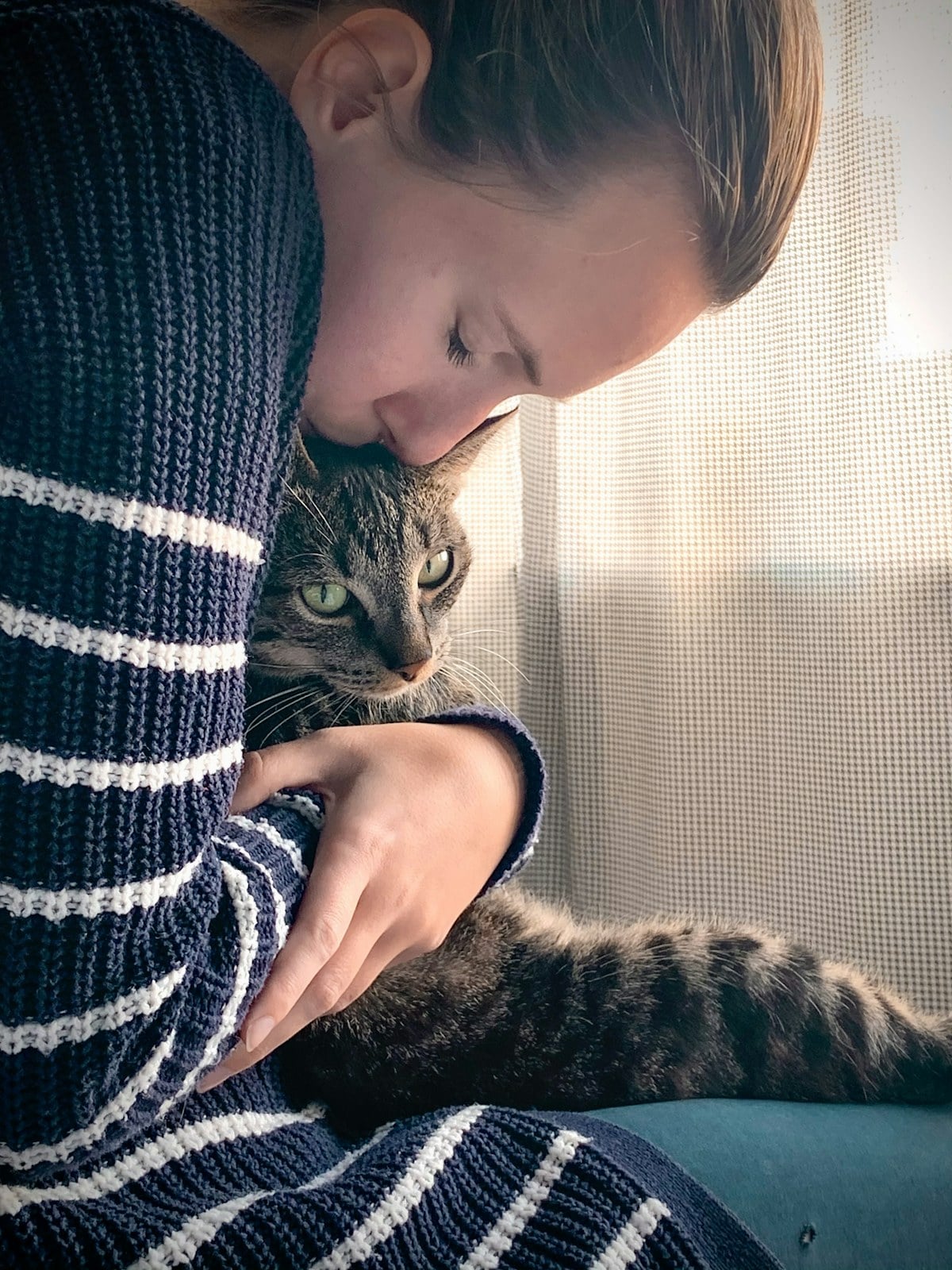
Which isn’t the same thing as a cat sensing your sadness and coming to soothe you, but it’s certainly evidence that cats are paying attention to their humans and responding to them. And most cat owners will tell you that the cat who jumps onto your lap when you’re having the worst day of your life doesn’t need peer review to prove its empathy.
7. Finding Their Way Home
Here’s one that science currently cannot explain. Holly was a 4-year-old tortoiseshell who went missing from her owners, Jacob and Bonnie Richter, on an RV trip to Daytona Beach, Florida in early November 2012. Holly got lost and did not come home with the couple when they made the trek back to their West Palm Beach home.
Two months later, on New Year’s Eve, a woman found a skinny, staggering cat in her backyard in West Palm Beach, about a mile from the Richters’ house and roughly 200 miles from where Holly disappeared. The vet scanned her microchip and lo and behold, her info matched Holly! The Richters were notified and this amazing cat had made it to within a mile of her own front door.
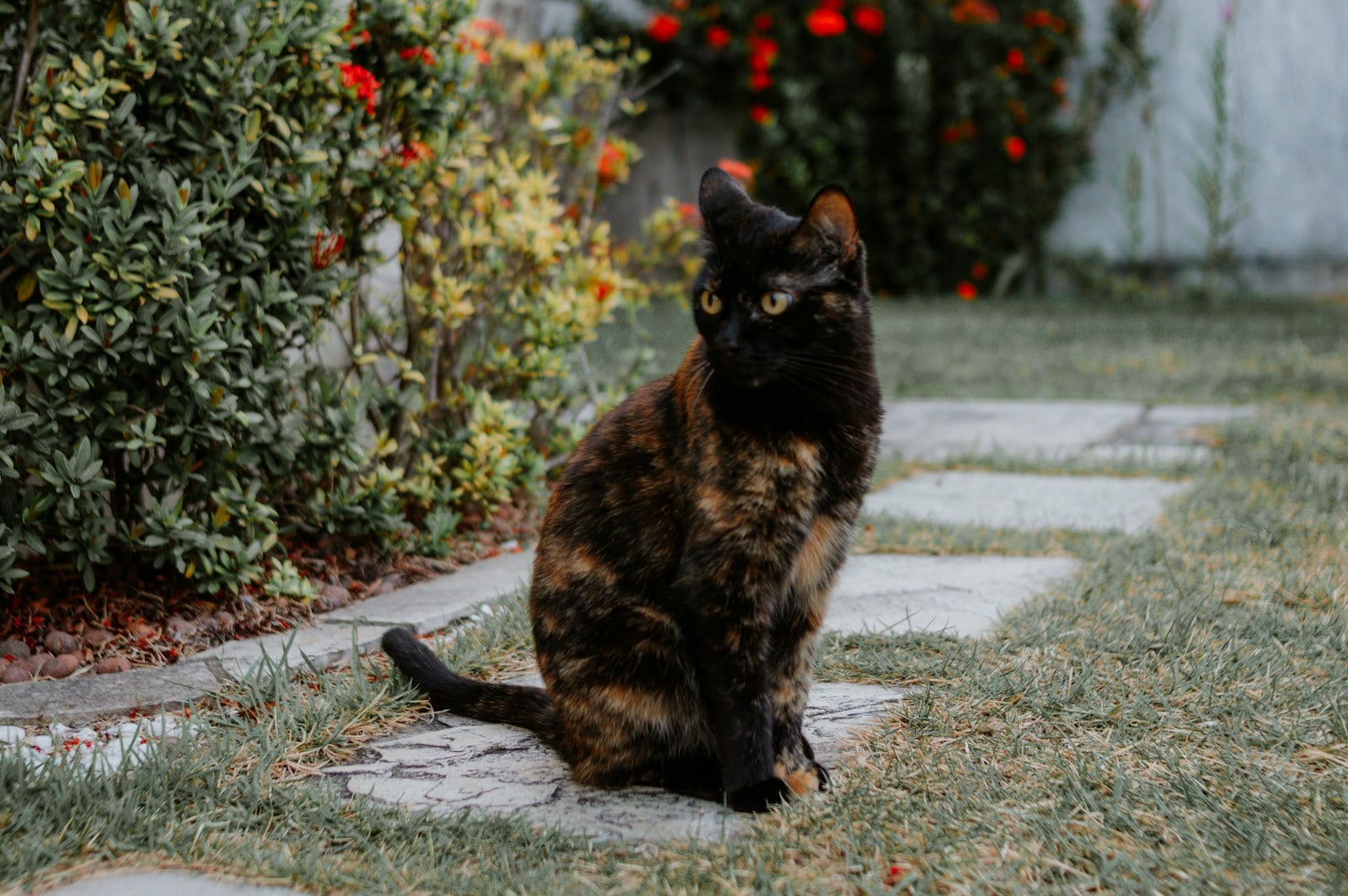
How a house cat manages a trip like that is still an open question. Scientists have floated ideas, from smell to the sun’s position to the Earth’s magnetic field, but nobody has proven how cats navigate over long distances, and many cats who get lost never make it back.
There isn’t much research on this, and what exists is old. In 1922, a biologist named F. H. Herrick transported a mother cat in a sack to seven different locations, each one to three miles from her kittens, and released her. Each time she made her way back, with return times ranging from four hours to 78 hours. When he tried a much farther location, sixteen and a half miles away, she didn’t make it home.
In 1954, two University of Kiel researchers in Germany placed cats in a maze with exits all the way around it and watched which exit they chose. At about three miles from home, roughly 60 percent picked the exit facing home. Beyond that, the cats were disoriented, and kittens raised in a lab had no sense of direction at all. Lost Pet Research & Recovery has a good summary of both studies if you want the details.
When The New York Times asked Marc Bekoff, a behavioral ecologist at the University of Colorado, he offered a few guesses, from being street-smart to reading cues from other animals, then added, “I have no data for this.” Sometimes the answer really is that we don’t know.
This is also why I think Holly’s story is worth sharing with any owner who has not yet had their feline friend microchipped. Her navigation skills brought her back nearby. Her chip brought her back home.
So, Is It a Sixth Sense?
And of course cats’ apparently psychic qualities can often be put down to the same five senses we have but much more honed. They hear sounds we can’t and may see wavelengths of light we can’t. They sense vibrations we don’t and of course they pay far more attention to where you are and what your face is doing than they let on.
Put these factors together and add a great talent for standing about quietly observing for most of the day and it’s not too great a leap of faith to suppose the cat seems able to predict what’s about to happen.
Examples like Oscar and Holly and staring into space at bare walls defy ready explanation, or rather they may well have an explanation but we just don’t know what it is. Cats pick up on things in the environment that go unnoticed by humans and, infuriatingly, keep quiet about what they observe. It would seem that a little mystery goes a long way to making life with a cat more fun.