How to Read Your Cat’s Body Language
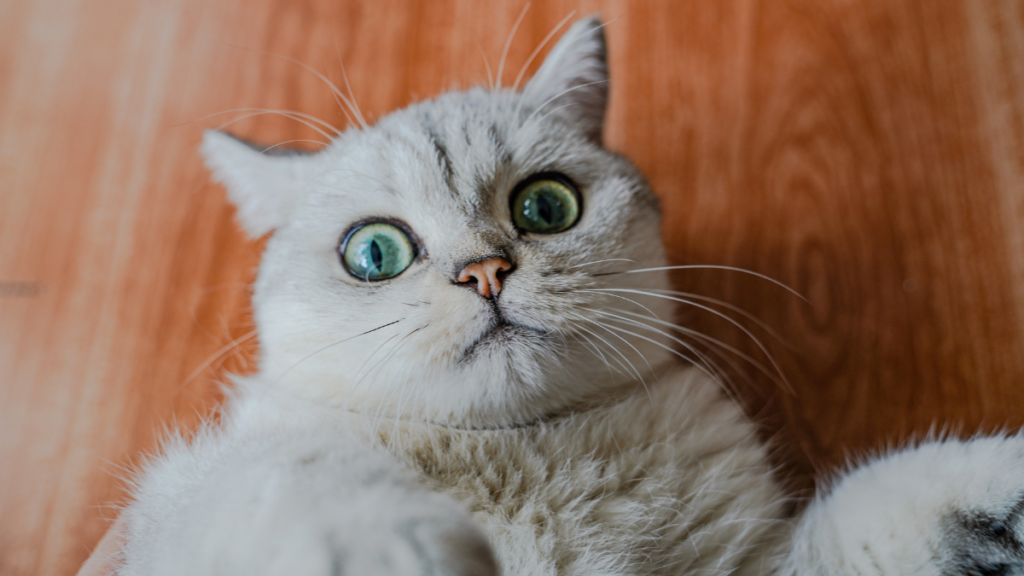
When my husband Cory and I first met Thelma and Louis at their foster’s home, they had almost exactly the same personalities as today. Louis was an instant lovebug who came right over to me. Thelma was more of a daddy’s girl, going into Cory’s lap for protection. When we brought them home, Louis was ever the protector of Thelma (though as he got bigger he also grew to bite her in the butt). If Louis saw her sleeping on one of us, he would immediately come over so he could sleep next to her, which, now that I think about it, might be more FOMO. Now after three years with the loves of our lives, we are tuned in to any body language they’re exhibiting. We look at their ears to make sure they’re not in pain, or if they’re loafing (comfortable) or crouching (unsure), or if they’re just rolled on their back letting their belly hang out in the air, like Louis.
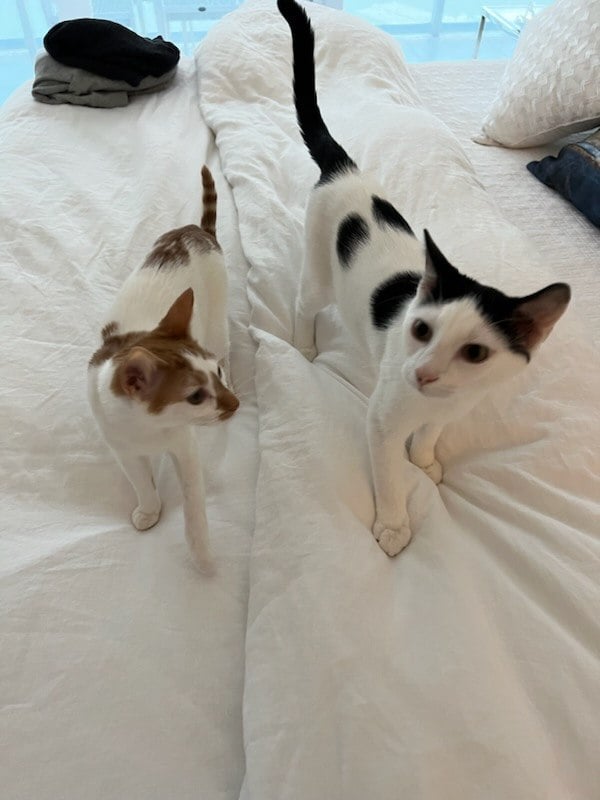
That’s the thing about cats: they tell you almost everything with their body. The tail, the ears, the pupils, the whiskers, even the direction their weight is leaning, all of it is a running commentary on how they feel about whatever is happening in the room. You don’t need a degree to read it, either. A handful of signals cover most of what your cat will ever say to you, and once you know them, a lot of “he nibbled me out of nowhere” moments turn out to have had a few polite warnings first.
Fear Free, the group that trains vet teams in low-stress handling, describes exactly that pattern: “when a cat’s polite warnings they aren’t feeling safe go unheeded, their gentle requests may escalate into louder shouts to get others to listen (think a yowl, hiss or swat of the paw).”
The biggest mistake is the one cat behaviorist Jackson Galaxy has been correcting for years: “we look at cats through dog-colored glasses way too much.” A wagging tail means a happy dog but an agitated cat, and that one mix-up is responsible for a lot of scratched hands.
I grew up for years thinking that if a cat is wagging it’s tail it means they’re happy. Well, it turns out that is not always the case, as the next section will tell you!
The tail talks the most
If you learn one body part, make it this one. Tail positions run on a rough scale from confident to terrified, and the height of the tail reveals the most.
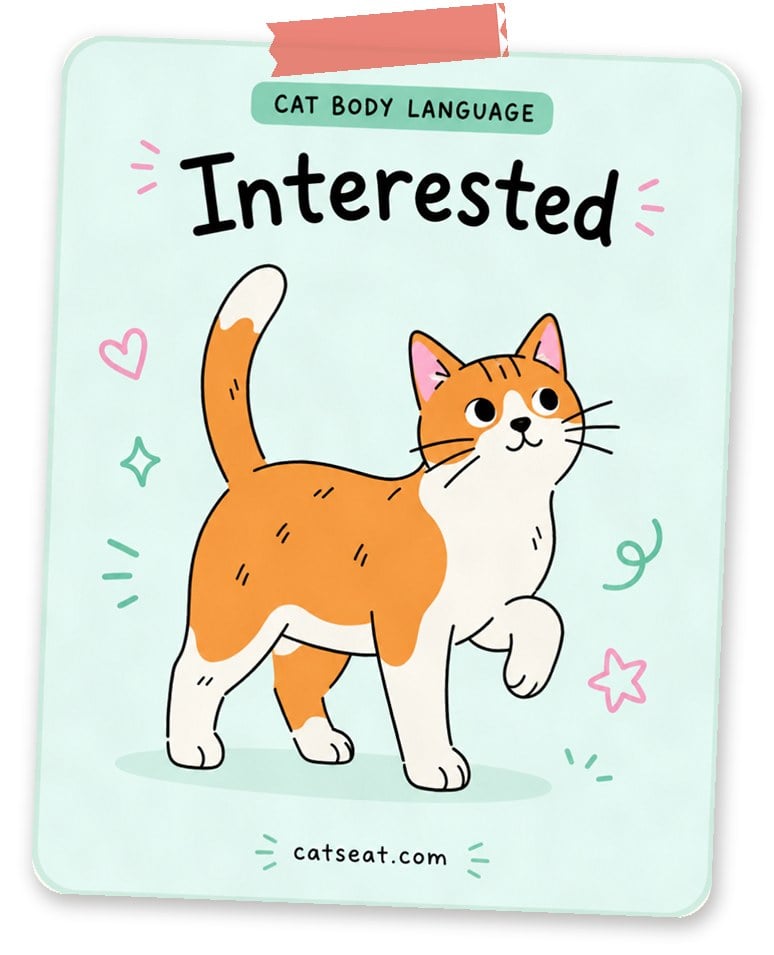
Straight up, with a little curl at the tip. This is the one you want to see. Galaxy calls it “the backwards question mark,” and in his video on tail language he says it’s the position he most wants to see in your cat: “confident, friendly, how you doing, love you.” A tail-up cat is announcing themselves on purpose, which in predator terms is a luxury. Fun fact from that same video: your house cat is the only cat that walks around with the tail held straight up. Wild cats can’t spare the energy.
Our cats Thelma and Louis greet us in two very different ways. Louis comes right up to us with this tail motion, and either plops down on the ground with his belly exposed, or comes and gives us hugs by rubbing his whiskers on our hands. Thelma, on the other hand, comes over cautiously, and I’ll hold my finger out so she can smell and decide what she wants (if she leans in, she wants pets).
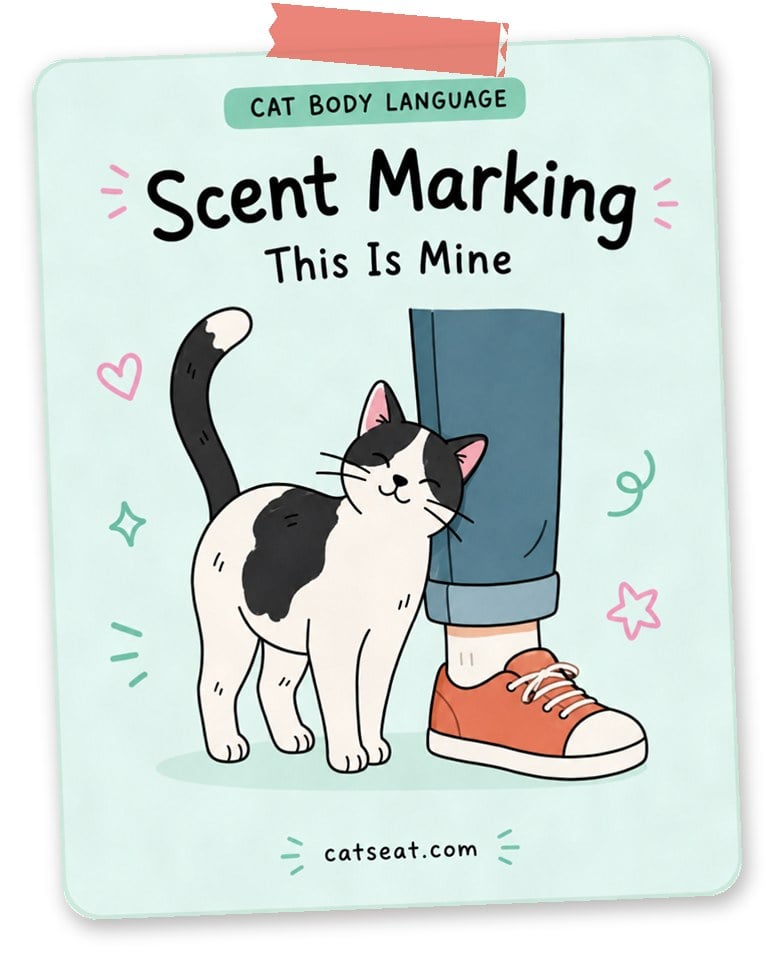
Straight out behind them, roughly level. That’s exploring mode. Galaxy reads the horizontal tail as “cautious, but explorative,” and does the cat’s internal monologue for it: “I trust this world, but you know, can’t be too safe in this world, so I’m heading this way and I’m heading this way at the same time.”
Thelma walks into a room with her tail like this often. If it’s a new room or she’s heard a weird noise, she’ll slowly skulk in. Louis, on the other hand, looks like a lumberjack, strutting into each room with ease. They do, like most cats, scatter very easily if they hear a noise. Cory and I often laugh that (thankfully) nothing bad has ever happened to these cats, yet they get scared like they have PTSD!
Low, then tucked. The lower the tail drops, the less sure the cat feels, and a tail glued flat to the belly means really frightened. Galaxy’s read on the fully tucked tail is blunt: “that is a petrified cat,” and it’s your cue to “fix something in your world, in their world.” His example of what that looks like in a real house:
“Let’s say you have a toddler, and with the arrival of a toddler in the room, toddling along, your cat’s tail goes from straight up to here we go… the tail is just getting lower and lower in between their legs, lets you know they’re scared of that toddler and that gives you the tools to start to construct a more positive relationship… Get them up in the world, man. Let them get above those fingers, make sure they have that way to observe the toddler from above. You’ll probably see the tail follow suit.”
— Jackson Galaxy, What is Your Cat’s Tail Trying to Tell You?
The flick, the wave, the wag. Side-to-side movement is where the dog-colored glasses do the most damage, and Galaxy’s picture of what’s actually happening has stuck with me:
“Think of a cat like an energetic balloon, and once the energy just gets to that point where they are just full, the tail becomes like that pressure release valve.”
— Jackson Galaxy, What is Your Cat’s Tail Trying to Tell You?
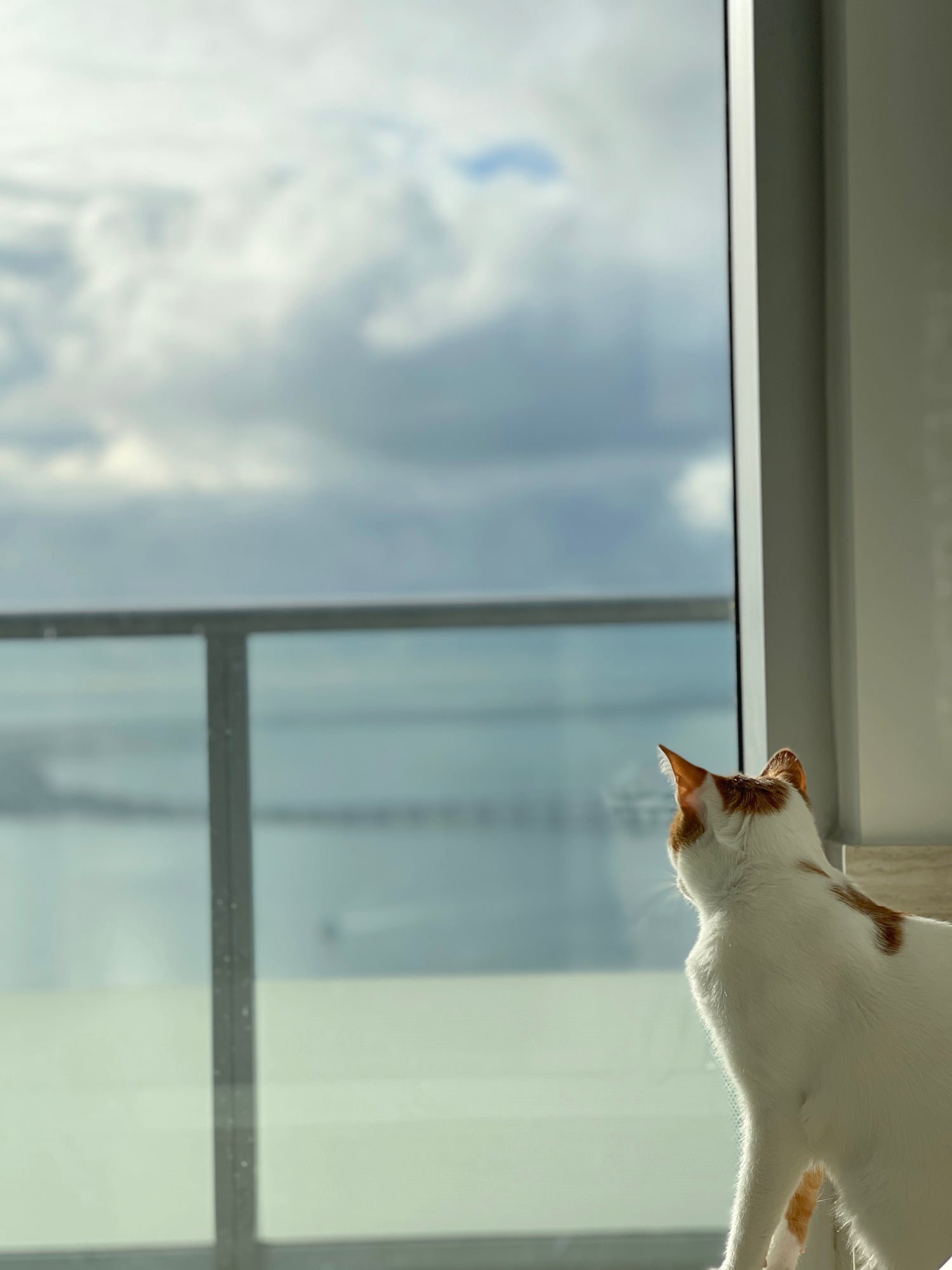
A twitchy tail tip during bird-watching is just energy leaving the building. Thelma is more of the window watcher in our house, and I actually think she’s more of a natural hunter. Her tail will twitch while watching a bird, a dog downstairs, or a bug on the window. When the movement grows into a wave, the cat is getting annoyed. When the whole tail is whipping from the base, stop petting, back up, and offer a toy instead, because at that point, he warns, “you will get bit, or they’re just going to run away and not trust your touch anymore.” By that point the cat has been asking you to stop for a while. And if the tail seems to start up out of nowhere, Galaxy has a word he wants retired: “that’s one of the words I really want you guys to get out of your vocabulary is ‘random.’ ‘Randomly my cat’s tail started going…’ no, something is happening in that room, in the space out the window, somewhere.”
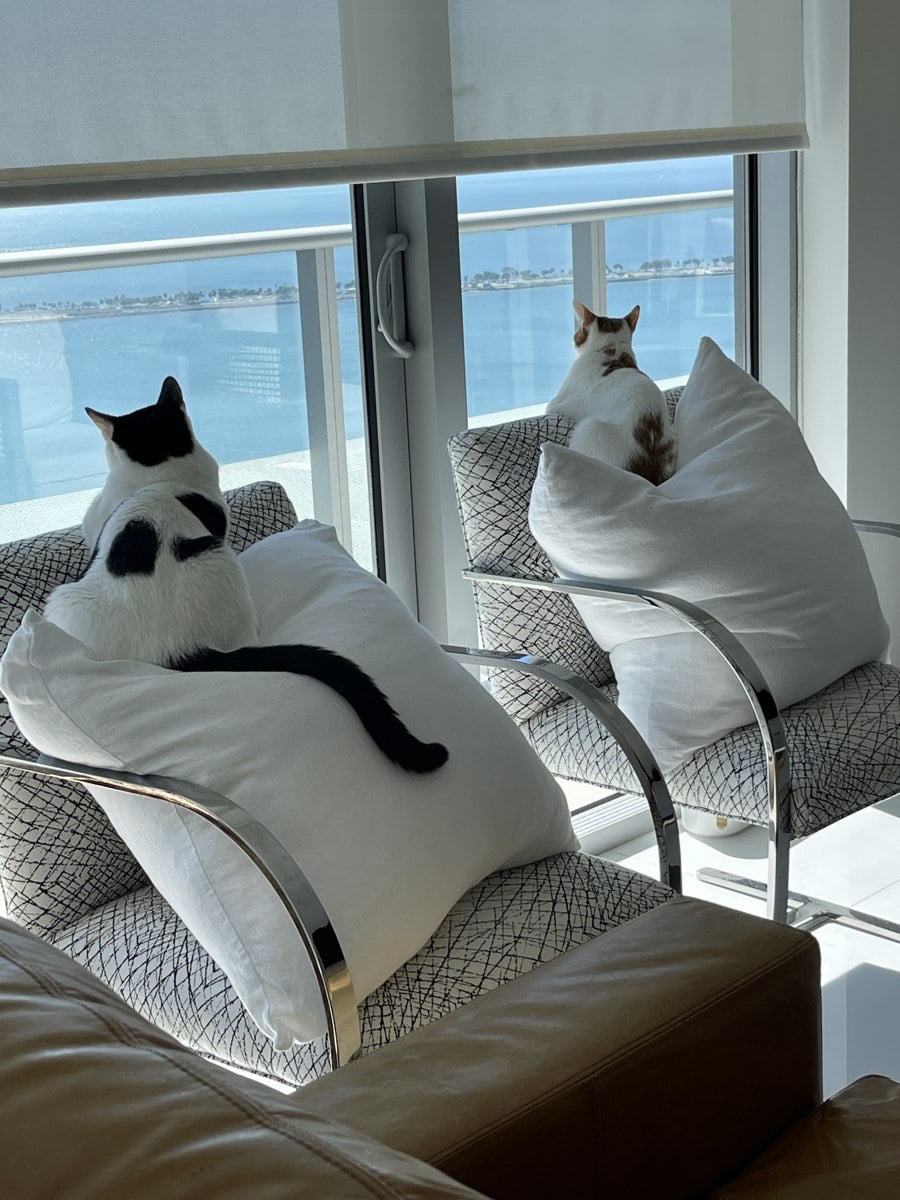
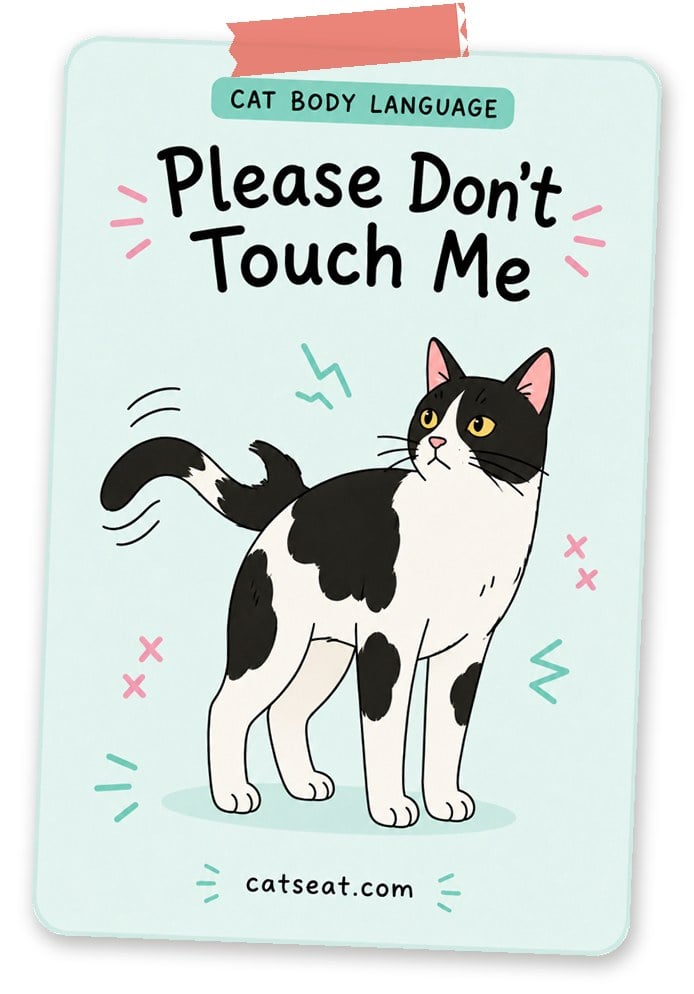
The quiver. A tail held up and vibrating at you looks alarming and is actually one of the nicest things a cat can say. It it’s pointed at a wall it can mean spraying, but aimed at a person, Galaxy translates it as pure excitement: “I’m so happy to see you! You are my person!”
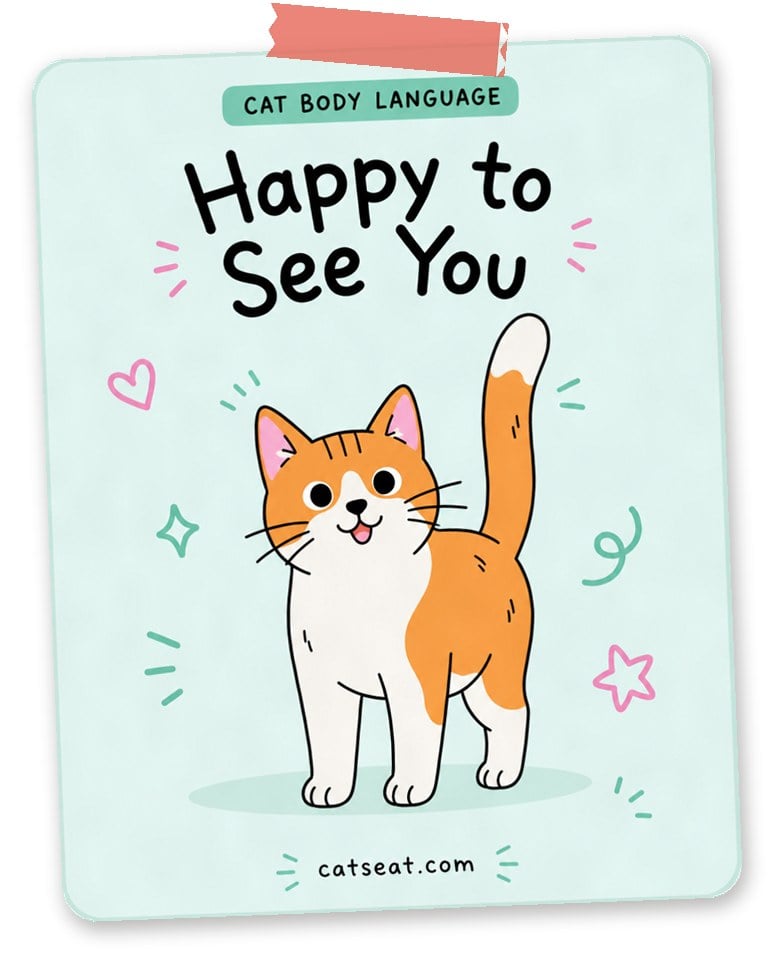
Thelma will quiver he tail when she is about to get a treat or if we walk her over to her food. It’s the cutest thing ever!!
The bottle brush. Fur puffed, back arched, the full Halloween silhouette. That’s a scared cat trying to look too big to mess with. We’ve seen a bottle brush tail a couple times, though the situation can vary (from loud noises to waiting for the other one to pounce on them), and that includes the classic Halloween cat position. In Galaxy’s translation, the body is saying “okay, if I’m really scared for my life, I’m going to try to look bigger than I am. I am going to try to look bigger and menacing in this moment so that maybe that’ll scare you off.” The right response is to remove the scary thing or just give them room rather than reaching in to soothe.
Ears are the mood dial
Ears that are forward and relaxed is a content cat. From there, the ears rotate with the mood. Veterinary behaviorist Dr. Alison Gerken describes the stressed middle setting as “airplane ears,” ears swiveled out to the sides like wings, a cat who isn’t panicking yet but would like the situation to change. Ears pinned flat to the head mean the situation didn’t change. Galaxy explains why the flattening happens at all: a cat bracing for a real fight protects the parts that tear (like an ear), so they “plant it to the side of their head, prepping for the fight.” It’s not that a cat is there weighing a decision, it just the body getting ready on its own.
Eyes: the blink and the pupils
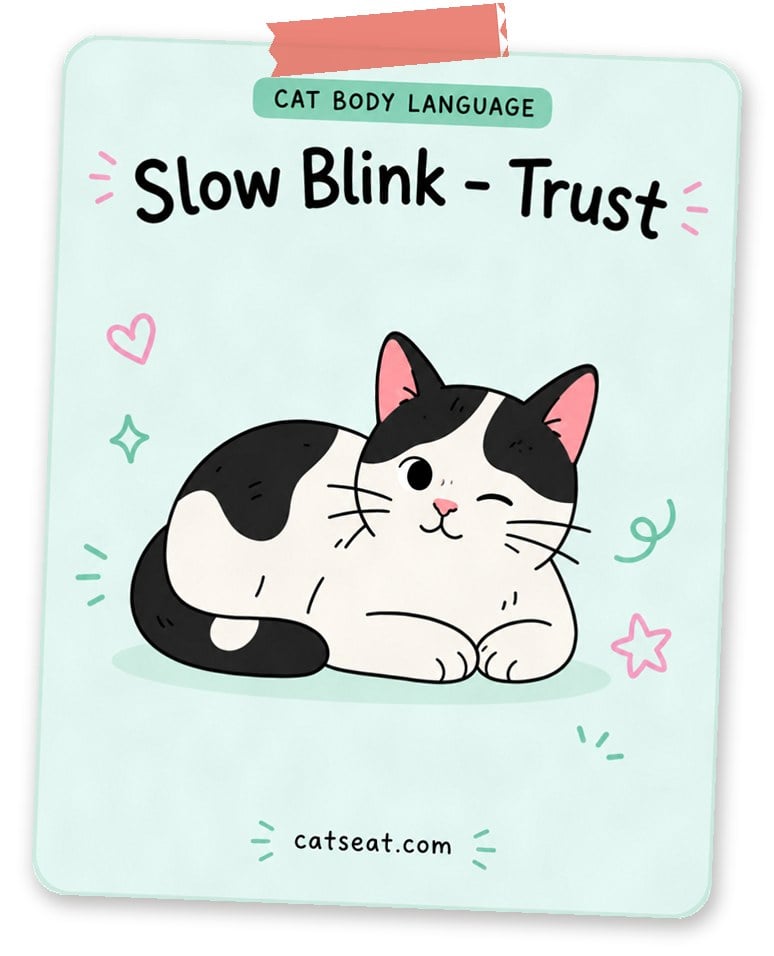
The slow blink you’ve heard about and hopefully seen is real, and it’s actually been tested!
The slow blink, in a lab
A 2020 study in Scientific Reports from a University of Sussex team ran the experiment cat owners have been running informally forever. Cats were more likely to slow-blink back when their humans slow-blinked at them, and in a second experiment with a stranger doing the blinking, cats were more likely to approach the stranger’s outstretched hand afterward. In other words, cats read the human slow blink as friendly, they answer it, and it works even on cats you’ve just met.
Pupils tell you how keyed up the cat is. Narrowed to slits means locked-on focus, which Galaxy describes as a cat “paying very close attention to what’s right in front of them,” anything from a toy about to be murdered to a treat in your hand. Blown-wide pupils mean the opposite, “now I’m looking all over the place,” as Galaxy puts it: “by widening out their pupils they’re also getting a full lay of the land,” letting in as much light and peripheral information as possible. That can be play excitement or fear depending on everything else the body is doing. Big dark eyes during a play session are normal, but the same eyes on a crouched, tucked, frozen cat mean they are scared.
Whiskers move too
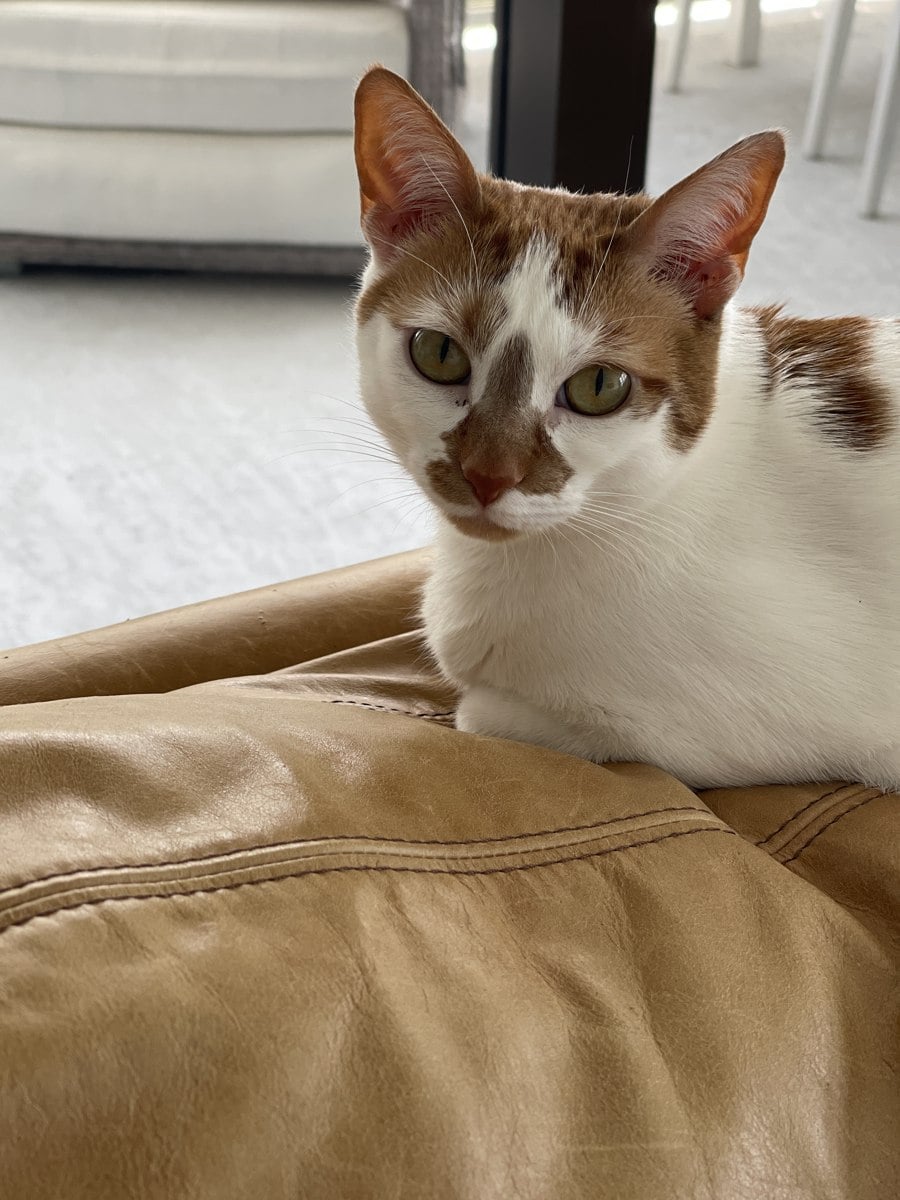
Whiskers are easy to overlook because the movements are small, but they follow the same forward-and-back logic as ears. Per Dr. Gerken, whiskers pushed forward go with interest and hunting focus, and whiskers pulled back flat against the cheeks go with fear. A curious cat aims everything at the interesting thing, whiskers included, while a worried cat retracts the equipment.
The whole-body statements
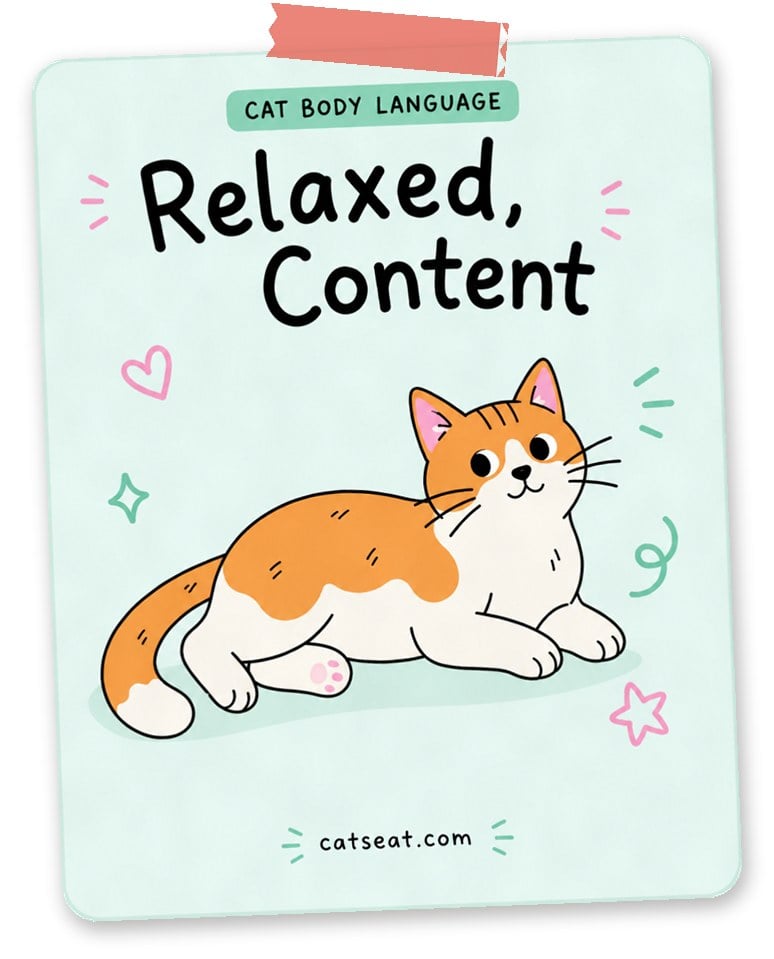
What neutral looks like. Before the dramatic stuff, it helps to know the baseline, because every signal in this article is a slight (or big) departure from it. The Fear Free video describes the neutral pose from the cat’s side: ears “forward but relaxed and maybe just slightly to the side,” a tail “curved loosely towards my body and it’s not twitching,” and “an almond-shaped black center in my eye.” A loose loaf with the paws tucked under counts too, that’s relaxed-but-ready. Thelma will sometimes sit relaxed with her paws crossed, which is about as unbothered as a cat can physically look. Everything below is what happens when something pulls them off this setting.
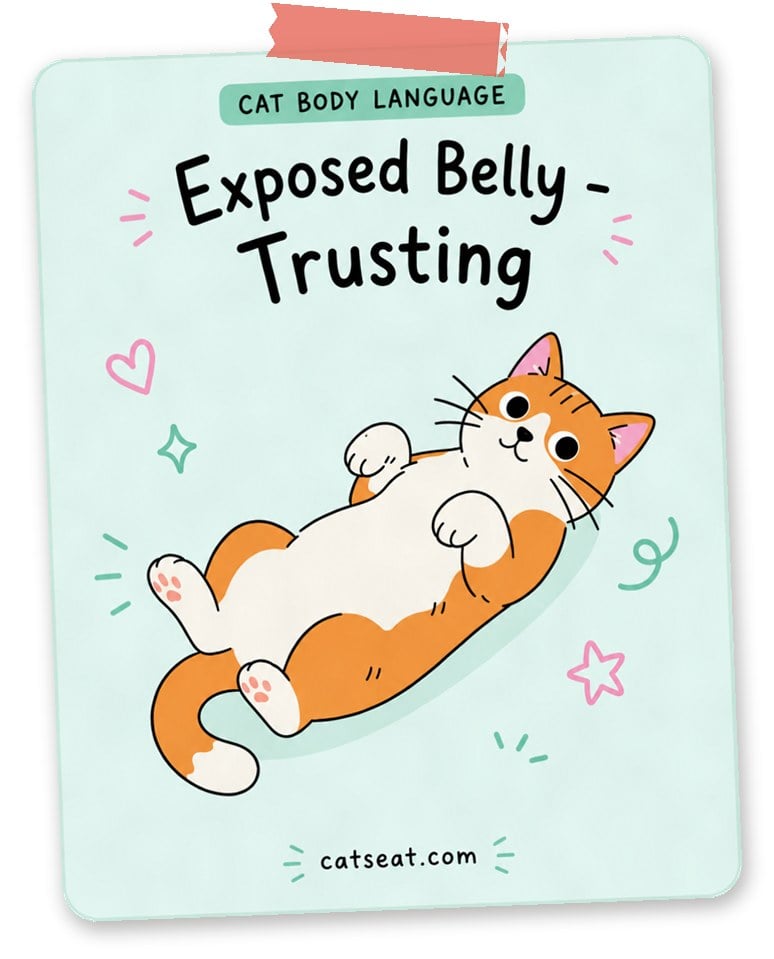
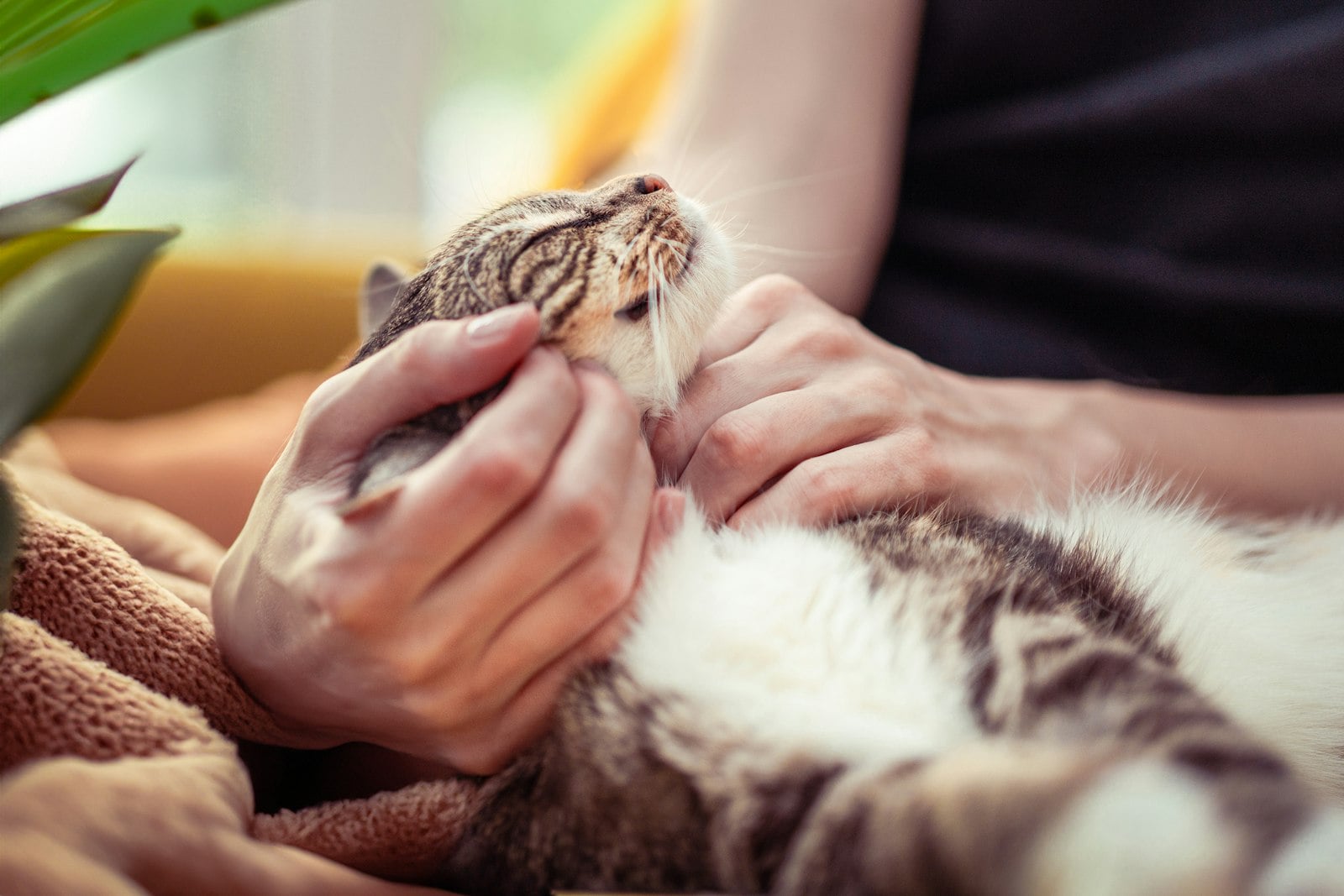
The exposed belly. This might be the most misread gesture cats have. A cat rolling over and showing you their stomach is showing you trust, but most cats still don’t want the belly touched. Galaxy calls the roll-over “a display of trust,” and then draws the line most of us have crossed at least once: “that doesn’t mean rub the belly, that is an invasion.” Some cats do like belly rubs, and those cats will make it known. For everyone else, the belly display is a compliment you accept with your hands to yourself.
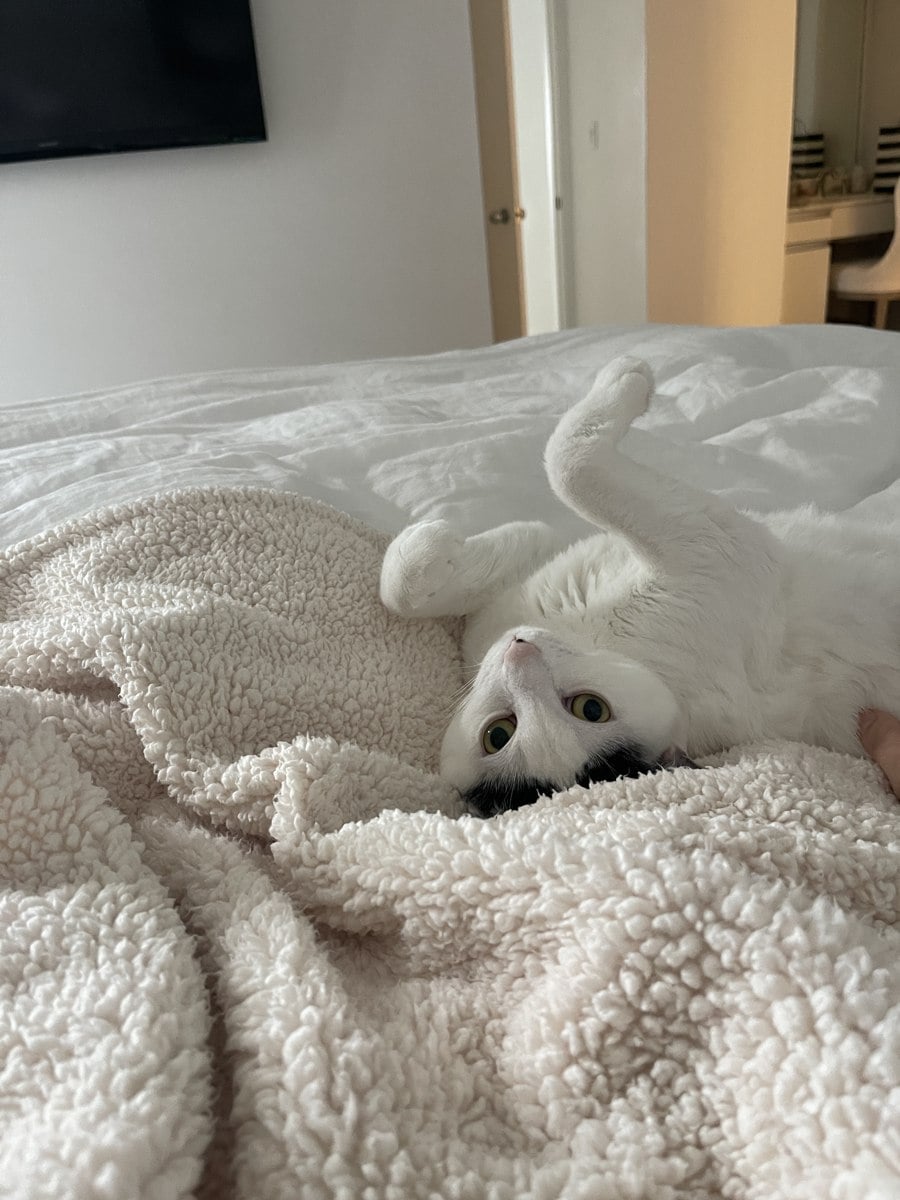
Louis is definitely one of the cats like exposes his belly AND wants it rubbed. We count ourselves lucky!
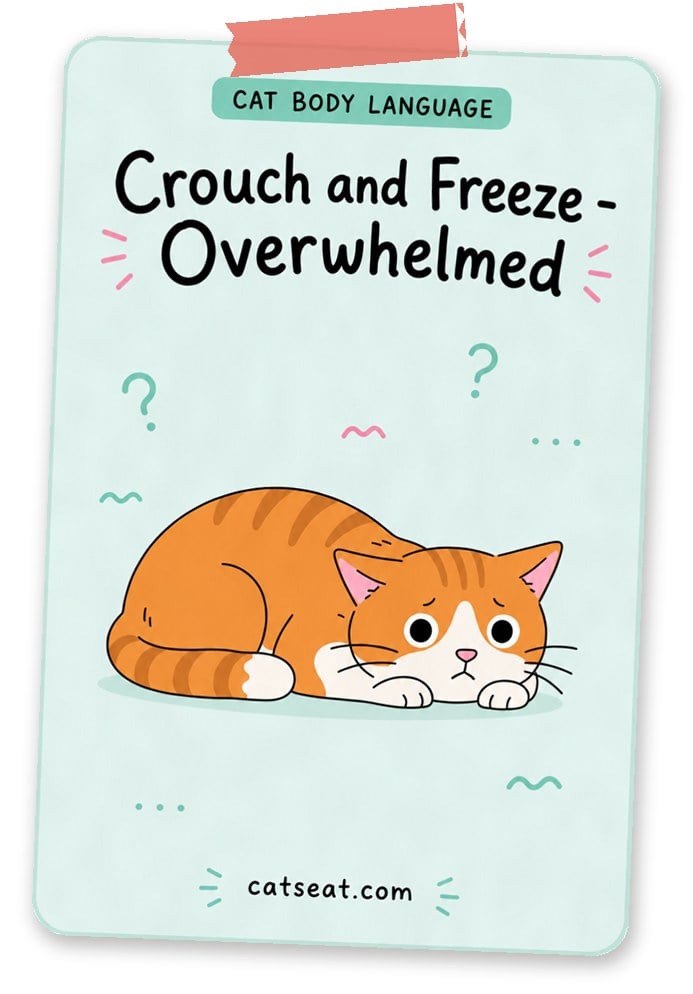
The crouch and freeze. Weight low, feet tucked, body compressed, tail wrapped tight. A frozen cat looks calm but is actually overwhelmed, holding still and hoping the problem passes on its own. This posture gets mistaken for “fine” because the cat isn’t running or hissing, which makes it the one most worth learning. (A cat curled up tight and asleep is a different thing entirely, and we covered the nap shapes in what your cat’s sleeping position really means.)
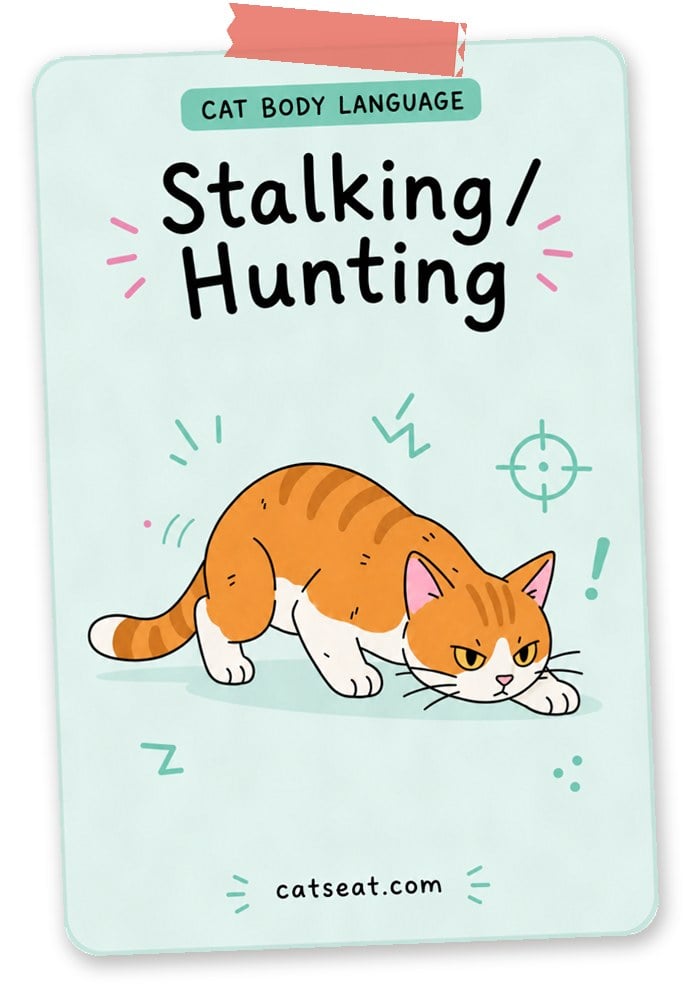
The stalk. When you see the low creep, the locked eyes, and the wiggling rear aimed at your ankle, you have a bored hunter on your hands. Galaxy’s prescription is the obvious one: that cat has hunting energy with nowhere to go, so give it somewhere to go. A daily wand-toy session fixes more behavior problems than almost anything else you can buy, and we keep a running list of toys that survive our two for exactly this reason.
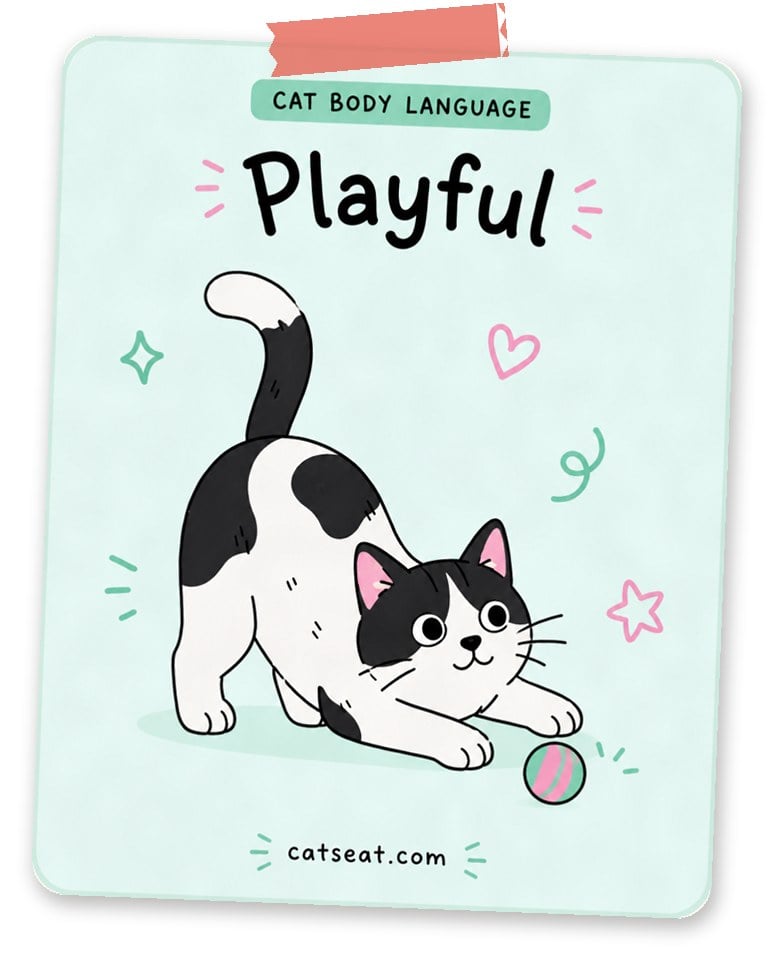
The play bow. Front end low, elbows on the floor, butt up in the air and sometimes wiggling, tail hooked upward. This is the classic ready-to-play pose, and it uses the same hunting mechanics as the stalk with all the tension taken out. It can confuse people, because an excited cat shares some wiring with an agitated one. In the Fear Free video, the cat narrator says that when something really excites them, “I might thrash my tail back and forth and my pupils might expand,” which on paper sounds like the annoyed cat from the tail section. The difference is the rest of the body: loose, bouncy, and springy means game on, while stiff and pressed low means give them space. A bow aimed at you is an invitation, and a wand toy is the correct response.
The four F’s, or how cats escalate
Fear Free made a whole video on cat body language narrated from the cat’s side of the conversation, and it groups the fear responses into “the four F’s: fret or fidget, freeze, flight and fight.” First comes the small stuff: looking away, whiskers drawing back, tail pulling closer to the body. The freeze stage is the one their video describes best, still in the cat’s voice: “I have become so frightened that I’m quite literally scared stiff… I flatten my whole body down so my feet are tucked under me and my tail’s likely curled up so tight I’m hugging myself with it.” After that comes trying to leave, and only after all of that, the hiss and the swat.
Two lines from that video are important to note. It’s about the cat who finally swats after every warning got ignored: “this is when people often label us as a bad cat, but we’re just trying to tell you that we’re afraid.” And the closing request: “please hear us before we get to this point.”
The practical version: when you see the early signals, stop what you’re doing and let the cat choose what happens next. A cat whose small signals convey the message doesn’t need to make a bigger one. Responding to all their signals as they happen is the fastest trust-builder there is. It’s a big part of how we bonded with ours.
For instance our cats love getting squeamies (the light butt taps near their tail), but I’ve learned to tell when one of them gets overstimulated. After about a minute Louis will reach around and do a light nibble on my hand, which is his way to say he’s excited but it’s my cue to stop.
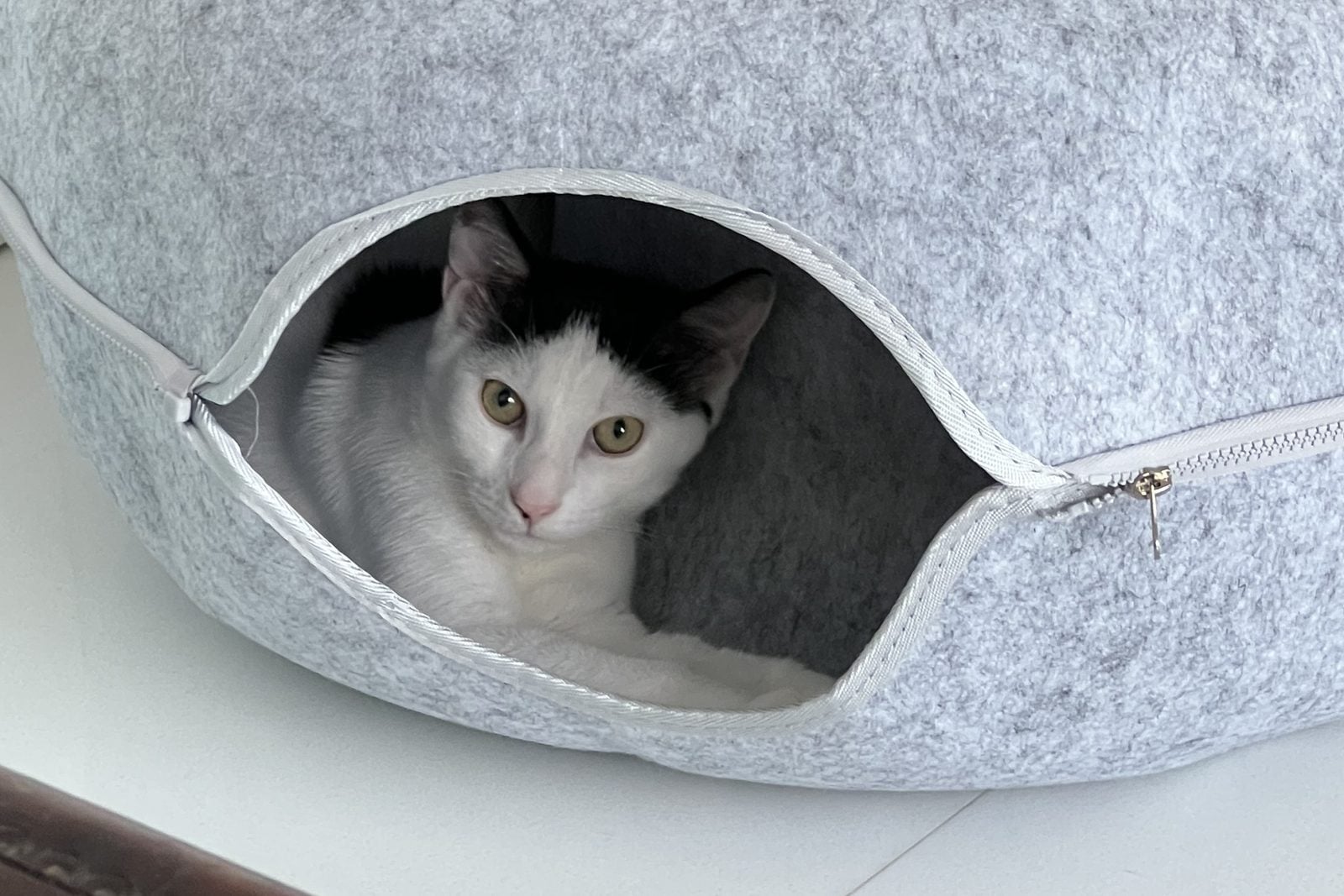
Another example is when I’m (attempting) to brush them. Louis for instance will love it at first, but then he’ll go into the tube and hide. I’ll try again once more while he’s in there, but if he moves further in I’ll wait until he’s out. He’s telling me he doesn’t want it right now, and I listen!
When it’s not a mood
All of these body signals are fun to learn about, but they’re also a very useful indicator if something is potentially wrong. . Dr. Uri Burstyn, the Vancouver vet behind the Helpful Vancouver Vet channel, explains it better than anyone:
“They’re just independent little killing machines that choose to share their life with us. But as a result of that, when they’re ill they don’t show it. They try to hide it because they’re kind of middle of the food chain.”
— Dr. Uri Burstyn, Helpful Vancouver Vet
The conversation he describes having in the exam room happens constantly: “often people come to me with a really sick cat and they’ll be really dumbfounded when I tell them ‘hey, your cat’s really in pain’ and they’ll be like ‘she’s not whining or anything.'” They were waiting for whining that was never going to come. Instead, the red flags are the ones that are easiest to miss: the hunched, tucked posture that doesn’t relax, hiding more than normal, a cat that has stopped grooming, or new yowling, which he notes “can be a sign of pain.” Body language reading works best on a baseline, and you’re the only one who really knows your cat daily signs. If something seems new, persistent, and unexplained, put a call into your vet. Otherwise, we hope you get lots of exposed bellies tonight!

Founder and editor of Cat Seat and cat mom to Thelma and Louis. She’s been writing online since 2000.
Hi! I’m Lindsay. I run this site alongside my hubs Cory and our very opinionated cats, Thelma and Louis. We’re so happy you’re here!
Great article 🥂
Thank you for reading Gregory!
Yes
Thank you for the info
Always good to know our fur babies better!!
Tail whipping, beating it on floor.
I can’t thank you enough for all of your helpful information. I’m on Pinterest every day and every day I see a new article of yours about cats. And I save every single one of them to my cat and kittens board so I can go back and read them over and over because they are so helpful to me. I have learned so much from you and i can’t thank you enough and I’m definitely going to keep reading and following you. you are definitely a cat whisperer🥰